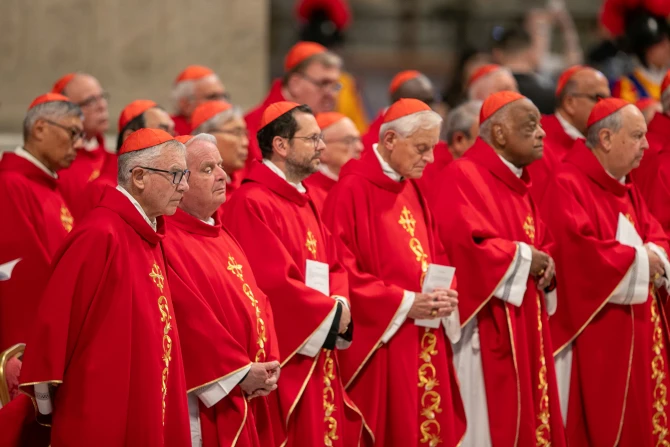
The conclave to elect Pope Francis’ successor will begin on May 7. (Here’s a detailed explanation of how the process will work.) Over 130 cardinal electors will vote in the conclave, the largest group of cardinal electors ever.
SIGN UP FOR OUR NEWSLETTER HERE
It is also arguably the most diverse group of electors ever, geographically speaking. The proportion of cardinal electors from Africa and the Middle East, Asia and the Pacific, Latin America, and countries in Europe — countries that are not the historically heavily represented Italy — has grown since the last conclave in 2013.
Pope Francis during his 12-year pontificate elevated a large majority of the current cardinal electors, some of whom serve countries with very small Catholic populations, such as Pakistan, Iran, and Mongolia. In all, Francis appointed cardinals from 72 different nations, including from over two dozen countries that had never before had a cardinal in the Church’s history, such as Haiti, Papua New Guinea, East Timor, Singapore, and South Sudan.
A closer look at the numbers — taking the estimated number of Catholics in a country and dividing them by the number of cardinal electors — gives some idea of how “represented” that country’s Catholic community will be in the conclave. The smaller the resulting number, the more “representation” those Catholics get in the conclave via the cardinal or cardinals who serve them.
The caveat, of course, is that the Catholic Church isn’t a representative democracy, so although it’s an interesting thought exercise, it’s not accurate to say that a cardinal is a “representative” of the area entrusted to him in the same way that, say, a U.S. member of Congress is.
For example, Brazil has the largest Catholic population in the world at 105,300,000 and seven cardinal electors. This means each elector “represents” 15,043,000 Catholics in Brazil — a pretty big number.
In contrast, Iran has a mere 13,600 Catholics but one cardinal elector. Thus Iran’s ratio is 13,600 Catholics per elector, which is — at least on paper — better than Brazil’s.
In terms of raw numbers, Italy has the largest number of electors of any country, with 17 cardinals currently set to participate. But raw numbers can be deceiving. Italy also has a huge number of Catholics, meaning that each cardinal elector “represents” about 2,471,000 Catholics. This places Italy at No. 33 on the list of most “represented” countries.
So which country has the most representation, proportionally, at the conclave? That would be Mongolia, which has a tiny but devout Catholic population of 1,116 and one cardinal elector, the Italian-born Cardinal Giorgio Marengo, who is also one of the youngest cardinal electors. Mongolia’s ratio of 1,116 Catholics per elector gives its Catholics an outsized “voice” within the conclave.
By contrast, take a look at Mexico. Its Catholic population is massive, at some 91,200,000. But for such a large Catholic country, Mexico has only two cardinal electors. That means each elector speaks for 45,600,000 Catholics, the least proportional representation among countries with electors.
If you’re wondering where the United States falls in this analysis: The U.S. has 10 cardinal electors, the second-most of any country in terms of raw numbers. But the country’s large Catholic population of nearly 67 million drops it to 56th place in the rankings, at nearly 6.7 million Catholics per elector.
(The exact number of cardinals may change between now and the start of the conclave, as two cardinals have already voluntarily dropped out due to illness, but the numbers almost certainly won’t change drastically.)
Of course, some countries with historically large Catholic populations will have no representation in the conclave at all because of a lack of cardinal electors. One notable example is Ireland (though Cardinal Kevin Farrell, the camerlengo, is Irish-born but has ministered for many years in the United States). Others include Vietnam, Lebanon, Mozambique, Mauritius, the Dominican Republic, and Honduras.
This article was originally published on Catholic News Agency.