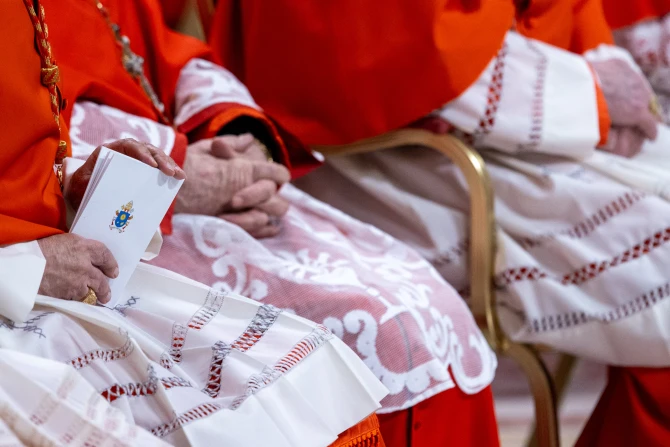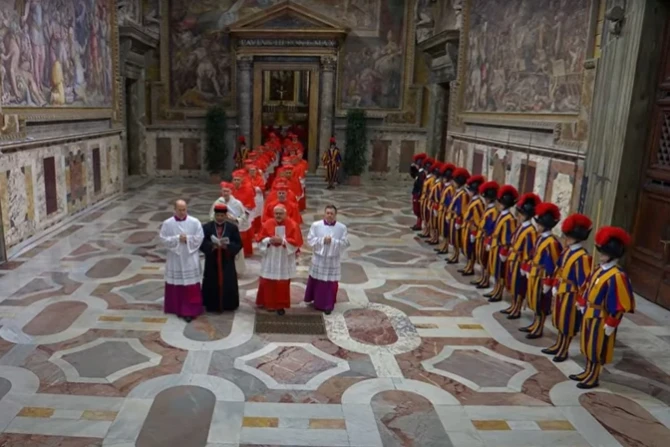
The word conclave comes from the Latin “cum clave,” literally “with a key,” which conveys the image of the cardinal electors being locked in the Sistine Chapel until the new pope is elected.
SIGN UP FOR OUR NEWSLETTER HERE
Isolating the cardinals from outside influences began in 1271 when Pope Gregory X, after a conclave that lasted almost three years following the death of Clement IV — and which was marked by external political interference — approved the apostolic constitution Ubi Periculum, which imposed total isolation for the cardinals in addition to the requirement of continuous voting.
The legislative document prohibited the cardinal electors from receiving messages, visits, or any form of communication with the outside world. It also included pressure measures such as if they had not elected a pope after three days, their food was restricted: First, the most elaborate dishes were eliminated, then even wine.
The importance of secrecy became even more crucial in the modern era. During the 1903 conclave, Emperor Franz Joseph of Austria invoked “jus exclusivae” — the right of veto enjoyed by some European Catholic monarchies such as Austria, Spain, and France — to invalidate the candidacy of Italian Cardinal Mariano Rampolla through a representative in the Sistine Chapel.
Although the veto did not prevent Rampolla from gaining several supporters, it very likely influenced the final choice.
As soon as he took the chair of Peter, the newly elected Pope Pius X immediately abolished the veto to protect the conclave from all secular interference. The Ubi Periculum was modified and eventually suspended, but its spirit remains in force in later documents, such as the apostolic constitution Universi Dominici Gregis of St. John Paul II (1996), which governs the current procedure for modern conclaves.
This document, which was amended by Benedict XVI before his resignation from the papacy in 2013, stipulates that violating the secrecy of the conclave is punishable by automatic excommunication (“latae sententiae”), one of the most severe sanctions under canon law.
The secrecy ends up being broken
However, the recent history of the Catholic Church shows that this secrecy eventually breaks. The 2013 conclave, in which Pope Francis was elected, is a clear example of how, despite strict secrecy, details about the voting rounds and the candidates with the most support were leaked.
Despite the confidentiality required by the process, journalist Gerard O’Connell reconstructed in his book “The Election of Pope Francis” how then-Cardinal Jorge Mario Bergoglio allegedly received 45 votes in the second round of voting, a figure that rose to 85 in the fifth, thus exceeding the required two-thirds majority.
He also revealed, citing internal sources, that the candidacies of Italian Cardinal Angelo Scola; Cardinal Marc Ouellet, former prefect of the Dicastery for Bishops and president of the Pontifical Commission for Latin America; and Cardinal Sean O’Malley, president of the Pontifical Commission for the Protection of Minors, also supposedly had strong showings in the initial ballots.
Even Pope Francis himself shared anecdotes from the conclave that elected him, such as Brazilian Cardinal Claudio Hummes’ suggestion that he adopt the name Francis in honor of the saint of Assisi.
In 2024, journalist Javier Martínez Brocal published the book “El Sucesor” (“The Successor”) in which the late pontiff, the only one with the authority to reveal information about the conclave without violating secrecy, brought to light other details, including those of the 2005 conclave in which Benedict XVI was elected.
Attempts to block the 2005 election of Benedict XVI
Specifically, Pope Francis revealed that in the 2005 conclave, following the death of St. John Paul II, the cardinal electors used his name to “block the election of Ratzinger and then negotiate a third, different candidate.”
“It so happened that I ended up with 40 of the 115 votes in the Sistine Chapel. It was enough to stop the candidacy of Cardinal Joseph Ratzinger, because, if they had continued voting for me, he would not have been able to reach the two-thirds necessary to be elected pope,” he recounted in the book by the Spanish journalist.
Pope Francis, the only one authorized to speak about what was going on in the conclave, stated bluntly: “They used me.”
After making this maneuver public, he made it clear that by voting for him, “the idea of those behind the votes” was not that then-Cardinal Jorge Mario Bergoglio would be elected. “It was a maneuver in all respects. The idea was to block the election of Cardinal Joseph Ratzinger. They were using me, but behind the scenes, they were already thinking of proposing another cardinal. They still didn’t agree on who, but they were about to throw out a name,” he emphasized in the book.
In any case, this phenomenon of airing the details of the conclave is not new. In 2005, after the election of Benedict XVI, journalist Lucio Brunelli published a detailed account of the conclave in the magazine Limes based on notes taken by a cardinal. Although these were secondary elements, they made it clear that the wall of silence can sometimes crack.
According to the apostolic constitution Universi Dominici Gregis, secrecy regarding the dynamics of the conclave also extends to non-elector cardinals, who this week participated in the general congregations, the meetings prior to the conclave.
This obligation, in Latin “graviter onerata ipsorum conscientia,” meaning “it weighs on the conscience of those involved,” underscores the profound moral responsibility to maintain secrecy even after the election has taken place, unless the pope himself grants a special dispensation.
However, the camerlengo, Cardinal Kevin Farrell, is responsible for recording the results of the final vote count in writing, which also allows for controlled historical documentation of the process.
This story was first published by ACI Prensa, CNA’s Spanish-language news partner. It has been translated and adapted by CNA.