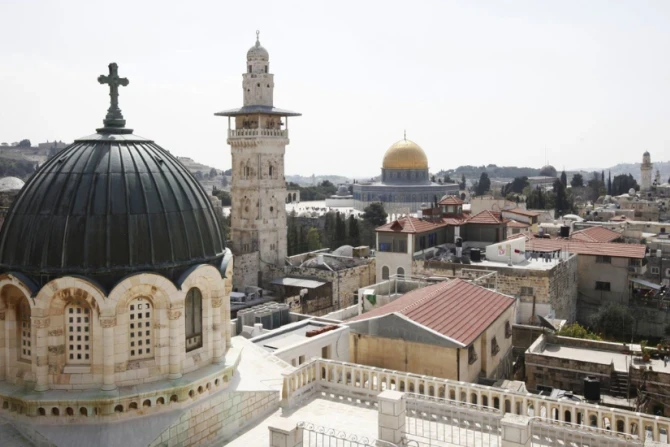
In Jerusalem, the property tax, known as the “Arnona” tax, has become one of the most contentious issues between the city’s municipality and the churches.
Under Israeli law, this is a municipal levy imposed on all properties within city and local council boundaries, regardless of type, and its calculations are based on square meters and the use of the property.
Attorney Fareed Jibran, legal and public affairs adviser to the Latin Patriarchate of Jerusalem, explained to ACI MENA, CNA’s Arabic-language news partner: “Arnona is a municipal property tax, not a state tax. The basic principle is that every property within municipal borders, whether residential, commercial, or public, must pay tax in exchange for the services the municipality provides.”
For centuries, churches in Jerusalem and most of their institutions were exempt from this tax, since Ottoman rule, through the British Mandate, and into the early years of Israel’s establishment. The exemption was nearly absolute, except for purely commercial activity.
“Churches historically provided services the state did not, such as education, health care, and ecclesiastical courts. For this reason, they were granted tax exemptions,” Jibran explained.
“The shift in the legal framework about 15 years ago ignored this historical reality, leading to tax demands on monasteries, clergy residences, guesthouses, hospitals, and organizations like Caritas, even though these are nonprofit institutions playing a vital social role,” he added.
‘More than 30 years later, no solution has been reached’
The issue also carries an international legal dimension.
Since 1993, the Vatican and Israel have been negotiating the financial and tax status of Catholic Church properties in Jerusalem, including Arnona.
“The fundamental agreement is clear: As long as negotiations are ongoing, neither side has the right to take unilateral measures,” Jibran said. “Nevertheless, in recent years, municipalities have begun sending seizure orders and initiating legal action against churches, despite the Vatican’s protests that such steps violate the agreement.”
The agreement initially envisioned concluding negotiations within two years. “But today,” Jibran noted, “more than 30 years later, no solution has been reached. The state claims some properties are used commercially, such as restaurants within church grounds, which would not qualify for exemption. This opens debate about what counts as ‘commercial’ versus what is considered a Church service.”
Impact on the churches
According to Jibran, the taxes imposed on church institutions directly affect their ability to carry out their religious and social mission and to safeguard Christian heritage in Jerusalem.
“These taxes impact the upkeep of historic buildings and ancient churches, the running of schools and hospitals, and the provision of community services,” he said.
In a recent move that sparked strong protest, Israeli municipal authorities froze the bank accounts of the Greek Orthodox Patriarchate of Jerusalem and imposed high tax demands on its properties. The Palestinian Higher Presidential Committee for Church Affairs denounced the measure as an “attack on the authentic Christian presence in Palestine.”
So far, no official confirmation has been given that the freeze has been lifted, leaving the Church facing financial challenges that hinder its ability to provide spiritual, humanitarian, and social services.
This story was first published by ACI MENA, CNA’s Arabic-language news partner, and has been translated for and adapted by CNA.