The Norwegian Trappist monk chosen to preach the Vatican’s Lenten retreat once called himself an atheist — and today is one of Europe’s most respected Catholic thinkers.
Pope Leo XIV, not even a year into his pontificate, still has much to show the world about his own spiritual practices — up until now, there hasn’t been much information readily available about how Pope Leo observes the season of Lent.
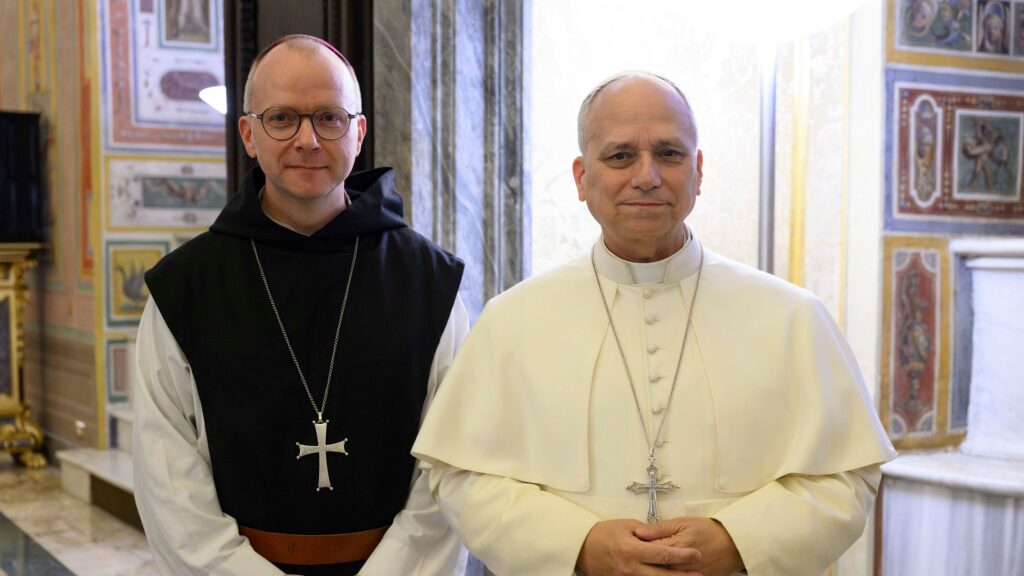
But for the Vatican’s first Lenten retreat of his pontificate, Pope Leo has signaled a significant focus on the contemplative by inviting a Trappist monk, Bishop Erik Varden of Trondheim, Norway, to lead the spiritual exercises for the Pope and the rest of the Roman Curia Feb. 22–27. Cardinals residing in Rome and the prefects of Vatican dicasteries are invited to participate, suspending or reducing their regular work activities in order to spend time in spiritual reflection.
Bishop Varden, a popular spiritual author whom Pope Francis selected as a bishop in 2019, has already delivered several Lenten reflections for the curia that are available to read on his blog, Coram Fratribus.
Here are seven things to know about Bishop Varden.
1. He was once an atheist.
Born in 1974 in southern Norway, Bishop Varden grew up in a non-practicing Lutheran family. As he recounted in a recent interview with the Napa Institute, Bishop Varden went through a period of agnosticism and skepticism during his teenage years and relished his personal independence.
This early skepticism eventually gave way to a gradual conversion process. Originally planning to study Russian and Arabic, Bishop Varden was “haunted” by the idea of becoming Catholic after visiting a Trappist monastery in Wales at age 17. After arriving at university, he sought instruction in the Catholic faith, which began with reading the documents of the Second Vatican Council. This period also included his discovery of the Bible, Church Fathers like St. Athanasius, and his decision to change his studies to theology.
Born in 1974 in southern Norway, Bishop Varden grew up in a non-practicing Lutheran family. As he recounted in a recent interview with the Napa Institute, Bishop Varden went through a period of agnosticism and skepticism during his teenage years and relished his personal… pic.twitter.com/LnsCIXfGpU
— National Catholic Register (@NCRegister) February 25, 2026
At age 19, in 1993, he was received into the Catholic Church.
2. Music and literature helped to bring him to the faith.
Bishop Varden’s journey to Catholicism was catalyzed by specific cultural and liturgical encounters that stirred a sense of the divine. At age 15, Gustav Mahler’s Symphony No. 2 (“Resurrection”) “pierced” him, he said. He described the experience as revealing that there was something “somehow greater than I was,” signaling a reality beyond his own experience. Later in life, he found himself deeply influenced by Gregorian chant and Mozart’s sacred choral works, finding a fascinating “interrelation between beautiful musical expression and text.”
The literary works of Hermann Hesse, specifically “Narcissus and Goldmund,” also played a significant role in his intellectual and spiritual awakening, he said in his Napa interview.
3. He is a world-class scholar and historical theologian.
Before entering monastic life, Bishop Varden spent a decade at the University of Cambridge. He did his undergraduate studies at Magdalene College and later earned a doctorate in historical theology from St. John’s College. His doctoral research focused on the 17th-century French Oratorian Pierre de Bérulle, and he subsequently served as a fellow at Cambridge. His academic expertise led to later teaching roles in Paris and Rome, specifically at the Pontifical Oriental Institute and the Pontifical Athenaeum of Saint Anselmo, where he specialized in Syriac Christianity and patristic traditions.
4. He’s a Trappist monk.
In 2002, Bishop Varden joined Mount Saint Bernard Abbey in Leicestershire, England. His community is the Cistercians of the Strict Observance (OCSO), commonly known as Trappists.
St. Robert of Molesme, St. Stephen Harding and St. Alberic founded the Cistercian order in the 11th century in the French valley of Cîteaux, seeking a return to the original austerity of the Rule of St. Benedict. Perhaps their most famous member is St. Bernard of Clairvaux, a doctor of the Church. The Trappists became a separate religious order from the Cistercians in 1892.
As a monk, Bishop Varden embraced the Rule of St. Benedict, characterized by silence, manual labor and contemplative prayer. He was ordained a priest in 2011 and was elected abbot of the community in 2015. Despite a personal sense of “utter inadequacy,” Bishop Varden accepted the leadership role at age 39. He said he found it extraordinary “to find oneself in all one’s inadequacies, with all one’s fragilities and contradictions, entrusted with this grace, and enabled to be a channel of grace for others.”
Despite his current role as a bishop, Bishop Varden remains deeply influenced by his monastic roots, noting that being a monk is “imprinted” on his being. He said he remains amazed by the “utter gratuity of [being a monk], and unbelievable joy.”
5. He oversaw the creation of the first Trappist brewery in England.
As abbot of Mount Saint Bernard, Bishop Varden led a major economic initiative rooted in the stewardship of the abbey’s future. Facing declining revenue from traditional dairy farming, the community transitioned first to beef farming and finally to the production of Tynt Meadow English Trappist Ale. Launched in 2018, this was the first certified Trappist beer brewed in England. Varden oversaw the project to ensure the venture supported the monastery’s financial sustainability without compromising monastic discipline or the monks’ commitment to manual labor.
6. He’s a prominent Catholic in a relatively non-Catholic country.
Bishop Varden, upon being named a bishop in 2019, became the first native Norwegian bishop of Trondheim in modern times; his last five predecessors have all been German missionaries. Bishop Varden also serves as head of the Norwegian bishops’ conference.
According to Statistics Norway, the official government statistics office, 65% of the country’s population belonged to the Church of Norway, a Lutheran denomination, in 2022. About 7% of the population belongs to other Christian denominations, of which Catholicism is the largest. The Catholic Church has experienced growth in the country in recent years, mainly through the influence of immigrants, though Norwegian society is predominantly secular.
Trondheim, specifically, is a major city and former national capital located on a fjord about halfway between the southern tip of Norway and the Arctic Circle. At the time of Bishop Varden’s appointment, the territorial prelature of Trondheim spanned 21,806 square miles and served an estimated 15,000 Catholics.
Bishop Varden, in his interview, said being asked to become a bishop, especially after 30 years away from his native country, was “the hardest thing that’s ever been asked of me.” As he serves in Norway, Bishop Varden told Napa that his guiding hope remains that “through us, in all our weaknesses, Christ can truly be alive.”
7 Things to Know About Bishop Varden, Pope Leo’s Lenten Retreat Master
— National Catholic Register (@NCRegister) February 25, 2026
The Norwegian Trappist monk chosen to preach the Vatican’s Lenten retreat once called himself an atheist — and today is one of Europe’s most respected Catholic thinkers.
Read more on https://t.co/H2bwtFecns… pic.twitter.com/qK03oPmJQg
7. His meditations at the Vatican are focused on St. Bernard of Clairvaux.
Bishop Varden’s meditations, titled “Illuminated by a Hidden Glory,” examine the Christian experience with both an idealistic dimension and a realistic view.
So far, Bishop Varden’s reflections have touched on the ways that St. Bernard of Clairvaux can serve as an “idealist” guide for Lent. Bishop Varden described his fellow Cistercian as “a good, wise companion for anyone setting out on a Lenten exodus from selfishness and pride, wishing to pursue authenticity with eyes set on the all-illumining love of God.”
Despite the saint sometimes adopting “rigid positions that involved fierce partisanship,” Bishop Varden described Bernard as “a genuinely humble man, fully given to God, capable of tender kindness, a firm friend — indeed, able to befriend former enemies — and a compelling witness to God’s love. He was, and remains, fascinating.”
The bishop’s reflections are available to read on his blog (coramfratribus.com).
This article was originally published by NCRegister.