Cardinal Pietro Parolin says sidelining international law and embracing “preventive war” could ignite a broader conflict and deepen civilian suffering.
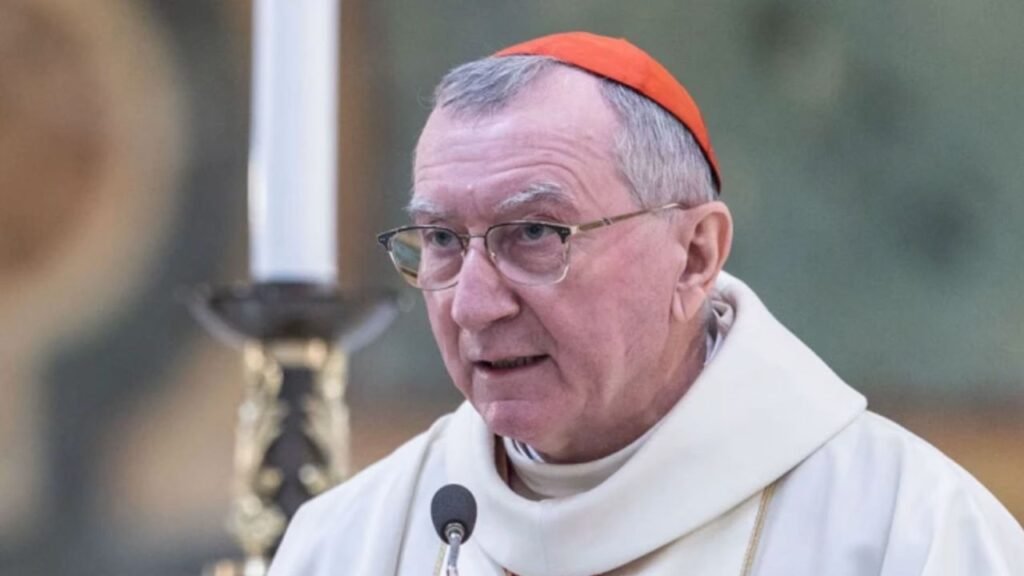
Cardinal Pietro Parolin, the Vatican’s secretary of state, is warning that U.S. and Israeli bombings against Iran — and Tehran’s ensuing military response — could trigger a global spiral of violence with unpredictable consequences.
In an interview with Vatican News, the Holy See’s official news outlet, on March 4, Parolin lamented what he described as a troubling weakening of international law. “Might has replaced justice; the force of law has been replaced by the law of force,” he said.
Parolin said he is concerned the world is drifting toward what he called a dangerous form of multi-polarism marked by the primacy of power and political self-reference.
U.S. President Donald Trump said Tuesday that he launched the offensive after receiving indications Iran was about to carry out an attack and that action was needed to prevent retaliation against U.S. bases. Asked about the justification, Parolin said it can be difficult to determine who is right or wrong when analyzing the causes of a war, but he stressed that conflict “will always produce victims and destruction,” with devastating effects on civilians.
Warning against ‘preventive war’
The Vatican secretary of state was particularly critical of the logic of preventive war, warning that if every state claimed a right to launch a “preventive war” according to its own criteria and without a supranational legal framework, the entire world would risk going up in flames.
Parolin said he is living through the current moment “with great sorrow,” noting that the peoples of the Middle East — including Christian communities — “have once again fallen into the horror of war,” which destroys human life, causes devastation, and pulls entire nations into spirals of violence with uncertain outcomes.
He also pointed to Pope Leo XIV’s remarks during Sunday’s Angelus, when the pope spoke of a “tragedy of enormous proportions” and the risk of an “irreparable maelstrom,” language Parolin said accurately captures the gravity of the moment.
Diplomacy over weapons
Addressing the U.S. and Israeli attack on Iran, Parolin said peace and security must be pursued through diplomacy, especially within multilateral bodies such as the United Nations.
He recalled that the United Nations’ founders, in the wake of World War II, sought to prevent new horrors by establishing rules for managing conflicts. Today, he said, diplomacy that promotes dialogue and seeks broad consensus is increasingly being replaced by a “diplomacy of force,” rooted in the belief that peace can be achieved “through weapons.”
‘No first- and second-class victims’
Parolin insisted that the use of force must remain an “ultimate and most grave” recourse, after exhausting every tool of dialogue and within a multilateral framework of governance. Otherwise, he said, the “law of force” takes the place of the force of law — and peace is treated as something that comes only after the annihilation of an enemy.
The cardinal also condemned what he described as the selective application of international law.
“There are no first- and second-class dead, nor people who have more right to live than others,” he said, rejecting the idea that civilian casualties can be reduced to “collateral damage.”
Parolin reiterated the importance of international humanitarian law, stressing that respect for it cannot depend on circumstances or military or strategic interests. He underlined the duty to protect civilians and infrastructure such as hospitals, schools, and places of worship.
A fragile international order
Parolin argued that the current decline reflects a loss of awareness of the common good: “The awareness has weakened that the good of the other is also a good for me,” he said. That erosion, he added, has fueled a deep crisis in the multilateral system and weakened principles such as peoples’ self-determination and territorial sovereignty.
He concluded by expressing hope that the pope’s appeal will be heard and that “the noise of weapons will soon cease” and negotiations resume.
“Our peoples are asking for peace,” Parolin said, adding that the pope’s call “should shake leaders … and prompt them to multiply their efforts in favor of peace.”
This article was originally published by ACI Prensa, EWTN News’ Spanish-language partner. It has been translated and adapted by EWTN English News.