COMMENTARY: If ecumenism is to have integrity, it must be built not on gestures that obscure reality, but on a shared submission to the truth Christ embodies.
However compassionate the Church is toward those who suffer from the mental illness of gender dysphoria, we have long recognized that we do people no service if we reinforce them in the illusion — particularly if the illusion is about something that really matters.
Reality is the surest route to sanity and a holy reordering. If that is true in the area of sex and identity, it is also true in ecumenical matters and in ecclesiology.
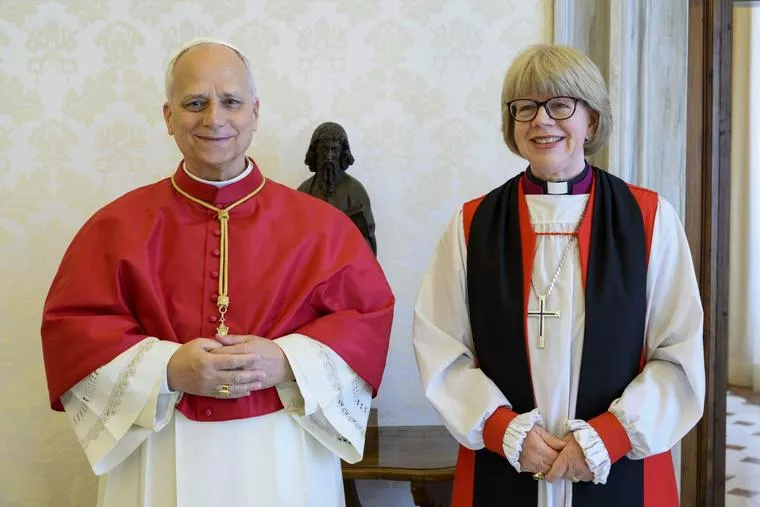
That is why so many people have felt a serious disquiet about the way in which the Pope has welcomed the Anglican Protestant archbishop of Canterbury, Sarah Mullally.
Apostolicae Curae made it clear why Anglican orders were null and void and how they always had been, while recognizing that this was in fact the original and deliberate intention of the Anglican ordinal and of the politicized ecclesiology of the 16th and 17th centuries.
The fact that Anglicans have since changed their minds and seek a degree of legitimacy from the Mother Church with which they are in schism does not change history or their credentials.
It does Anglicans no good to pretend that the longings of their ecclesial imagination can change the nature of reality.
The Journey of Sarah Mullally
We will come back to that in a moment, but first it might be worth spending some time on the character of the first woman Anglican archbishop herself.
Sarah Mullally has been on a journey. It’s not just been a journey from being a nurse to being a clergywoman. It’s a journey from conservative, evangelical clarity to progressive, fashionable liberalism.
In theological terms, one could say that she’s moved from Protestant biblical orthodoxy into the category of therapeutic deism.
In a recent review of Andrew Atherstone’s biography of Sarah Mullally, George Conger, a prominent Episcopal commentator, draws attention to this journey from conservative fidelity to progressive political fashion in Mullally’s life.
It is a historical fact that conservative evangelicals have been shunned by the Anglican establishment in England.
They are seen as an embarrassment theologically, culturally and politically to the Establishment, and the doors of preferment and promotion have always been shut firmly in their faces.
To attain greater responsibility or to be promoted, one has to allow one’s theology to develop or morph into a more politically sophisticated agnosticism with a social conscience — and perhaps more than the social conscience, a socialist political leaning.
George Conger points out that this was exactly the path Sarah Mullally took, which resulted in her being promoted with astonishing rapidity.
She began as a faithful conservative evangelical, a product and promoter of the Christian Union and its culture.
I suppose we might argue as to whether or not she deliberately decided to abandon her orthodoxy in order to satisfy her sense of secular ambition, but we would have to recognize that we don’t know the answer to that. It’s simply that the story of her life raises the question.
We do know, however, that she was seriously ambitious in the world of nursing, rising to head the bureaucracy overseeing nursing in the U.K., and so perhaps it’s not too much to wonder whether her capacity for ambition tainted her evangelical fidelity to the extent of being willing to sell out her convictions in order to be promoted rapidly within the Anglican Church.
Whatever caused it, that certainly is what happened.
Abortion and Homosexuality
As she took that journey, she moved into two areas of contested theological ethics that place her at the far end of progressive heterodoxy.
She promoted abortion as an ethical preference, which was part of her legitimization of the feminist agenda and her repudiation of the sanctity of life in the womb as the Church has always taught. She also supported the blessing of homosexual marriages in contradiction to what the Church has always taught about marriage, sex and identity.
The Catholic Church has a reputation for clarity on both abortion and the nature of marriage.
And it does itself no good in welcoming clergy from other denominations who embody heterodox preferences as if such clarity didn’t matter.
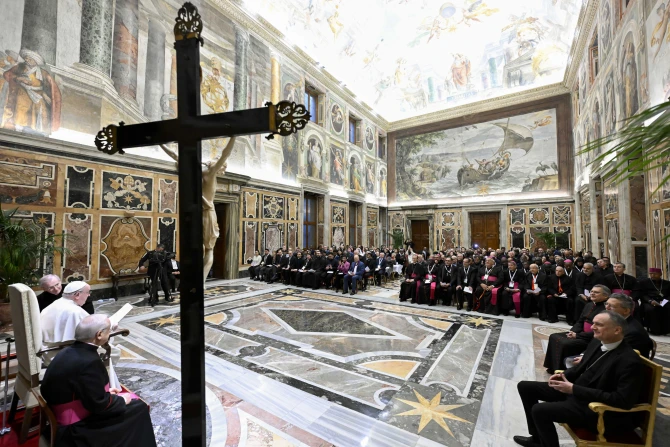
As the Register’s Edward Pentin has noted, in their effusive welcome of Mullally, Vatican officials extended courtesies “that went well beyond diplomatic hospitality and included gestures laden with ecclesial significance.”
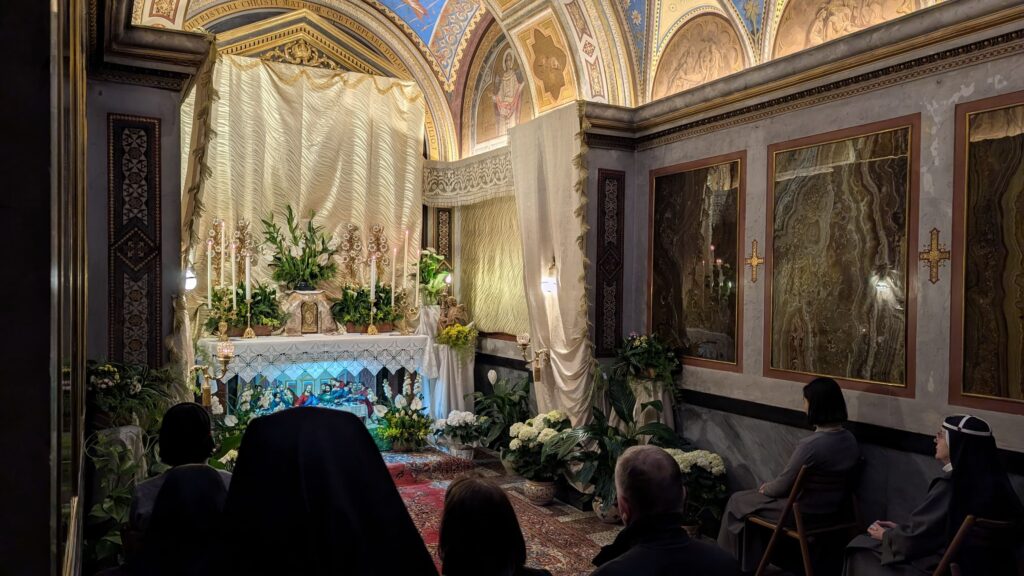
These included a private audience with Pope Leo XIV and the opportunity, a first for a visiting archbishop of Canterbury, to give a blessing in the Clementine Chapel in St. Peter’s Basilica – “the very site,” Pentin explained, “of St. Peter’s martyrdom and so a place where apostolic succession is visually and spiritually concentrated.”
So, in welcoming Sarah Mullally to the Vatican with such fervor, the Catholic hierarchy has shown itself insensitive both to its own judgment of the validity of Anglican orders and to the ethical anarchy that Sarah Mullally represents.
This does a disservice not only to the Catholic faithful and to Catholic theologians, but also, to be personal for a moment, to Anglican converts who chose to become Catholic, in part, to heal the schism of the Church in their own discipleship — and did so precisely because they were convinced of the lack of integrity of Anglican orders and the danger of its ethical heterodoxy.
Telling the Truth
At the same time, in terms of therapeutic integrity, it has always been accepted that to affirm someone in their self-harming delusion without any attempt at therapeutic intervention is a betrayal of responsibility to the deluded.
There may be plenty of room for discussion and discernment about the best way in which reality can be made accessible to the deluded, but just to accept the delusion without any provocation, any qualification, or any discomfort, is not kind or loving.
And in a sense, that probably sums up the dynamics of this disordered welcome. It is not so much setting love antithetically against truth as the perennial temptation of being nice rather than being honest.
If it is the Catholic view of tactics that being nice is more productive and faithful than being honest, then the case might be made for it. But that has never been the case in the past. The Catholic Church has always made a priority out of telling the truth and accepting that there is a cost to be paid for mending disorder, infidelity and rebellion.
When a penitent comes to the sacrament of reconciliation, it is a precondition that they’re willing to recognize the truth about themselves in order to find a way forward.
It seems strange at an ecumenical and institutional level that a rule that applies so obviously to individual penitence is suspended or even reversed at an institutional or corporate level.
Anglicanism in its formularies still repudiates the Mass, still repudiates the authority of the Bishop of Rome, and still repudiates purgatory and a number of unnamed ecumenical councils.
In terms of its history, it is responsible for the destruction of Catholic culture in England and the state theft of all the resources that belonged to the Church at the height of its presence in England.
It would be impolite to bring this up at every ecumenical visit, but it remains uncomfortably odd to pretend that the energized antagonism that birthed the Church of England should not be recognized, if not repented of, in some contemporary form.
One of the ecumenical tasks must surely be to find a way of setting us free from history, free from politicized ideological mistakes, free from misplaced antagonism between different ecclesial communities, but our faith is crystal clear in how that is to be achieved.
Jesus said that he is the truth, and by remaining faithful to him and the truth we discover that the truth will set us free.
The way in which the visit of the archbishop of Canterbury has taken place did not in any sense reflect the truth of the situation, and consequently nothing will be done to set us free from the dark schismatic weight of an unresolved past.
The Path to Unity
That might be considered the first task of the ecumenical process and even a responsibility of the Western Patriarch in the shadow of a painful, violent and disordered historical legacy.
If ecumenism is to have any integrity at all, it cannot be built on gestures that obscure reality or soften contradiction, but only on a shared submission to the truth that Christ himself embodies. Anything less risks becoming a theater of sentiment rather than a work of reconciliation.
The path to unity does not lie in the careful avoidance of difficulty, but in the courage to name it, to repent of it, and to allow the truth to do its proper work of setting us free.
Until that happens, such encounters, however well-intentioned, will remain suspended between appearance and reality, offering the form of unity without its substance, and leaving the deeper wounds of history unhealed.
This article was originally published by NCRegister.