ANALYSIS: The way Leo XIV addressed the blessing issue marked a necessary discontinuity with his predecessor.
The press conference on the plane returning from Africa provided the first sign of Leo XIV’s notable break with Pope Francis’ pontificate.
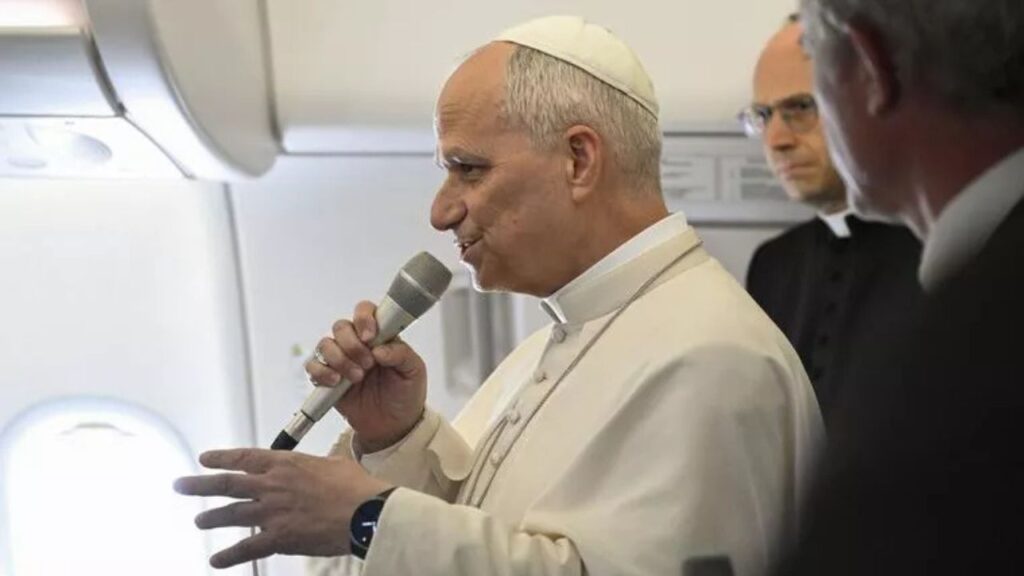
When asked specifically about the decision of Cardinal Reinhard Marx, archbishop of Munich and Freising, to formally bless same-sex couples, Leo XIV said the Holy See had already informed the German bishops that it did not agree with “the formal blessing of couples — in this case, same-sex couples as requested — or of couples in irregular situations, beyond what Pope Francis has specifically permitted, saying that all persons should receive the blessing.”
Leo went further.
“When a priest gives the blessing at the end of Mass,” he said, “when the Pope gives the blessing at the end of a great celebration like the one we had today, there are blessings for all people.”
He also noticed how “Francis’ famous expression, ‘everyone, everyone, everyone’ (todos, todos, todos) expresses the Church’s conviction that everyone is welcomed, everyone is invited, everyone is invited to follow Jesus, and everyone is invited to seek conversion in their own lives.”
“To go beyond this today,” Leo said, “could cause more disunity than unity,” adding “that we should seek to build our unity on Jesus Christ and on what Jesus Christ teaches.”
At the beginning of his response to reporters, Leo XIV also emphasized that the Church’s moral teaching concerns not only sexual matters, but also justice, equality and peace. It’s not the first time he’s said this, and it’s not surprising.
In this regard, it is worth mentioning how the Compendium of the Social Doctrine of the Church itself encompasses a variety of topics and organizes them around a central theme: the Eucharist.
This is why the Eucharist has weight, and so does the liturgy, and every time this weight is relativized, the Church’s social doctrine is relativized as well.
The way Leo XIV addressed the blessing issue marked a necessary discontinuity with his predecessor.
The blessing of irregular couples was outlined in Fiducia Supplicans, one of the few Vatican documents that prompted entire episcopal conferences to distance themselves.
Subsequently, the Dicastery for the Doctrine of the Faith published an implementing note, which only created greater disunity, an issue that Pope Leo highlighted in last week’s presser. It even went so far as to define how long the blessing should be and how it should be performed, an extreme exercise in casuistry and pragmatism that also ran counter to Pope Francis’ call to avoid casuistry.
It was essentially an unnecessary document because it intervened in a practice that was already in place. No priest had ever refused a simple blessing (i.e., a Sign of the Cross on the forehead) when asked.
Fiducia Supplicans also generated another downside. Armed with the document, pastors involved in LGBTQ ministry called upon same-sex couples and had their portraits photographed while they blessed them privately, in a gesture that was not a marriage but which nevertheless symbolically seemed to approve a union that was not a marriage.
The politics of mercy thus became fodder for ideological controversy, especially at a time when the Church in Germany was shaken by these progressive tendencies, which sought precisely to undermine its structure.
The German “Synodal Way” is a structural crisis rooted in the notion that the crisis of the Church in Germany, confirmed by the crisis of abuse and cover-up, is rooted in antiquated systems that must be dismantled, even if it means jettisoning centuries-old practices such as celibacy or, indeed, the very notion of family.
The principle of adapting the world to keep pace with the times was at the core of a broad discussion at the latest Synod on Synodality. The final document of the synod did not showcase the term “universal Church”; it was replaced by “the whole Church.” It was a precise choice. Father Giacomo Costa, special rapporteur of the synod, explained in the final press conference that the synod’s fathers wanted to avoid the idea that “the universal Church is at the top of a system of local Churches. The Church is the whole Church, in the ensemble of the Churches.”
The problem is that concepts shouldn’t change because they’re misunderstood, but rather, they need to be explained so they can be better understood. Ultimately, a world that adapts is a world that gives up teaching.
But if there’s no one to teach, there’s no unity either. And this is where Leo XIV hits the nail on the head. All the anxiety to create a new, practical, alternative path, in step with the times, even beyond Church doctrine, has created disunity. This disunity is evident in every field.
Look, for example, at the traditionalist camp: We know that the Priestly Society of St. Pius X (SSPX), the so-called Lefebvrians, has decided to ordain new bishops on July 2. Although the ordinations would be valid, since they would be performed by legitimately ordained bishops, they would not be licit because they lack papal approval. For these reasons, it would result in excommunication and, therefore, a small schism.
The Holy See obviously tried to avert this eventuality, and the Dicastery for the Doctrine of the Faith invited the SSPX to a dialogue at the former Holy Office. This dialogue came to nothing. Interestingly, however, the SSPX reversed the arguments and asked that the same mercy it had claimed to apply to other situations be applied to them. It asked, in effect, for a suspension of the law in the name of pastoral care, which perhaps in this case should be defined more precisely as pastoralist care.
Leo XIV has never explicitly distanced himself from Pope Francis’ pontificate. He recognizes his missionary zeal and wants to highlight his good faith and his desire to evangelize. But with his words on the plane, Leo XIV also highlighted how there are ways to go about it and ways not to go about it.
Ways that create or exacerbate division are not the way.
There’s no telling whether this is the end of the synodal journey of the German Church. Pope Francis repeatedly addressed the issue, emphasizing that there was already an Evangelical Church in Germany and highlighting a process of Protestantization within the German Church that could not be accepted. However, the late pontiff also left room for the German Church to intervene, through his pastoral actions and decisions, which, in seeking to open up to all, created opportunities for discussion.
Leo XIV, instead, established a clear principle, placing doctrine back at the center.
If the German Church had been able to “play” with Pope Francis, this seems more difficult with Leo XIV. It’s a different approach that doesn’t deny the need to reach everyone but doesn’t want this need to become a reason for the faith’s destruction.
It’s not a new approach, but it’s different from what we’ve become accustomed to over the past 12 years, and it remains to be seen whether it will trigger a rejection.
This article was originally published by National Catholic Register.