The pastoral aid kit includes summaries of key themes, questions for reflection, concrete cases, and prayers along with activities designed for children and young people.
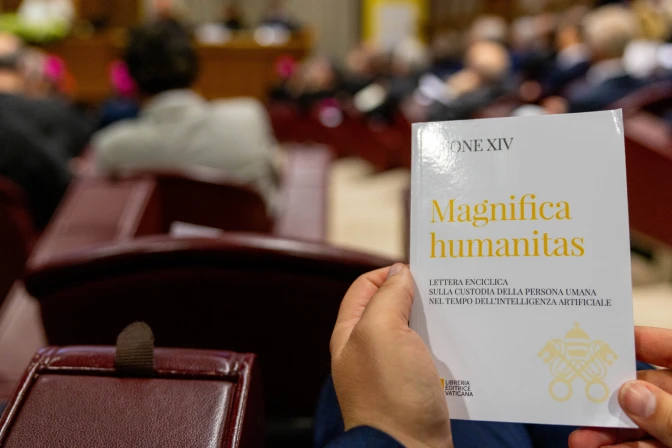
The Dicastery for Promoting Integral Human Development has presented a pastoral aid or kit on Magnifica Humanitas with the aim of making the new encyclical by Pope Leo XIV more easily understood.
On May 27, the dicastery explained on social media how the pastoral kit is structured and provided a link to it. The material includes summaries of key themes, biblical texts and citations, questions for reflection, concrete cases, and prayers. Additionally, it features activities designed for children and young people.
In the introduction to the document, the Vatican notes that it seeks to “accompany individuals, groups, and communities in a simple yet profound reflection on the relationship between faith, human dignity, and technological innovation.”
“Digital technologies and artificial intelligence are changing the way we work, communicate, learn, build relationships, and even understand ourselves,” the text notes.
In the face of this new paradigm, the dicastery recognizes that many may feel “excited, fearful, curious, or confused.” Nevertheless, it advocates for navigating these changes “with discernment, hope, and responsibility.”
The material was designed for parish groups, catechesis, pastoral councils, as well as for one’s personal spiritual life.
The underlying theme of the encyclical consists of two biblical images that feature prominently in the accompanying resource: the Tower of Babel and the rebuilding of Jerusalem. According to the text, these two images represent opposing paths in today’s world.
“On the one hand, there is the risk of building a world dominated by power, individualism, and dehumanization; on the other, there is the possibility of building together a ‘city’ founded on listening, fraternity, justice, and mutual care,” the introduction explains.
The document expresses the Holy See’s hope that this material will enable the faithful to “rediscover our ‘magnificent humanity,’ so that every innovation may be illuminated by the Gospel and oriented toward the common good.”
To download this pastoral aid from the Dicastery for Promoting Integral Human Development, click here.
This story was first published by ACI Prensa, the Spanish-language sister service of EWTN News. It has been translated and adapted by EWTN News English.