In Barcelona’s Raval — a lively neighborhood where more than half the population is of migrant origin — joy palpably filled the streets on Wednesday.
Before celebrating Mass on June 10 at Barcelonaʼs iconic Sagrada Familia Basilica, Pope Leo XIV brought his affection to this community in one of the cityʼs most disadvantaged yet vibrant areas, demonstrating that the pope has not come to just admire churches but to touch human suffering.
In this neighborhood, St. Augustine Church houses — within the premises of a former convent — a soup kitchen run by the Missionaries of Charity and the Mano Amiga Foundation, which distributes clothing and food to the poor.
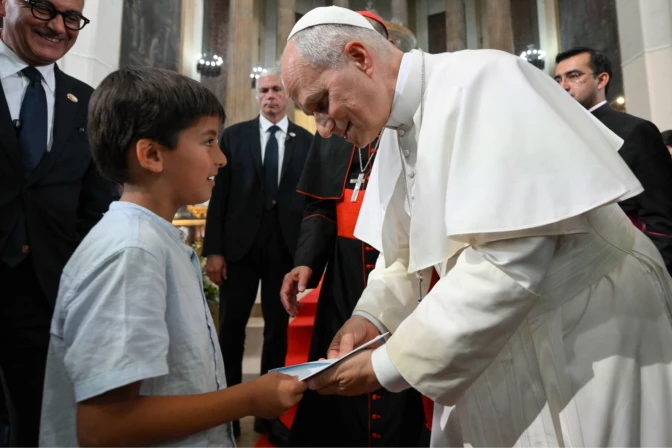
The beneficiaries of this ministry include the family of 6-year-old Renzo. He and his family arrived in Spain some time ago fleeing extreme poverty in Argentina.
Renzo — a little boy from a vulnerable family struggling to make ends meet — put the pope on the spot.
“Why do bad things happen to some people? And not to others? Whose fault is it? Why are there so many people living on the street? No one sees them; no one helps them,” he asked the Holy Father with the sweet innocence of a child.
But before addressing that question, the pope answered another: whether he had wanted to be pope when he was a child.
“I didn’t want to be pope, neither as a young man nor as an old man,” the pontiff remarked, drawing laughter from those present.
But “when the Lord calls, one must say yes,” he added. It was evident that the pope felt at ease in this parish. He even said: “I truly feel at home here, and thank you for everything you represent.”
Leo shared that “it is not easy to find the answer, Renzo, to your question about why bad things happen to some people while others are spared,” while noting that “reflecting on the life of Jesus might help us.”
“God’s word tells us that Our Lord ‘went about doing good and healing all who were oppressed by the devil,’ and yet we know he was crucified. But the story did not end there, for he rose again on the third day, conquering both evil and death,” the Holy Father recalled.
The pope emphasized that “through the life of Jesus Christ, God shows us that, even amid suffering, he never abandons any of his children, for he has prepared eternal joy for us — a place where there will be no more sorrow or pain. Let us have confidence; Jesus is with us, helping and accompanying us, and giving us the strength to navigate the difficult moments we may encounter in life.”
During a diocesan meeting with organizations dedicated to social assistance, the pope highlighted the aid they provide to people living in this neighborhood marked by marginalization.
Each diocesan ecclesial community, he noted — moved by charity and guided by the Holy Spirit — “is called to reach out, according to its own means and capabilities, and with discretion, sensitivity, and perseverance, to the wounds and needs of the least and most vulnerable, in order to alleviate their suffering and remedy their poverty.”
As Christians, he affirmed, “we are called to the task of making God’s love for every man and woman present within the concrete fabric of history.”
Also present at the gathering were the four Augustinians living in Barcelona and the surrounding area who served as hosts: two Tanzanians and two Filipinos who minister at neighborhood parishes and one in Badalona.
The pope focused much of his address on forgiveness. “Forgiving does not mean saying that what was wrong was actually right, nor does it mean letting someone continue to cause harm. It does not mean forcing oneself to forget, as if nothing had happened,” he explained.
[Forgiving] does not mean forcing oneself to forget, as if nothing had happened.”
Pope Leo XIV
Forgiving, he added, “means not letting hatred take over our hearts.” He emphasized: “Jesus asks us to forgive because it is the only way to experience God’s peace and heal spiritual wounds.”
The pontiff also addressed one of the most painful social ills: the loneliness of the elderly. “Let us not allow loneliness and abandonment to become the norm in the lives of older adults. That is a very sad thing,” he warned.
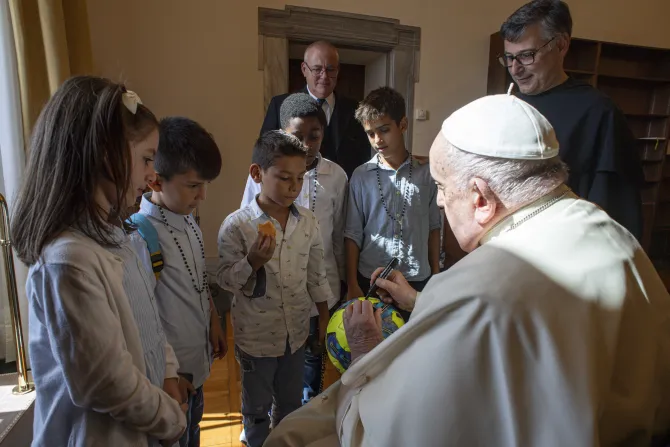
Renzo also asked the pope if he liked soccer, a question that drew laughter from those present.
As is well known, the pope plays tennis, but he revealed that he also played soccer as a young man. He shared that in Peru, he “followed the local teams closely” while also playing soccer alongside the seminarians.
“A little sport is good for everyone,” he said, concluding the moving encounter.
CORRECTION: This article was edited to correct the child’s nationality. He is Argentinean, not Peruvian, as we originally reported.
This story was first published by ACI Prensa, the Spanish-language sister service of EWTN News. It has been translated and adapted by EWTN News English.