Architect of the Italian Church’s ‘cultural project,’ he led high‑stakes fights over life, family, and secularism while seeking to re‑anchor Catholic witness in national culture.
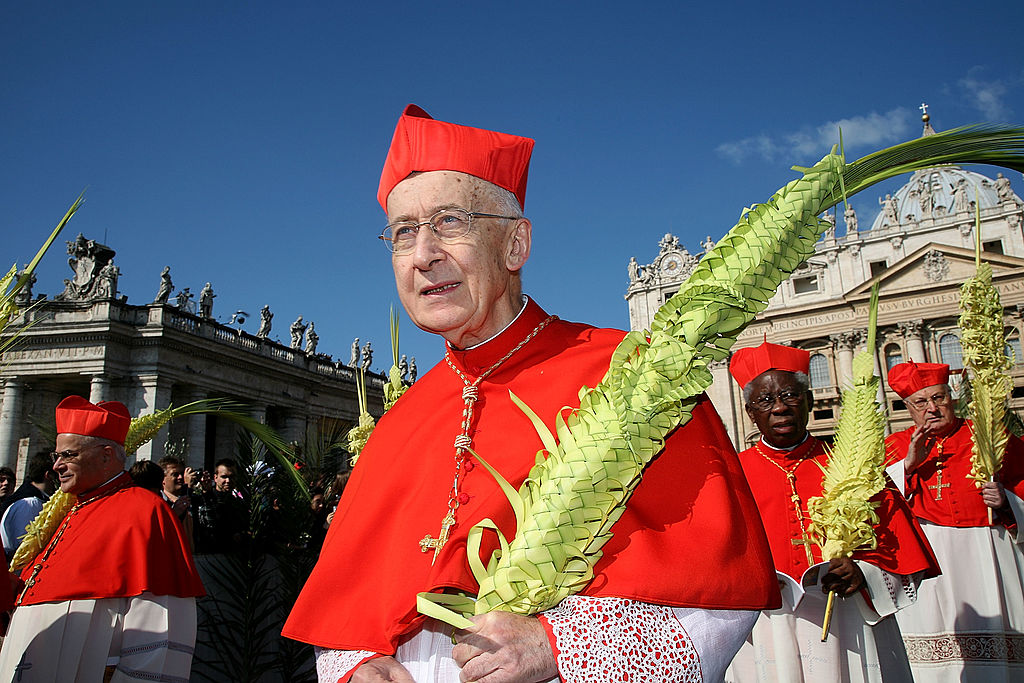
Cardinal Camillo Ruini, a formidable strategist of the Church in Italy during the pontificate of St. John Paul II and a key architect of its post-Cold War engagement with politics and culture, died Tuesday in Rome.
As head of Italy’s bishops’ conference and vicar of Rome during the 1990s and the 2000s, the cardinal often took strong and influential stances on social and moral issues, giving him a reputation for helping to shape ecclesiastical and political opinion.
Personally courteous, reserved, and even shy in manner, he was also intellectually sharp, politically shrewd, and very determined on questions of principle, especially when it came to “nonnegotiable” issues such as the right to life, marriage, and the family. Any severity he would direct toward ideas rather than persons, while he remained generally polite and respectful toward opponents.
All of this made him a trusted collaborator of John Paul II — and later of Benedict XVI — as he dedicated himself to keeping the Catholic Church in Italy relevant at a time when secularism was increasingly taking hold of the nation’s politics and society.
His skills and tact became most evident in 2004 when he urged Italian Catholics to boycott advocating the liberalization of Italy’s legal restrictions on in vitro fertilization (IVF). The referendum the following year failed due to low turnout and while secularists accused Ruini of having overstepped the mark for a churchman, others praised his strategy and his determination to speak out. Some affectionately awarded him the nickname “Rovini,” meaning the “ruiner” of secularists’ plans.
A year later, the cardinal drew the ire of the “gay lobby” when he warned that giving full legal recognition to unmarried couples would represent an “eclipsing of the nature and value of a family and a very grave harm to the Italian people.” In 2007, he was the key promoter and inspirer of a large Family Day rally in Rome, intended to block civil-unions legislation being pushed by the government of Romano Prodi. He also spoke out on several high-profile “end-of-life” cases, always in defense of the sanctity of human life.
Also known for his views on the relationship between faith and politics, Ruini frequently addressed issues such as secularism, a “healthy secularity” regarding Islam, and what he perceived as the “naturalistic tendency of modern man,” which he considered a significant threat to religious faith.
In Italy he was especially noted for being the architect and longtime president of the Church’s “cultural project,” formed in the aftermath of the collapse of the Christian Democracy era that had dominated postwar Italian politics. The project sought to shift Catholic influence from party politics to the deeper work of shaping national culture and public debate.
Evangelizing mission
Both the cardinal and St. John Paul II worked well together, giving renewed coherence to the Church’s evangelizing mission and devising a framework in connection with John Paul II’s encyclicals. But his positions also drew opposition within the Church, especially from allies of Jesuit Cardinal Carlo Maria Martini, a former archbishop of Milan, who believed he was abandoning the “spirit of the Council.”
“Cardinal Ruini deserves recognition for having steered the ship through the storm, for having shared John Paul II’s vision and for having fought to implement it in our country,” wrote Italian commentator Professor Stefano Fontana in La Nuova Bussola Quotidiana on June 17.
Born in Sassuolo in the province of Modena on Feb. 19, 1931, Camillo Ruini was the son of a local doctor who, during his schooling and in late adolescence, discerned a vocation to the priesthood. At 18 he entered seminary, later continuing his studies in philosophy and theology in Reggio Emilia and then at the Pontifical Gregorian University in Rome.
Ordained a priest on Dec. 8, 1954, Ruini returned three years later to his native Reggio Emilia, where for nearly two decades he formed young clergy as a philosophy lecturer in the diocesan seminary before becoming a widely respected professor and then head of inter‑diocesan and academic theology institutes in Modena and Bologna. Alongside this teaching he threw himself into lay apostolates, serving as chaplain to Catholic university graduates, diocesan delegate for Catholic Action, and president of the John XXIII Cultural Centre — work that honed the intellectual and pastoral instincts he later brought to the national stage.
Appointed auxiliary bishop of Reggio Emilia‑Guastalla in 1983, he soon emerged as a key organizer of the 1985 Loreto ecclesial convention, a landmark attempt to reset relations between the Church and Italian society after the political and ecclesial upheavals of the 1960s and 1970s. In 1985 he joined the bishops’ commission for Catholic education, culture, and schools.
John Paul II elevated him to the cardinalate in 1991, after which he entered the decisive phase of his episcopal career as president of the Italian Bishops’ Conference (1991–2007) and vicar of Rome (1991–2008). A member of several Vatican dicasteries and the author of numerous essays and research works, he also served as grand chancellor of the Pontifical Lateran University. He played a significant role in the 2005 conclave that elected Benedict XVI, and from 2010 to 2014, at the request of Pope Benedict, he served as president of the International Commission of Inquiry on Medjugorje. He also headed the academic committee of the Joseph Ratzinger-Benedict XVI Vatican Foundation.
He praised John Paul II and Benedict XVI but was less at ease during the pontificate of Pope Francis. His criticisms, he suggested, stemmed not from conservatism but from concern that some of the faithful might struggle to understand Francis’ direction of the Church. Upon the pontiff’s death in April 2025, Ruini set out four conditions that, in his view, the new pope should possess: sound doctrine, capacity for governance, a spirit of communion, and the strengthening of the faith. Many observers saw in these criteria an implicit critique of the pontificate just ended.
Final interview
The cardinal continued to speak out publicly up until his final days. In one of his last interviews given to Corriere della Sera to coincide with his 95th birthday in February, Ruini said he disapproved of Benedict XVI’s resignation, praised Francis for his “great courage” but faulted him for “taking too little account of tradition,” and said his first impression of Leo XIV was excellent.
He had a negative opinion of President Trump, saying he had “upset American and world politics,” which were “going in a very questionable direction.” He was also not supportive of restoring the Traditional Latin Mass, saying: “It’s very important for people to understand the language in which they celebrate.”
The cardinal died after suffering from a heart condition in his later years, but he endured his final months with serenity. He spoke and wrote often about death, reported Corriere della Sera, accepting his approaching end with “detachment and even cheerfulness,” and continued to celebrate Mass until shortly before his passing.
In his tribute to the late cardinal published June 17, Pope Leo XIV said the news of his death had awakened in his heart “deep feelings of closeness, together with gratitude to the Lord for the gift of this esteemed man of the Church, who lived his ministry generously.” He recalled the cardinal’s legacy to the Italian Church, remembering him as an “experienced and wise brother, strengthened by deep faith, sharp intelligence, and farsighted vision,” and who “served the Gospel and the Church with discretion and self‑sacrifice.”
Similar heartfelt tributes were received from the ecclesial and political world: John Paul II’s former personal secretary, Cardinal Stanislaw Dziwisz, said Ruini “always sought the good of the Church, with clarity of faith, loyalty to the magisterium, and a deep sense of duty and pastoral responsibility.” He expressed his gratitude for Ruini’s collaboration with John Paul II at “decisive moments” in the life of the Church.
The current Vicar of Rome, Cardinal Baldassare Reina, gave thanks for Ruini’s “long and fruitful Christian life and for his service to the Church,” and Cardinal Matteo Zuppi, president of the Italian bishops’ conference, said the cardinal helped the Church in Italy to “think, discern, speak, and walk in its own time.”
Ruini’s episcopal motto — “Veritas liberabit nos” (“The truth sets us free”) — “remains a summons for all,” he said. Italy’s premier, Giorgia Meloni, described him as a “great man of the Church,” while Prodi recalled a “profound connection” with Ruini, who, as a young man in Reggio Emilia, guided him and other youth in the diocese.
Elisabetta Valgiusti, a Roman citizen who knew Ruini personally, praised him for being a “leading figure in the life of the Catholic Church at every level and in public debate more broadly.” She especially lauded him for his understanding of culture, which she said he saw as a “meeting ground between the Church’s own mission and the nation’s most urgent needs.”
Valgiusti, an EWTN documentary filmmaker who founded Save the Monasteries to help Christian communities through cultural and communication projects, told the National Catholic Register, the sister partner of EWTN News, that she remembered her conversations with him “with gratitude and respect,” especially during the pandemic period.
“We will miss his strong and upright voice, and also his piercing gaze,” she said.
Pope Leo XIV will celebrate the funeral for Ruini at the Altar of the Chair in St. Peter’s Basilica on Thursday afternoon, June 18, together with cardinals, archbishops, and bishops.
This story was first published by the National Catholic Register, the sister partner of EWTN News, and has been adapted and updated by EWTN News.