The unauthorized July 1 rite in Écône, Switzerland, came despite Pope Leo XIV’s appeal to “please turn back” and could trigger automatic excommunication for the six bishops involved.
Pope Leo XIV is not even two years into his pontificate and he is already facing one of the most delicate episodes of his ministry: a new rupture within the Church.
In a defiant move and despite repeated warnings from Rome, the Society of St. Pius X (SSPX) went ahead Wednesday with the consecration of four new bishops without a pontifical mandate — an act of open disobedience to the authority of the pope that, under canon law, carries automatic excommunication for the six bishops involved.
The Vatican’s official response is now awaited and could include a formal declaration of schism, as Rome had warned in the days leading up to the ceremony.
In 1988, after Archbishop Marcel Lefebvre, the founder of the SSPX, consecrated bishops without a papal mandate, Rome responded two days later. On July 2, St. John Paul II published the motu proprio Ecclesia Dei, in which he spoke openly of a “rupture” of ecclesial communion and created a commission to help reconcile faithful linked to the society.
A schism is a tragedy for any pope. In the case of Pope Leo XIV, it also carries a more personal resonance: The pope belongs to the Augustinian order, the same religious family to which Martin Luther belonged, whose break with Rome helped lead to the Protestant Reformation and the fracturing of Western Christianity.
A repeated act of defiance
The illicit ceremony took place in a meadow in Écône, Switzerland, home to the SSPX international seminary — the same place where Lefebvre caused a rupture with Rome exactly 38 years ago by consecrating four bishops without the required pontifical mandate.
That act of defiance was repeated Wednesday, July 1, apparently without regret, despite the paternal plea in which Pope Leo XIV warned Tuesday of the “sin of extreme gravity” they were about to commit.
The ceremony was carried out by the two surviving bishops from the illicit 1988 consecrations. Spanish Bishop Alfonso de Galarreta presided as principal consecrator, assisted by Swiss Bishop Bernard Fellay as co-consecrator.
The new bishops — Swiss Father Pascal Schreiber; American Father Michael Goldade; and French Fathers Michel Poinsinet de Sivry and Marc Hanappier — were designated as auxiliaries of the society with the stated aim of serving the Church, though in practice the act marks a decisive step toward rupture.
Provocative symbolism
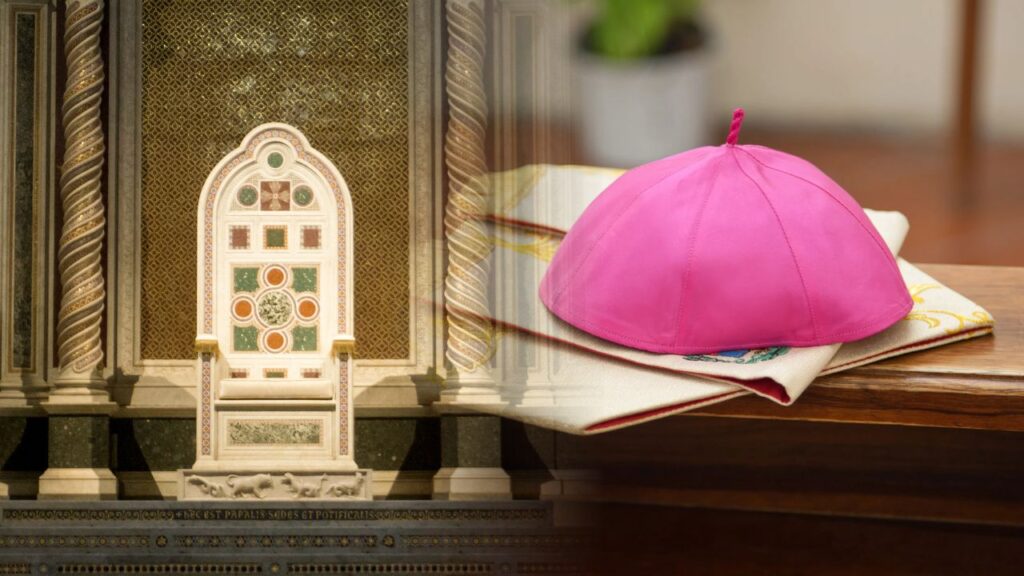
The ceremony included several elements loaded with symbolism recalling — not without a certain provocation — the 1988 consecrations. The throne on which De Galarreta sat was the one once used by Lefebvre. The vestments worn by the bishops were those used by the four bishops ordained 38 years ago.
Thousands of faithful arrived hours early, many dressed in traditional attire and straw hats and carrying folding chairs, in an atmosphere that mixed celebration with solemnity. For the occasion, the SSPX even sold commemorative items, including an exclusive 75 Swiss franc box of wine — about $92.50 — called “Cuvée des Sacres,” featuring pinot noir, syrah, petit arvine, and fendant, with each bottle decorated with the image of one of the consecrated bishops.
De Galarreta whispered the liturgical formulas into the microphone, strictly in Latin, with his back to the 17,000 faithful present, according to organizers. Those gathered came from nearly 70 countries.
Without the pope’s mandate
Outwardly, the episcopal consecration followed a valid rite. But it lacked a key element to make it licit: the mandate of the pope.
The ceremony began with a solemn procession to an altar set up beneath a tent, with members of several religious orders linked to the SSPX taking part. Priests and religious sisters connected to the society sat in the front rows.
Many families were also present, following the rite on giant screens set up in the Swiss field.
In principle, those faithful did not automatically incur excommunication. Father Pierpaolo Dal Corso, an expert in penal and sacramental canon law, told ACI Prensa, the Spanish-language sister service of EWTN News, that such a penalty would apply only if they rejected the authority of the pope or the legitimacy of the Catholic Church.
In 1996, the Pontifical Council for Legislative Texts clarified that excommunication for schism does not automatically apply to those who attend SSPX celebrations. In the same line, canonist Monsignor William King told ACI Prensa that excommunication requires conscious adherence to the denial of the pope’s authority.
Before the rite of consecration, Father Davide Pagliarani, the SSPX superior general, spoke and even defended the need to canonize Lefebvre. The movement’s founder died in 1991 without public signs of repentance, a necessary condition for full reconciliation with Rome.
An invalid argument
Pagliarani read a text justifying the consecrations by appealing to an alleged “state of necessity,” an argument also used in 1988, though the Holy See has repeatedly said it does not apply — especially after an explicit warning from the pope.
In his remarks, Pagliarani made clear his doctrinal break, saying that “from the Second Vatican Council to our own day, the authorities of the Church have been imbued with a spirit contrary to the faith and have acted against holy tradition.”
“We consider it a sacred duty toward Holy Mother Church and souls to proceed with the consecration of bishops fully faithful to holy tradition and the constant magisterium of the Church,” he added.
The four candidates pronounced their oath in Latin, even pledging to “fight against schismatic heretics,” in a paradox that did not go unnoticed.
The SSPX superior general insisted on rejecting what he called a “false dilemma” between fidelity to the faith and ecclesial communion, attempting to argue that the society’s decision does not constitute a break with the Catholic Church.
But the canonical situation of the SSPX remains complex. The society continues to reject key elements of the Second Vatican Council, especially Dignitatis Humanae, the council’s declaration on religious freedom.
“We are accused of not respecting the pope, but it is precisely because we love him as the vicar of Christ that we do not want to see him humiliated alongside false shepherds, representatives of false religions,” Pagliarani said, effectively closing the door to ecumenical and interreligious dialogue.
“We live these consecrations in joy and hope. We do not live them in polemics, tension, bitterness, or resentment,” he said.
“Your worst enemies will not attack you head-on, but will try to make you slide gradually toward a more updated perception of the faith and of relations with the world. When you sense this danger, reflect, pray, seek counsel, evaluate, remain still before reacting like a serpent,” he urged the newly consecrated bishops.
He added: “Never, ever retreat. That is what it means to be like a serpent: to perceive the duplicity, the ambiguity, the cunning that exists in the world.”
“God now asks us to be treated as rebels,” Pagliarani declared at another point.
The SSPX is already clearly outside the canonical jurisdiction of the Church. But with this new step, it has directly defied the pope. If the Vatican now formally declares a schism, its members will become even more isolated, without the possibility of receiving any ministry or mission in dioceses. That would leave its members — some 600,000 people — headed toward an increasingly sectarian circle.
Although SSPX priests are suspended, Pope Francis granted them faculties to hear confessions and witness marriages. If a schism is confirmed, those concessions could be reviewed.
This story was first published by ACI Prensa, the Spanish-language sister service of EWTN News. It has been translated and adapted by EWTN News English.
A correction was made on Jul. 1, 2026: An earlier version of this story implied that the 1988 consecrations took place on July 1. The correct date is June 30.