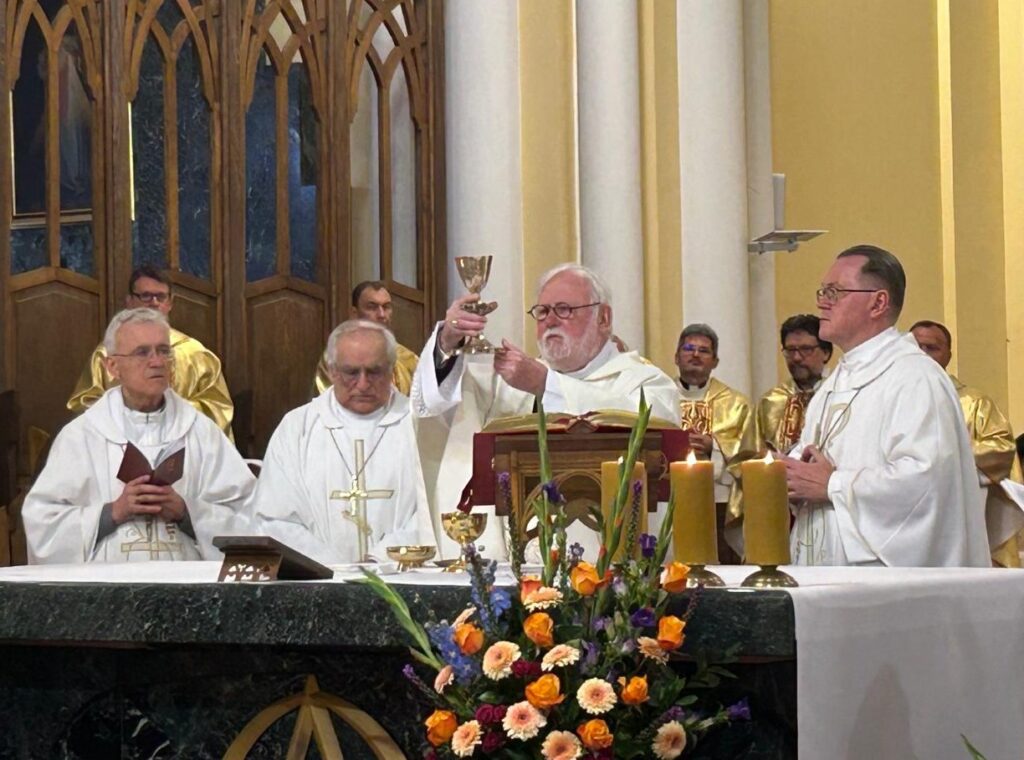
ANALYSIS: Recent meetings between the Vatican and Moscow hint at a new era in diplomatic relations.
Archbishop Paul Richard Gallagher’s trip to Moscow marked a definitive paradigm shift in the Holy See’s diplomacy regarding the situation in Ukraine.
We cannot know what was said behind closed doors during the bilateral meeting with Russian Foreign Minister Sergey Lavrov. However, a good deal can be gleaned from the opening remarks from both the Holy See and the Russian delegation ahead of the meeting and at the press conference following it, which were broadcast via video by the Russian Foreign Ministry.
Archbishop Gallagher is the Vatican’s secretary for relations with states, a position comparable to that of a foreign minister within the Holy See. He already visited Moscow in 2021, but this second trip, five years later, has greater relevance.
First, it comes amid Russia’s ongoing and large-scale aggression against Ukraine, which began in 2022. Second, Russian-Vatican relations had been mostly excellent under the previous pontificate, which gave great credence to Moscow’s opinions, although Francis said he had urged Patriarch Kirill of Moscow not to be a “state cleric.” Finally, the meetings are the first of their kind to take place under the new pontificate.
Leo XIV has not changed the Holy See’s diplomatic line: It promotes peace and dialogue and never interrupts diplomatic relations, even in difficult situations.
Nonetheless, Leo has introduced a different, more “diplomatic” strategy, if one could call it that.
Pope Francis relied heavily on his personal impressions and his personal charisma. Leo, by contrast, has taken a more conventional, institutional approach, with keen attention to detail and the conviction that peace cannot be achieved without clarity.
Since his first address to the diplomatic corps on May 16, 2025, Leo XIV has emphasized that the Church must speak the truth, even when it is incomprehensible to the world. At the Rosary and prayer vigil for peace on April 11, 2026, the Pope went further, emphasizing that the Church often risks being despised.
This approach represents the lens through which Archbishop Gallagher’s mission to Moscow can be interpreted.
The archbishop did not go to Moscow simply to engage in dialogue at all costs. He went to Moscow with a mandate to clarify the Holy See’s position — going so far as to highlight some of the difficult situations facing the Catholic Church in Russia — while establishing dialogue as much as possible. Thus, Archbishop Gallagher’s trip to Russia represents a true paradigm shift.
The archbishop made it clear right away, in his inaugural speech, that he was in Russia because the Russian Federation had invited him, establishing a framework for dialogue and a balance of power. However, he also emphasized that relations between Russia and the Holy See are ongoing and that a channel of information has been kept open — as Archbishop Gallagher recalled in an interview with Vatican News at the end of the trip.
The line that made the most headlines — rightly — was Archbishop Gallagher’s firm statement: “This war must end.” Only, he didn’t just say that the war must end. He called for clear and transparent negotiations. He emphasized the “lingering differences” between the Russian Federation and the Holy See in assessing certain situations, clarifying that the Holy See does not give in to Russian propaganda.
However, Archbishop Gallagher’s words did not make as big an impact in Western media as they might have, likely for two reasons.
The first is practical: The Holy See’s foreign minister spoke in English, but his words were drowned out by videos released with a Russian translation. While the Russian Foreign Ministry rushed to transcribe and release the exact content of Lavrov’s words, neither the Holy See’s Secretariat of State nor the Vatican media did, even though they had sent a journalist to accompany the archbishop.
The second reason is that the clarity with which Archbishop Gallagher spoke left no room for misrepresentation. His words could not be twisted by political bias because he was clear and courageous in addressing the issues at hand.
Archbishop Gallagher’s work in Russia also has something refined about it.
On the one hand, he didn’t shy away from emphasizing Russia’s responsibility, with words that must have resonated forcefully behind closed doors. On Aug. 26, Archbishop Gallagher met with Yuri Ushakov, Putin’s foreign affairs adviser, in a particularly significant meeting. The Secretariat of State’s X account, @TerzaLoggia, reported the news. Kremlin spokesman Dmitry Peskov declined to comment on the meeting.
On the other hand, Archbishop Gallagher managed to establish a consistent line of dialogue. So far, it has worked at the embassy level — an approach praised by the Vatican’s foreign minister — and now there will be constant contact at the level of the deputy foreign ministers.
The Holy See recognizes that Russia is a global player that cannot be excluded from discussions, and it extends its hand to a Moscow that feels increasingly isolated.
In this ongoing contact, the Holy See will maintain its commitment to peace in Ukraine and to continuing its humanitarian mission. It will also open channels of dialogue with Russia on many other issues, from the situation in the Middle East to artificial intelligence.
What Archbishop Gallagher has accomplished could be called “classic” Vatican diplomacy. It would not have been possible, however, without Leo XIV’s outlining of an approach that has some differences from the approach of his predecessor and that nevertheless also translates into specific actions.
It remains to be seen whether the situation in Ukraine is an isolated case, or whether papal diplomacy will pursue this approach in different scenarios across the globe.
In a year and a half, for example, the agreement between the Holy See and Beijing for the appointment of bishops will face its next round of (re)negotiation: Will Leo XIV prefer the approach of truth diplomacy, aiming to make the agreement clear and public? Or will he take a more pragmatic approach, accepting some Chinese pressure to maintain its presence?
Then there are other high-stakes issues that are very much open.
For instance, from the situation of the Catholic Church in Venezuela to that in Nicaragua, where the nuncio and Vatican diplomats have been expelled, Latin America is a veritable powder keg. The Pope will experience Europe’s ferment of issues firsthand during his upcoming trip to France. North America is in the midst of a trade war, and the Pontiff’s native United States is facing crucial midterm elections this fall. Then there are wars in Africa, along with instability across the Holy Land, where the Holy See continues to advocate for the two-people, two-state solution.
Archbishop Gallagher’s journey marked a turning point, but it remains to be seen where the turn will take the Holy See.
This article was originally published by National Catholic Register.