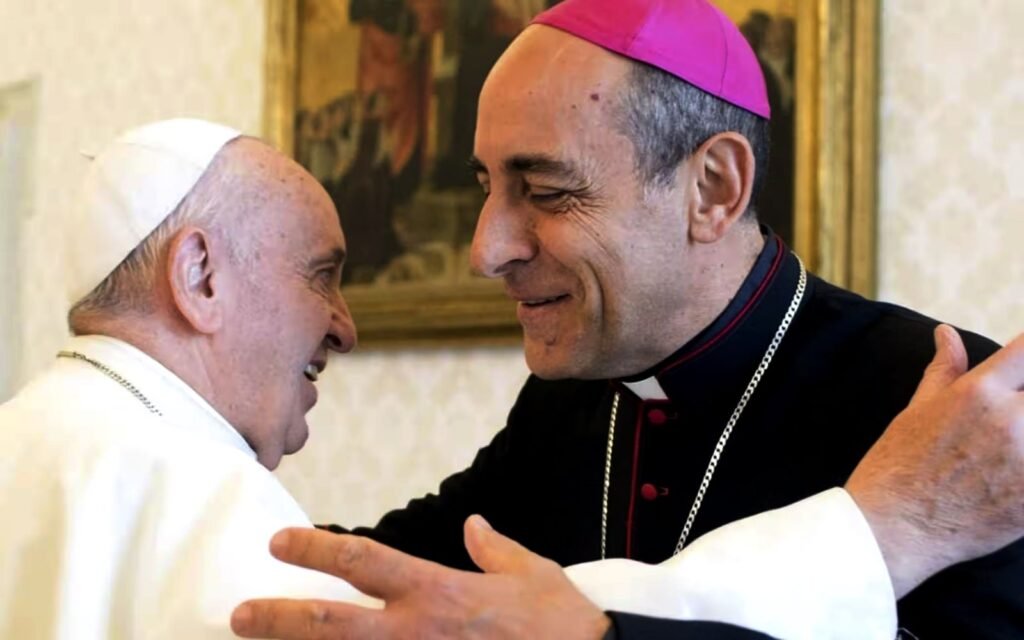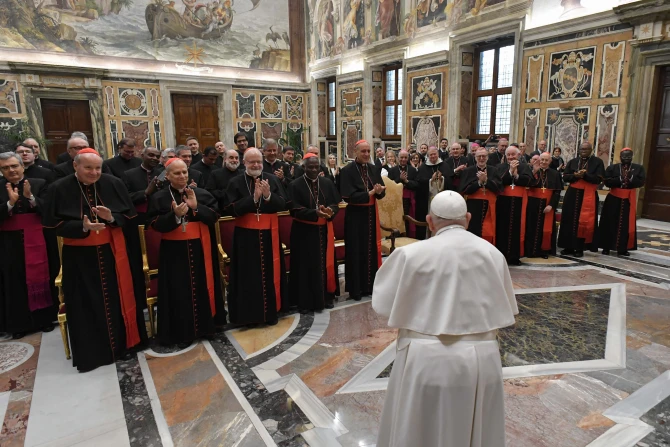
The final day of the Jubilee of the World of Communications, which ran from Jan. 24–26, coincides with the one-year anniversary of Pope Francis’ meeting with participants of the plenary session of the Dicastery for the Doctrine of the Faith (DDF) following the release of Fiducia Supplicans — the Vatican’s declaration on the pastoral meaning of blessings.
Though the initial tidal wave of controversy surrounding Fiducia Supplicans has largely died down, for many, the Vatican’s document on “pastoral and spontaneous blessings” caused more confusion than clarity on the Church’s long-standing teachings on human sexuality, morality, and the sacrament of marriage.
The close of the special jubilee for communicators provides an opportunity to reflect on the impact of Fiducia Supplicans and Vatican communications — particularly sensitive communications delivered by the office responsible for defending and promoting Catholic doctrine — to people living in various historical, socio-cultural, and political contexts around the world.
North America
The National Catholic Register, CNA’s sister news partner, reported Fiducia Supplicans did not cause too many complications for the Catholic priests in the United States. Following the Register’s survey of all 177 Latin-rite dioceses in the U.S., “virtually none reported receiving either complaints or comments from priests or other people regarding practices stemming from the document,” the Register reported.
A spokesman for Father Peter Karalus, vicar general of the Diocese of Buffalo, New York, told the Register that after initial discussions on the Vatican document with the diocese’s presbyteral council and other consultative bodies, there had “not been any follow-up discussions or requests for discussion.”
The 21 dioceses that responded to the Register’s inquiry also reported that blessings offered by priests are not tracked.
In Mexico, the Mexican Episcopal Conference (CEM) asked priests and parishioners to avoid distorting the pastoral meaning of blessings called for by Pope Francis. The bishops’ conference stated that “an attitude of welcome, closeness, and discernment” with “delicacy, firmness, and clarity” are needed to accompany people “on their path to fulfill the will of God in their lives.”
Europe
In Germany, many dioceses had instituted formal blessings for same-sex couples prior to the release of Fiducia Supplicans. A CNA Deutsch analysis found that 21 of Germany’s 27 dioceses provide some form of “queer pastoral care,” with several offering structured blessing ceremonies that exceed the parameters outlined in the DDF declaration.
To further clarify the purpose and meaning of Fiducia Supplicans, the Vatican’s press office issued a Jan. 11, 2024, press release explicitly stating only “pastoral and spontaneous blessings” are permitted, while any rituals that could suggest equivalence to marriage were prohibited.
In stark contrast, the Dutch bishops’ conference explicitly rejected nonliturgical blessings for same-sex couples as proposed in Fiducia Supplicans, CNA Deutsch reported. Dutch Bishop Rob Mutsaerts criticized the declaration as appearing to seek “peace with secular society” at the cost of clarity on Church teaching.
In Spain, Archbishop José Sanz Montes of Oviedo shared similar sentiments, saying the DDF declaration showed “gender ideology has penetrated the Church,” reported ACI Prensa, CNA’s Spanish-language news partner. Sanz Montes added: “Today, if you don’t use the jargon of gender ideology … if you don’t wear a pin and the 2030 agenda in your guts, it seems like you’re in another world and you’re being pushed aside.”
The fact that the DDF already released a 2021 explanatory note on blessing unions of persons of the same sex — clearly stating that the “Church does not have, and cannot have, the power to bless unions of persons of the same sex” — Sanz Montes as well as Spanish Bishop José Ignacio Munilla said they did not think the release of Fiducia Supplicans was necessary.
Africa
The strongest collective resistance to Fiducia Supplicans came from the Catholic Church’s African bishops.
The Symposium of Episcopal Conferences of Africa and Madagascar (SECAM) was clear and vocal about its outright rejection of spontaneous nonliturgical blessings, which it said “caused a shockwave” and “sow[ed] misconceptions and unrest in the minds” of many Catholic faithful.
“We, the African bishops, do not consider it appropriate for Africa to bless homosexual unions or same-sex couples because, in our context, this would cause confusion and would be in direct contradiction to the cultural ethos of African communities,” read the Jan. 11, 2024, SECAM statement signed by Cardinal Fridolin Ambongo.
Middle East
The controversy sparked by Fiducia Supplicans extended into north Africa and the Church in the Middle East.
Just months after the document’s release, Egypt’s Coptic Orthodox Church halted dialogue with the Vatican following consultation with other Eastern Orthodox churches in the region — a setback to ecumenical dialogue after Pope Francis instituted an annual “Day of Friendship Between Copts and Catholics” in 2013 and included the Coptic Orthodox martyrs to the Catholic Church’s list of saints in 2023.
Following the Coptic Orthodox Church’s 2024 synod, spokesman Father Moussa Ibrahim confirmed the decision to halt theological dialogue with the Catholic Church after its perceived “change of position on the issue of homosexuality.”
Latin America
A 2024 article published by ADN Celam, a news service of the Latin American and Caribbean Episcopal Council (CELAM), described Fiducia Supplicans as “an instrument of merciful love and great pastoral richness” that does not change Church teaching on human sexuality and morality.
Defending the document signed by Argentine DDF prefect Cardinal Victor Manuel Fernández as “clear and firm,” ADN Celam added that the Dec. 18, 2023, release of Fiducia Supplicans on the feast of Our Lady of Hope, one week before Christmas Day, was not a “random” decision.
“We trust that this pastoral approach to couples in irregular situations and same-sex couples, through blessing outside the liturgical or semi-liturgical context, will invoke the help of God for those who humbly turn to him,” the ADN Celam report said.
Asia
In the Catholic Church’s stronghold in the region, president of the Catholic Bishops’ Conference of the Philippines (CBCP), Cardinal Pablo Virgilio David, endorsed Fiducia Supplicans, stating: “The document speaks for itself and therefore does not require much explanation,” CBCP News reported.
The Dec. 20, 2023, CBCP advisory highlighted five key paragraphs — namely paragraphs 13, 25, 31, 38, and 39 — for Filipino priests to consider for prudent discernment and fatherly care for the country’s Catholic faithful.
Both Singapore’s Cardinal William Goh and India’s Cardinal Oswald Gracias believe the Vatican document left little room for misunderstanding the Church’s teachings on human sexuality.
“We show mercy but we do not approve of same-sex unions because without truth, love is compromised,” Goh shared through his communications office.
“Fiducia Supplicans has become the subject of controversy because it is misunderstood … There is no change in Church doctrine on marriage between a man and a woman,” Gracias told Asia News. “The tradition of the Church, the magisterium is very clear and there is no contradiction.”
This article was originally published on Catholic News Agency.