Skip to content

Cardinals test out virtual reality headsets at new AI-inspired jubilee art exhibit

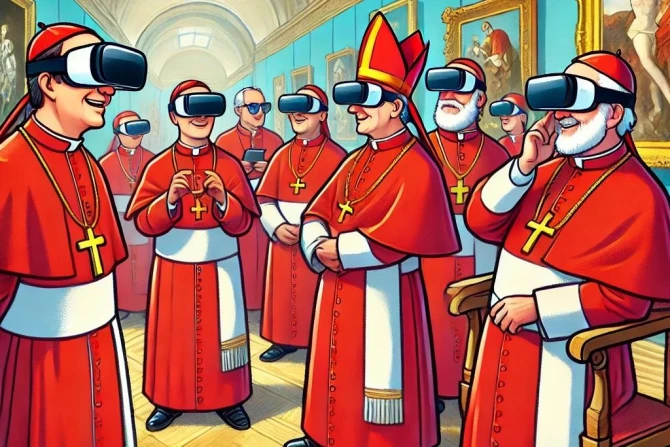
Catholic cardinals this week donned virtual reality headsets at the premiere of an innovative art exhibit that opened this week for the 2025 Jubilee Year showcasing contemporary art inspired by artificial intelligence.

Catholic cardinals this week donned virtual reality headsets at the premiere of an innovative art exhibit that opened this week for the 2025 Jubilee Year showcasing contemporary art inspired by artificial intelligence.

The exhibit, titled “Interconnected Hearts: Taiwan Contemporary Art Exhibition 2024,” is hosted at the Republic of China’s Embassy to the Holy See, just steps away from St. Peter’s Square. It features art created by three Taiwanese artists using 3D scanning, virtual reality (VR), machine learning, and AI technologies.

Among the first to try out the VR headsets at the exhibit’s premiere on Nov. 11 was 84-year-old Cardinal Silvano Maria Tomasi, the pope’s special delegate to the Sovereign Military Order of Malta.

Cardinal José Tolentino de Mendonça, the prefect of the Vatican’s Dicastery for Culture and Education, described the art exhibition as “intriguing and extremely innovative.”
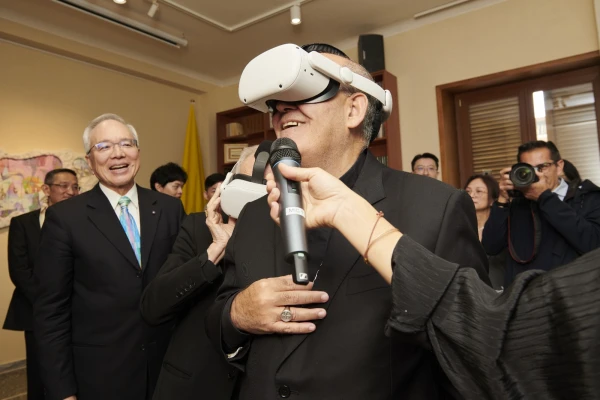
Ambassador Matthew Lee (left) and Cardinal Jose Tolentino wear the headsets at the Republic of China’s Embassy to the Holy See on Monday, Nov. 11, 2024, at the Vatican. Credit: Embassy of the Republic of China to the Holy See

Using VR headsets by META, Tolentino experienced a piece by Hung Yu Hao, which digitally unites architectural elements from Taiwan and St. Peter’s Square in a shared virtual space. 

“The works that are before our eyes today flow from the creativity of human genius, enhanced by the use of artificial intelligence,” the Portuguese cardinal said.

Taiwan’s embassy to the Holy See sponsored the art exhibit as a testament to Pope Francis’ commitment to examining AI’s ethical implications, both in his message for the World Day for Peace 2024 and in the pope’s speech to the G7 in Puglia.
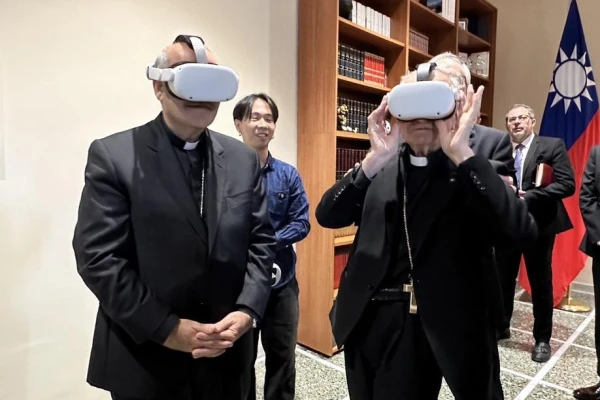
Cardinal Tolentino (left) and Cardinal Tomasi don VR headsets at the Republic of China’s Embassy to the Holy See on Monday, Nov. 11, 2024 at the Vatican. Credit: Embassy of the Republic of China to the Holy See

At the exhibit’s opening, Ambassador Matthew Lee highlighted how Taiwan is “at the vanguard of AI technology with advanced ingenuity and human resources.”

Taiwan’s President Lai Ching-te has declared his commitment to transforming Taiwan into an “AI Island.”

The ambassador noted that the exhibit, which will run through Feb. 14, 2025, has been officially added to the jubilee cultural events calendar by the Dicastery for Evangelization.

“The Chinese title of the art exhibition, ‘心信相連,’ expresses that the hearts of the faithful are connected with God, filled with faith to God, and therefore forging an unwavering trust in God,” Lee said.
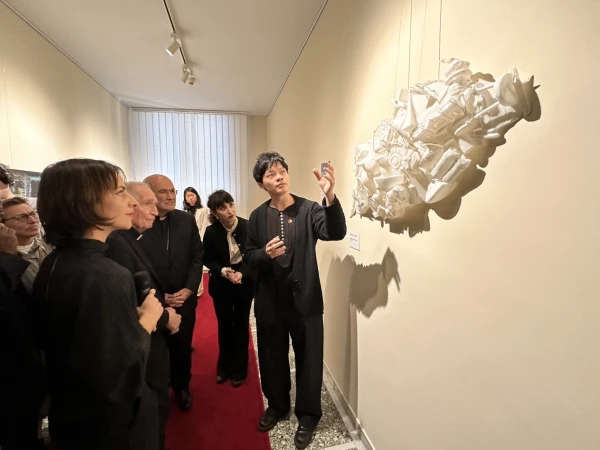
An artist from Taiwan explains how this 3D printed artwork is a human-AI collaboration at the Republic of China’s Embassy to the Holy See on Monday, Nov. 11, 2024, at the Vatican. Credit: Embassy of the Republic of China to the Holy See

As the Vatican embraces new technology, the Church remains mindful of AI’s ethical implications. Cardinal Tolentino noted that Pope Franics has described AI’s potential to lead to “a cognitive-industrial revolution. 

Tolentino added that this “new magnificent tool” must “always be at the service of the weakest and most needy and never a tool of domination, domination, and oppression.”

“Only in this way will we humans affirm and strengthen our humanity,” the cardinal said.

A high-tech week for the oldest institution in the world also featured a Vatican collaboration with Microsoft. 

Microsoft Vice Chair and President Brad Smith unveiled a 3D digital model of St. Peter’s Basilica, developed using advanced AI, which allows virtual visitors worldwide to explore the basilica’s art and history.
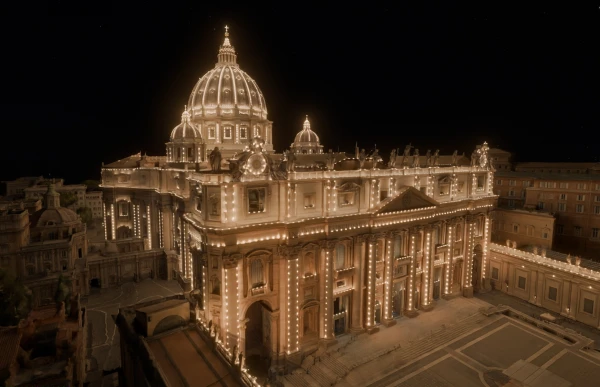
An AI-generated image of St. Peter’s Basilica at night. Credit: Microsoft La Basilica Di San Pietro: AI-Enhanced Experience

“It is literally one of the most technologically advanced and sophisticated projects of its kind that has ever been pursued,” said Smith, who has been a leading partner in the Vatican’s AI-ethics initiatives. 

The Microsoft president also announced the launch of an educational Minecraft game exploring St. Peter’s Basilica expected in January 2025 and a new immersive in-person exhibition on the terrace of St. Peter’s Basilica for the Catholic Church’s jubilee year.

This article was originally published on Catholic News Agency.

SIGN UP FOR OUR WEEKLY NEWSLETTER HERE

Receive the most important news from EWTN Vatican via WhatsApp. It has become increasingly difficult to see Catholic news on social media. Subscribe to our free channel today

Share

Would you like to receive the latest updates on the Pope and the Vatican

Receive articles and updates from our EWTN Newsletter.

More news related to this article

Pope Pius XII praying in an undated photo. (photo: Vatican Media / Vatican Media )

Pius XII Expert: No Serious Historian Can Call Him ‘Hitler’s Pope’

On the 150th anniversary of Pius XII’s birth, Emilio Artiglieri pays tribute to the late wartime pontiff and

The History & Requirements of the Swiss Guard: the Oldest Standing Army

Pope Francis has expressed his desire to visit his native Argentina next year, stating that he has always wanted to return, but has requested not to be linked to the politics of his country, and the trip will take place after the presidential elections in October 2023.

Was Pope Em. Benedict XVI Afraid of Dying? Exclusive Interview with Msgr. Georg Gänswein

In this exclusive interview with Archbishop Georg Gänswein, Pope Benedict XVI’s personal secretary, EWTN Vatican Bureau Chief, Andreas

Pope Francis’ Favourite Church: The Basilica of Saint Mary the Major

The Papal Basilica of Saint Mary Major, revered as one of Rome’s four major basilicas, stands as a

The Atlas of Pope Francis: Exploring His Geopolitical Approach and International Impact

Join us as we delve into Father Antonio Spadaro’s new book, “The Atlas of Francis. Vatican and International

Bishop accountability group voices concerns about Archbishop Fernández appointment

The following article was previously published on CNA. A bishop accountability group that tracks sexual abuse in the

LIVE
FROM THE VATICAN

Be present live on EWTNVatican.com