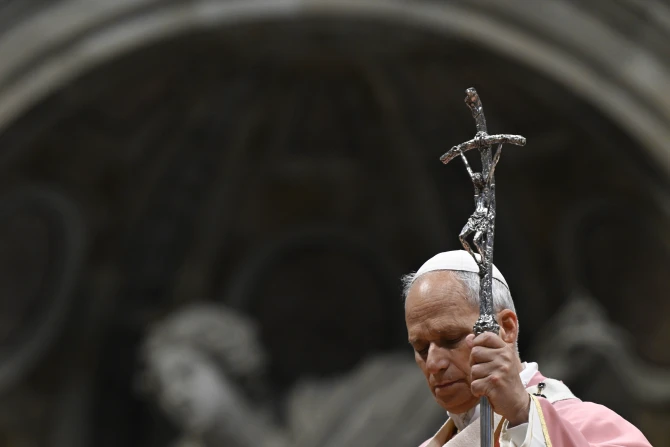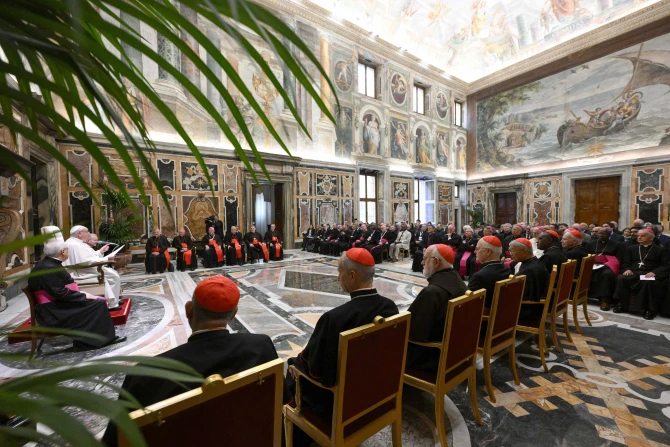
In an address to participants of the first plenary assembly of the Dicastery for Culture and Education on Nov. 21, Pope Francis said desire, fearlessness, and Christian hope are remedies needed to overcome the “shadow of nihilism” prevalent in society.
Describing nihilism as “perhaps the most dangerous plague of today’s culture” because of its attempt to “erase hope” in the world, the pope told dicastery members that their institution should work toward inspiring humanity.
“Schools, universities, cultural centers should teach us to desire, to remain thirsty, to have dreams, because, as the Second Letter of Peter reminds us, we ‘await new heavens and a new earth, in which righteousness dwells,’” the pope said.
“Understand your mission in the educational and cultural field as a call to broaden horizons, to overflow with inner vitality, to make room for possibilities unseen, to bestow the ways of the gift that only becomes wider when it is shared,” he continued.
Reminding his listeners of the Catholic Church’s expansive cultural and educational heritage, the pope said there is “no reason to be overwhelmed by fear.”
“In a word, we are heirs to the educational and cultural passion of so many saints,” he said after citing the examples of Sts. Augustine, Thomas Aquinas, and Edith Stein, and Catholic scientist Blaise Pascal.
“Surrounded by such a host of witnesses, let us get rid of any burden of pessimism; pessimism is not Christian,” he added.
The pope also drew upon the cultural works of musical and literary greats, including Mozart and American poet Emily Dickinson, and insisted that they, too, can be a source of inspiration for the dicastery’s various cultural and educational projects.
‘Let us think about the future of humanity’
Identifying poverty, inequality, and exclusion as “pathologies of the present world,” the Holy Father insisted it is a “moral imperative” of the Church to ensure people — especially children and youth — have access to a comprehensive education.
“Some 250 million children and adolescents do not attend school,” he stated. “Brothers and sisters, it is cultural genocide when we steal the future from children, when we do not offer them conditions to become what they could be.”
Sharing with dicastery members the experience of Antoine de Saint-Exupéry with the hardships of refugee families, the pope said the French writer felt wounded after seeing the children.
“It torments me that in each of these men there is a little Mozart, murdered,” writes de Saint-Exupéry in his autobiographical work “Land of Men.”
Toward the conclusion of the private audience, Pope Francis referred to the dicastery’s plenary assembly theme, “Let us pass on to the other shore” (cf. Mk 4:35), and encouraged his listeners to take courage and carry out their work with a sense of hope.
“I repeat: We must not let the feeling of fear win. Remember that complex cultural passages often prove to be the most fruitful and creative for the development of human thought,” he said.
“Contemplating the living Christ enables us to have the courage to launch into the future,” the pope added.
This article was originally published on Catholic News Agency.