Pope Francis told a group of theologians on Thursday he plans to visit Turkey for the 1,700th anniversary of the Council of Nicaea in 2025.
Patriarch Bartholomew Anticipates Joint Visit
Bartholomew I, the Eastern Orthodox Patriarch of Constantinople, anticipated that Francis would be making the trip in comments to reporters in May. In September, he confirmed that the joint trip is expected to happen at the end of May 2025.
The Council of Nicaea took place in the ancient city of Nicaea in 325 A.D. in the former Roman Empire, which is now the present-day city of İznik, in northwestern Turkey, about 70 miles from Istanbul.
“I plan to go there,” Pope Francis told members of the International Theological Commission on Nov. 28.
Historical Context: The Council of Nicaea
The Council of Nicaea, he said, “constitutes a milestone in the journey of the Church and also of all humanity, because faith in Jesus, the Son of God made flesh for us and for our salvation, was formulated and professed as a light that illuminates the meaning of reality and the destiny of all history.”
The Council’s Significance in Church History
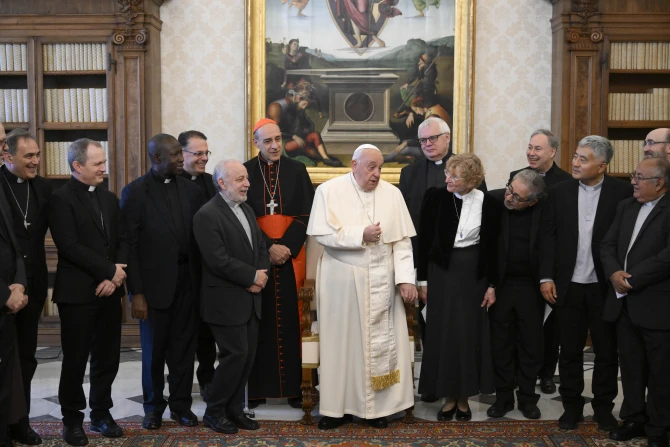
Pope Francis met with the International Theological Commission during their plenary gathering at the Vatican. He noted it is important that the commission’s meeting includes drafting a document about “the current meaning of the faith professed at Nicaea.”
“Such a document may be valuable, in the course of the Jubilee year, to nourish and deepen the faith of believers and, starting from the figure of Jesus, also offer insights and reflections useful for a new cultural and social paradigm, inspired precisely by the humanity of Christ,” the pope said.
The First Ecumenical Council
The Council of Nicaea was the first ecumenical council in the Church. It is accepted by the Catholic Church, the Eastern Orthodox Church, the Oriental Orthodox Church, and other Christian communities that accept the validity of early church councils.
It predates the Chalcedonian Schism — which separated the Oriental Orthodox communion from Rome — by more than 100 years and predates the Great Schism — which separated the Eastern Orthodox Church from Rome — by more than 700 years.
Condemnation of Arianism
During the council, the bishops condemned the heresy of Arianism, which asserted that the Son was created by the Father. Arius, a priest who faced excommunication for propagating the heresy, did not accept that the Son was coeternal with the Father.
A Shared Mission with Patriarch Bartholomew
Pope Francis said during a meeting with a delegation of the Ecumenical Patriarchate of Constantinople in June that he wished “wholeheartedly” to make the journey to Nicaea to mark the important anniversary with Bartholomew I.
If he travels to Turkey, a trip that has yet to be confirmed by the Vatican, it will take place amid a busy Jubilee Year for the pontiff.
Theological Reflections on Nicaea
“The Council of Nicaea, in affirming that the Son is of the same substance as the Father, highlights something essential: in Jesus we can know the face of God and, at the same time, also the face of man, discovering ourselves sons in the Son and brothers among ourselves,” Francis said on Thursday. “A fraternity, one rooted in Christ, that becomes a fundamental ethical task for us.”
“Today, in fact, in a complex and often polarized world, tragically marked by conflict and violence, the love of God that is revealed in Christ and given to us in the Spirit becomes an appeal to everyone to learn to walk in fraternity and to be builders of justice and peace,” he added.
Synodality: A New Missionary Stage
In his speech to the theologians of the international commission, the pope also emphasized the importance of synodality.
“I would say that the time has come to take a courageous step: to develop a theology of synodality, a theological reflection that helps, encourages, and accompanies the synodal process, for a new, more creative and bold missionary stage that is inspired by the kerygma and involves all components of the Church,” he said.
This article was originally published on Catholic News Agency.