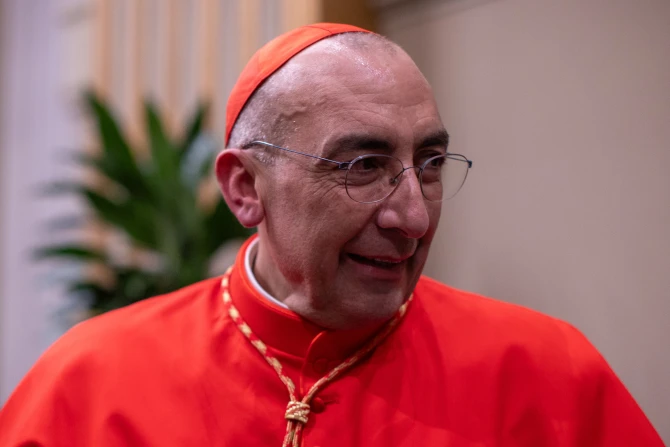
Cardinal Víctor Manuel Fernández will unveil guidelines for discerning Marian apparitions and other supernatural phenomena on Friday, but it is not the first time that the Vatican’s doctrine office has issued a directive for how the Church should respond to news of an alleged apparition.
Fifty years ago officials from the Congregation for the Doctrine of the Faith identified how the emergence of mass media had created an environment in which news of an alleged apparition could spread rapidly and quickly draw larger crowds than in past centuries thanks to the ease of modern travel.
Officials from the congregation met to discuss problems that could come up in examining apparitions in November 1974 and agreed on a procedure for Church authorities to follow in the case of a reported apparition.
The Vatican’s doctrine office made these norms public with the approval of Pope Paul VI in 1978, just three years before Cardinal Joseph Ratzinger was named the prefect of the congregation.
First, when a Church authority is informed of a new purported apparition or revelation, specific criteria should be used to judge whether or not cult or devotion should be allowed.
Criteria that would lead to a negative judgment on the alleged apparition included:
Doctrinal errors attributed to God, the Blessed Virgin Mary, or the saint during the apparition or revelation
Evidence of a search for profit or gain from the apparition
Gravely immoral acts committed by the recipient of the apparition or their followers
A psychological disorder or psychopathic tendencies
Clear errors concerning the facts of the apparition
Criteria that would lend itself to a positive judgment permitting some public devotion included:
A serious investigation into the alleged apparition establishes with “moral certitude, or at least great probability of the existence of the facts.”
The recipient of the apparition exhibits the qualities of honesty, a morally upright life, psychological health, and docility toward Church authority
Revelations include true theological and spiritual doctrines that are immune from error
Healthy devotion and abundant and constant spiritual fruit
The 1978 norms identify the local bishop as the competent authority with the responsibility of evaluating an alleged apparition in his jurisdiction. If he finds that it meets the positive criteria, he can permit some public devotion under his oversight, judging it as “pro nunc nihil obstare,” or “for now, nothing stands in the way.”
After years have passed, the bishop at the request of the flock can express a judgment regarding the authenticity and supernatural character of an apparition taking into account the spiritual fruit that has been generated from his new devotion.
The doctrine office noted that the regional or national bishops’ conference can also intervene in the case of an alleged apparition with the consent of the local bishop.
The Holy See can also intervene if asked by the local bishop or by a qualified group of the faithful. The Vatican also has the prerogative to intervene directly due to the universal jurisdiction of the pope and has the responsibility to intervene in “graver cases, especially if the matter affects the larger part of the Church” after consulting the local ordinary.
It is not yet clear how the new norms to be published by Fernández will change the procedures or competent authorities for dealing with an alleged apparition established by the Vatican in the 1970s. It is clear that the media environment has evolved in accelerated and unanticipated ways in the past 50 years, making it possible for a supposed Marian apparition to go viral worldwide in a matter of hours, which could necessitate a change in the way that the Church responds to such phenomena.
Regardless of what the new changes will bring, the Catholic Church will continue to consider Marian apparitions under the category of private revelations. According to paragraph 67 of the Catechism of the Catholic Church, private revelations “do not belong … to the deposit of faith.”
“It is not their role to improve or complete Christ’s definitive revelation, but to help live more fully by it in a certain period of history. Guided by the magisterium of the Church, the sensus fidelium knows how to discern and welcome in these revelations whatever constitutes an authentic call of Christ or his saints to the Church.”
This article was originally published on Catholic News Agency.