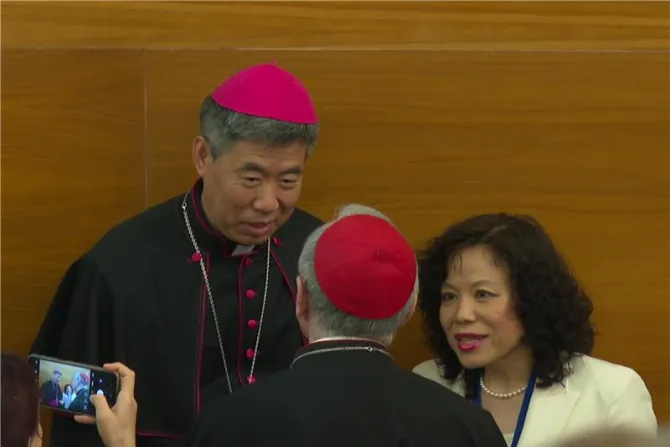
The bishop of Shanghai defended the Chinese government’s religious freedom record at a Vatican conference on Tuesday in a speech that called for the Church in China to “follow a path of ‘sinicization.’”
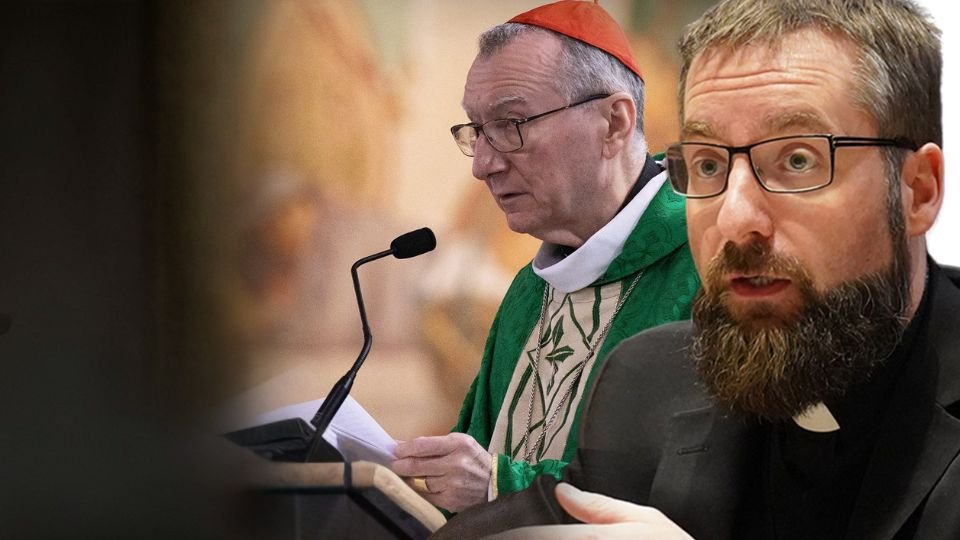
One year after Bishop Joseph Shen Bin was unilaterally installed by Chinese authorities as bishop of Shanghai in violation of the Vatican-China deal, the controversial Chinese bishop was a featured speaker at a Vatican conference beside Secretary of State Cardinal Pietro Parolin.
The Shanghai bishop delivered a 15-minute speech in Mandarin to a packed auditorium at the Pontifical Urban University on the Janiculum Hill overlooking St. Peter’s Basilica.
“The policy of religious freedom implemented by the Chinese government has no interest in changing the Catholic faith but only hopes that the Catholic clergy and faithful will defend the interests of the Chinese people and free themselves from the control of foreign powers,” Shen Bin said in his speech.
In China, Catholic priests are only allowed to minister in recognized places of worship in which minors under the age of 18 are not allowed to enter. Religious groups in China have been barred from conducting any religious activities online without first applying and receiving approval from the provincial Department of Religious Affairs.
Since coming to power in 2013, Chinese President Xi Jinping has mandated the “sinicization” of all religions in China, a move the U.S. Commission on International Religious Freedom called “a far-reaching strategy to control, govern, and manipulate all aspects of faith into a socialist mold infused with ‘Chinese characteristics.’”
The bishop of Shanghai echoed Xi’s call for “sinicization” of Christianity in his speech at the Vatican conference.
“Today the Chinese people are carrying out the great rebirth of the Chinese nation in a global way with Chinese-style modernization, and the Catholic Church in China must move in the same direction, following a path of ‘sinicization’ that is in line with Chinese society and culture today,” the bishop said.
Shen Bin is the president of a group called the Council of Chinese Bishops, a state-sanctioned bishops’ conference not recognized by the Vatican. He previously was the vice president of the Chinese Catholic Patriotic Association established by the Chinese Communist Party and under the control of the United Front Work Department.
He was consecrated as a Catholic bishop in 2010 with the consent of both the pope and Chinese authorities, according to the Vatican. He served as bishop of the Diocese of Haimen until April 2023, when he was transferred to Shanghai “without the involvement of the Holy See.” Pope Francis confirmed Shen Bin as the bishop of Shanghai three months later.
In his speech to the Vatican conference, Shen Bin quoted some of the statutes of the Chinese state-sanctioned bishops’ conference — a noteworthy choice given that Parolin had called for a Chinese bishops’ conference with “statutes appropriate to its ecclesial nature and pastoral mission” in the Vatican’s announcement of the pope’s acceptance of Shen Bin’s transfer last year.
The Chinese bishop also used Scripture to defend his stance that “the development of the Church in China must follow a Chinese perspective.”
“In dealing with the relationship between church and state, religion and politics, we must return to what the Bible says: ‘Render therefore to Caesar the things that are Caesar’s, and to God the things that are God’s,’” Shen Bin said.
The conference, titled “100 Years Since the ‘Concilium Sinense’: Between History and the Present,” was held in Chinese and Italian in the Great Hall of the Pontifical Urban University.
The one-day event marked the 100th anniversary of a Church council that took place in Shanghai in 1924 and brought together 105 Catholic missionaries, bishops, and Chinese Catholics to establish a framework for a native Chinese hierarchy.
The Pastoral Commission for China and Agenzia Fides, the information service of the Pontifical Mission Societies, organized the conference, which also featured Cardinal Luis Antonio Tagle and voices from mainland China as speakers. Pope Francis sent a video message to the conference in which he noted that Chinese Catholics have endured “times of patience and trial” in the past century.
None of the speakers at the Vatican conference spoke critically of human rights or religious freedom in China.
Professor Zheng Xiaojun, the director of the Institute of World Religions at the Chinese Academy of Social Sciences in Beijing, assured conference participants that religious freedom is fully guaranteed in China.
According to the 2024 report by the U.S. Commission on International Religious Freedom, religious freedom conditions in China deteriorated last year as the government intensified its implementation of its “sinicization” policy, which “requires groups to follow the CCP’s Marxist interpretation of religion, including by altering religious scriptures and doctrines to conform to that interpretation.”
This article was originally published on Catholic News Agency.