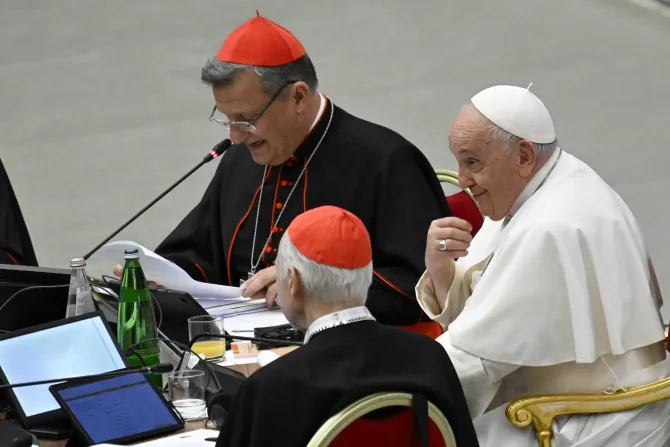
Church experts will meet in study groups to examine the question of women deacons and other key topics through June 2025 — well beyond the Oct. 27 conclusion of the final assembly of the Synod on Synodality, Pope Francis revealed in a new letter to the synod’s general secretary released Thursday.
Writing to Cardinal Mario Grech, secretary general of the General Secretariat of the Synod, the pope noted that the 42-page Synthesis Report produced after the first session of the synod assembly held last October “enumerates many important theological issues,” which “by their very nature, require in-depth study.”
Because it won’t be possible to complete this study before the start of the next synod assembly on Oct. 2, the pope explained, “I am arranging for them to be assigned to specific study groups, so that they may be properly examined.”
In his letter Pope Francis listed 10 themes he wants the study groups to examine. They are:
1. Some aspects of the relationship between the Eastern Catholic Churches and the Latin Church.
2. Listening to the cry of the poor.
3. The mission in the digital environment.
4. The revision of the Ratio Fundamentalis Institutionis Sacerdotalis in a missionary synodal perspective.
5. Some theological and canonical matters regarding specific ministerial forms.
6. The revision, in a synodal missionary perspective, of the documents touching on the relationship between bishops, consecrated life, and ecclesial associations.
7. Some aspects of the person and ministry of the bishop (criteria for selecting candidates to episcopacy, judicial function of the bishops, nature and course of ad limina apostolorum visits) from a missionary synodal perspective.
8. The role of papal representatives in a missionary synodal perspective.
9. Theological criteria and synodal methodologies for shared discernment of controversial doctrinal, pastoral, and ethical issues.
10. The reception of the fruits of the ecumenical journey in ecclesial practices.
These selected themes were among a more extensive list of topics deemed “matters of great relevance” that came up during the synod’s first session in October 2023 that required consideration “at the level of the whole Church and in collaboration with the dicasteries of the Roman Curia,” according to the Dec. 12, 2023, document from the synod’s general secretariat titled “Towards October 2024.”
Observing that these issues require extensive review, Pope Francis noted that there is inadequate time to fully address them ahead of the synod in October. Therefore, he said, “the study groups will offer an initial account of their activity on the occasion of the second session and, if possible, will conclude their mandate by the month of June 2025.”
The pope said “it is the task of the General Secretariat of the Synod, by joint agreement with the competent dicasteries of the Roman Curia, to constitute these groups, calling pastors and experts from all continents to take part in them, and taking into consideration not only existing studies but also the most relevant current experiences in the people of God gathered in the local Churches.”
“It is important that the aforementioned study groups work according to an authentically synodal method, of which I ask you to be the guarantor,” the pope continued in his letter to Grech.
At a press briefing at the Vatican on Thursday, officials of the Secretariat of the Synod discussed the pope’s letter as well as two new documents the secretariat released in conjunction with the letter.
The first document, titled “Five Perspectives for Theological Exploration in View of the Second Session of the XVI Ordinary General Assembly of the Synod of Bishops,” reflects on the guiding theme of the synod: “How to Be a Synodal Church on Mission?”
It highlights that the next session will serve to deepen “the dynamic connection between the participation of all and the authority of some, in the horizon of communion and mission … in its theological meaning, in the practical ways of setting it in motion, and in the reality of canonical structures.”
The document also outlined the intermediary steps that are to be taken in the upcoming months in preparation for the synod, noting that this process will be built upon a “new consultation process,” articulating this will unfold on three distinct levels: the local Church, the groupings of Churches (i.e. national, regional, continental), and on the universal level.
The second document is titled “Study Groups on Questions Arising in the First Session of the 16th Ordinary General Assembly of the Synod of Bishops to Deepen in Collaboration with the Dicasteries of the Roman Curia.”
It is the second document that specifies that theme No. 5 — regarding matters related to ministerial forms — “is the context in which the question on the possible access of women to the diaconate can be appropriately posed.”
The study group formed to examine this question will be under the direction of the Dicastery for the Doctrine of the Faith, the document notes. This group “is entrusted with the task of continuing “theological and pastoral research on the access of women to the diaconate, taking advantage of the results of the commissions specially established by the Holy Father.”
The group’s work “will also aim to respond to the desire expressed by the Synodal Assembly for ‘a greater recognition and appreciation of the contribution of women and a growth in the pastoral responsibilities entrusted to them in all areas of the life and mission of the Church.”
This article was originally published on Catholic News Agency.