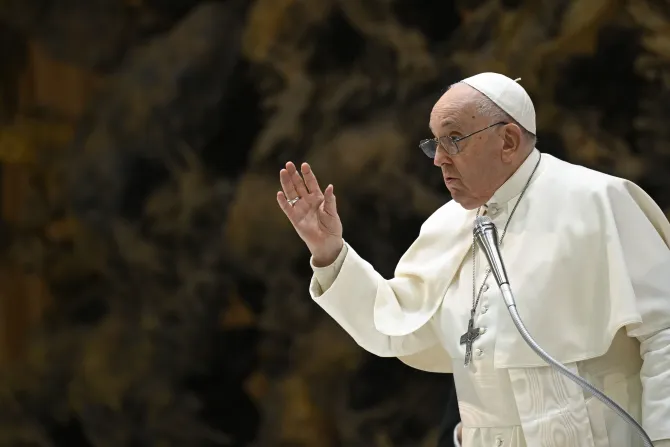
In a continuation of his catechetical series on vice and virtue, Pope Francis on Wednesday dedicated his general audience to highlighting the difference between love and lust, arguing that “in Christianity, there is no condemnation of the sexual instinct.”
Centering his reflection on the “human experience,” the pope drew upon the Song of Songs, also referred to as the Canticle of Canticles or the Song of Solomon, which he called a “wonderful poem of love between two lovers” that reveals falling in love “is one of the most astonishing realities of existence.”
The pope observed that in this process there is an altruistic factor in which “a person in love becomes generous, enjoys giving gifts, writes letters and poems. He stops thinking of himself to be completely focused on the other.”
“To love is to respect the other, to seek his or her happiness, to cultivate empathy for his or her feelings, to dispose oneself in the knowledge of a body, a psychology, and a soul that are not our own, and that must be contemplated for the beauty they bear,” the pope said to the faithful gathered in the Paul VI Audience Hall.

The Holy Father noted, however, that this notion of love requires “patience,” especially if it is “naive,” whereby “the lover does not truly know the face of the other, they tend to idealize them, they are ready to make promises whose weight they do not immediately grasp.”
The pope said that while “falling in love is one of the purest feelings” there is the risk that it could be “polluted by vice.”
“This ‘garden’ where wonders are multiplied is not, however, safe from evil” as it has been “defiled by the demon of lust,” a vice that is “particularly odious” because it “destroys relationships between people,” Francis said.
Reflecting on the modern paradigm of dating and romance, the pope asked: “How many relationships that began in the best of ways have then turned into toxic relationships, of possession of the other, lacking respect and a sense of limits?”
“These are loves in which chastity has been missing: a virtue not to be confused with sexual abstinence, but rather with the will never to possess the other,” the Holy Father continued.
“It plunders, it robs, it consumes in haste, it does not want to listen to the other but only to its own need and pleasure. Lust judges every courtship a bore, it does not seek that synthesis between reason, drive, and feeling that would help us to conduct existence wisely.”
Observing that romantic pursuits that are predicated upon lust “seek only shortcuts,” the pope emphasized that “the road to love must be traveled slowly, and this patience, far from being synonymous with boredom, allows us to make our loving relationships happy.”
The pope presented an additional reason why lust is so devious, saying: “It involves all the senses; it dwells both in the body and in the psyche.”
“If not disciplined with patience, if not inscribed in a relationship and in a story where two individuals transform it into a loving dance, it turns into a chain that deprives human beings of freedom,” the Holy Father added.
The pope closed his reflection by noting that the “battle” against lust and the objectification of human beings is a “lifelong” process. However, it is one that preserves “that beauty that God wrote into his creation when he imagined love between man and woman.”
“That beauty that makes us believe that building a story together is better than going on adventures, cultivating tenderness is better than bowing to the demon of possession, serving is better than conquering,” the pope said.