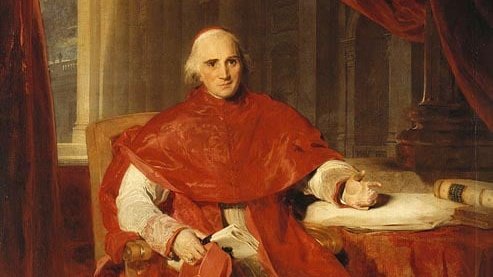
During a two-day conference in Rome, with interventions from, among others, Cardinal Parolin and Archbishop Gallagher, a conference dedicated to Cardinal Ercole Consalvi concluded on January 23 at the Vatican Museums, marking the bicentenary of his death. Consalvi, who remained a deacon throughout his life, served as Secretary of State for two terms: from 1800 to 1806 and from 1814 to 1823, alongside Pope Pius VII.
His successor, Cardinal Pietro Parolin, the current Secretary of State, remembered Consalvi’s figure. Parolin noted, “Consalvi repositioned the Holy See within international dynamics through his work at the Congress of Vienna in 1814-15, to the point of seeing the papacy as an active participant in the era of multilateral diplomacy, international congresses, and restoration, and he relaunched with determination and creativity the era of concordats, even reaching to sign texts for the first time with non-Catholic powers.”
Parolin added, “In an era where the principle of legitimacy crossed political reflections and international reordering criteria, Consalvi knew how to express and embody the political theology of the time, following the Pauline setting according to which all power comes from above, not worrying anymore about legitimacy in a dynastic or right key but with extreme realism entering into dialogues with those who actually held power.”
“The cardinal’s realistic policy,” Parolin continued, “has been defined by historiography with the same name of the cardinal; it’s called consalvismo, meaning that diplomatic attitude according to which there is a primacy of reality over ideal expectations. Historically, for Consalvi, it meant the capacity to accept the world emerged from the French Revolution for what it is, and not a vain and ahistorical effort to erase that world in all possible ways. It’s about adaptability while having clear the limits of one’s work, which in the Cardinal Secretary of State were dictated by the essential doctrinal needs.”
Parolin observed, “Consalvi himself recognized the limits of the international work of the Holy See and somehow of Catholicism itself when in 1820, writing to the Nuncio in Madrid, Monsignor Giacomo Giustiniani, he stated that the problem we must solve is not to avoid every kind of evil but to find a way to suffer as little as possible. It wasn’t a viaticum for pontifical diplomacy, but a prosaic realism, aware of the ideals and the means available to achieve them. And in this line, there are other Secretaries of State ranging from Mariano Rampolla del Tindaro to Pietro Gasparri, from Eugenio Pacelli to Agostino Casaroli: it’s the school of realpolitik that ultimately seeks in practice all possible solutions for the survival of local Catholicisms and in case for their development. It’s a diplomacy that wants to give reason for hope, that defends and promotes the requirements of the Gospel and that knows how to adapt intelligently to the times recognizing their peculiarities, giving contingent answers to contingent questions.”
Among other interventions at the two-day conference was also that of Archbishop Paul Richard Gallagher, Secretary for Relations with States and International Organizations.
“We are remembering a person who was able to face turbulent times with a spirit of faith and great fidelity to his Pope Pius VII and despite the intervals of their contacts, all the adventures of their life, Consalvi,” Gallagher emphasized, “knew how to interpret the thought of Pius VII. We have seen a man who was able to decide, a man with great moral authority, a man who was also able to make many sacrifices: let’s seriously think about what he had to suffer, even for the Pope and the Holy See.”
Gallagher concluded, “Think about the times of Consalvi and Pope Chiaramonti, truly very difficult times, and so I believe that for me personally, for my colleagues in the State Secretariat, Consalvi’s example is also a source of encouragement. I hope that this conference is not a single initiative but that it is perhaps part of a series of interventions to examine the history of diplomacy. Consalvi was certainly a man of principle who also knew not to yield on certain things, and this aspect is also an inspiration for us. He had this ability to work day and night.”
According to Professor Roberto Regoli, “it must be said that Consalvi himself contributed to creating the myth of himself, making himself pass as a moderate and reasonable negotiator when he tended to exaggerate the differences with the other members of the Curia in order to encourage his interlocutors – namely the ambassadors – to yield to his requests by presenting the other curial members with even more radical requests: it’s a way of playing with balance.”
Consalvi, finally observed by Professor Bernard Ardura, President Emeritus of the Pontifical Committee of Historical Sciences, “is an extraordinary man who lived two-thirds of his earthly life in the 1700s. He made the choice to be a cleric and had also received minor orders but in the Papal States all administration, all government was in the hands of clerics: not priests but clerics, and so he made this choice. He had his idea of what he would do in life: he would work precisely in the structures of the Papal States.”