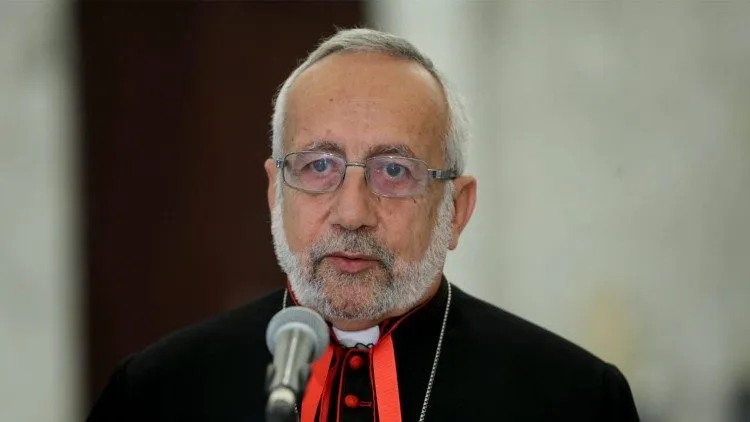
Lebanon remains an emblematic message to the world, despite the turmoil of recent years which stripped it of much, including its political credibility. It continues to showcase the peaceful coexistence of Christians, Muslims, and Jews, integral to its vibrant social fabric. Raphael Bedros XXI Minassian, the Catholicos-Patriarch of Cilicia of the Armenians and Eparch of Beirut, views Lebanon with an unwavering hope in the face of adversity.
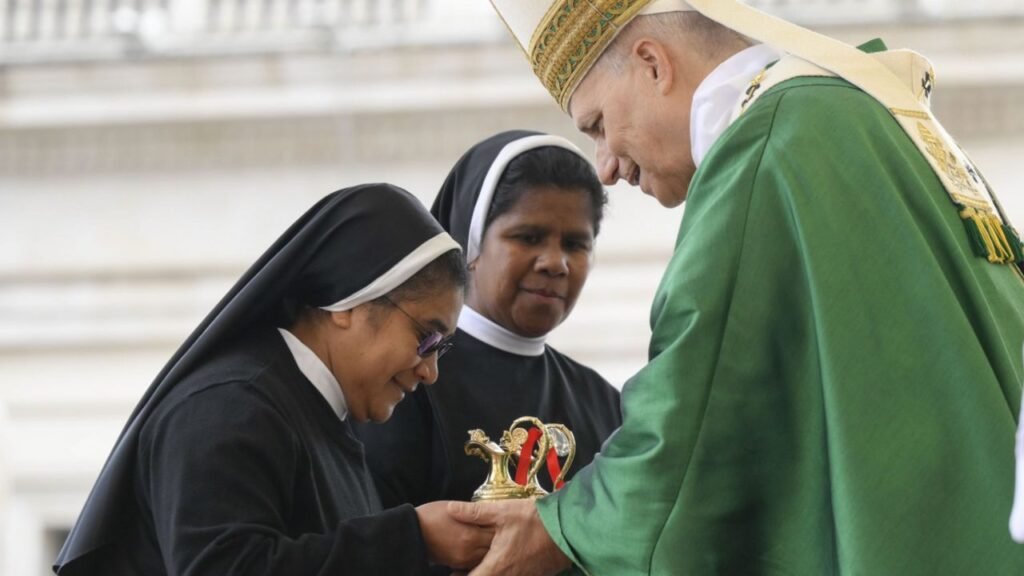
During the Synod, the Eastern Church patriarchs held two pivotal discussions concerning Lebanon: one with Archbishop Paul Richard Gallagher, regarded as the Vatican’s ‘Foreign Minister,’ and another with Pope Francis himself. Patriarch Minassian shares that during these discussions, Pope Francis took a personal interest in the situation in Armenia, particularly the plight of refugees from Nagorno-Karabakh. “He could have remained indifferent, but instead, he chose to engage,” Minassian observes.
In dialogue with ACI Stampa, Minassian’s commentary focused on the Middle East’s turmoil, highlighting the repercussions of the conflict between Israel and Hamas in Lebanon.
Minassian articulated a profound truth: “Wars are but a manifestation of weakness within the human heart. When dialogue prevails, we can address and resolve social, national, and international issues. The true measure of human intellect is found in dialogue, whereas war represents the very negation of our humanity.”
For the patriarch, wars signify a deficiency in human character, not a demonstration of strength, capability, or intelligence.
The exchange with Archbishop Gallagher, set against the backdrop of the Synod, was defined by Minassian as “an encounter rooted in ecclesiastical and pastoral concerns, distinct from the realms of politics and diplomacy.”
The discussions addressed regional predicaments and the varied experiences of the Eastern Churches.
“We addressed a particular set of circumstances, where harmonious functioning is imperative. The equilibrium and dialogue between the Western and Eastern Churches are essential,” Minassian emphasized.
Minassian posits that Lebanon necessitates introspection and a collective reevaluation of moral and social principles to understand our place, identity, and community.
Cardinal Bechara Rai, Patriarch of the Maronites, has been vocally advocating for Lebanon, urging for authentic political engagement and the adoption of “active neutrality” to facilitate the nation’s prosperity. Patriarch Minassian affirms, “His words echo the sentiments of us all, as he presides over the patriarchal synod of the eastern church.” Nonetheless, viewpoints are diverse.
The predominant concern extends beyond Lebanon to encompass the broader Middle East. Minassian underscores a critical perspective: “Ultimately, I believe those advocating for a new world order and paving new paths fail to recognize that there is but one sovereign of this earth: God. He alone owns this world. We are at liberty to accept or reject Him, but He reigns supreme.”
According to the patriarch, Churches hold a pivotal role. He asserts, “Political powers must learn to honor the sanctity of their territories, and this is the domain where we make our stand. Conversely, politicians often lack a religious compass, reducing religion to a mere proxy for interest.”
The Eastern bishops’ engagement with Pope Francis was notable, during which the Pope conveyed his concern for the Armenian people, particularly in the wake of the Nagorno-Karabakh crisis. “The Pope’s empathy for the suffering Armenians left a lasting impression on me,” Minassian recalls. “He represents the Church in its entirety, encompassing all rites, yet maintains a focus on the welfare of each nation and its people.”
Speculation about a potential papal visit to Lebanon surfaced last year. Minassian sheds light on the current prospects: “The Pope’s concern primarily lies with the war-torn context we find ourselves in, and he has encouraged us to remain steadfast in our homeland.”
Lebanon stands as a testament to resilience, for “even amid destruction, the social fabric endures, dialogue persists,” Minassian affirms. He adds, “While the affluent may have departed, society is not composed solely of the wealthy; it is sustained by the presence of the less fortunate.”
Minassian also reflects on a Synod proposal for a Council of Patriarchs of the Eastern Churches. He elaborates, “This initiative arises from the understanding that while the Pope leads the Roman Catholic Church, not all follow the Latin rite; in the Eastern Church, we are nations dispersed across the diaspora.”
“We, the patriarchs, aim to convene with the head of the Church of Rome in a patriarchal Synod. This is not merely a theoretical proposition but one that requires practical methodology,” Minassian states. Such a council could facilitate the synodal process, for, in the view of the Eastern Churches, the Vatican’s gathering “is not a synod but a synodal assembly—a step towards a truly synodal Church.”