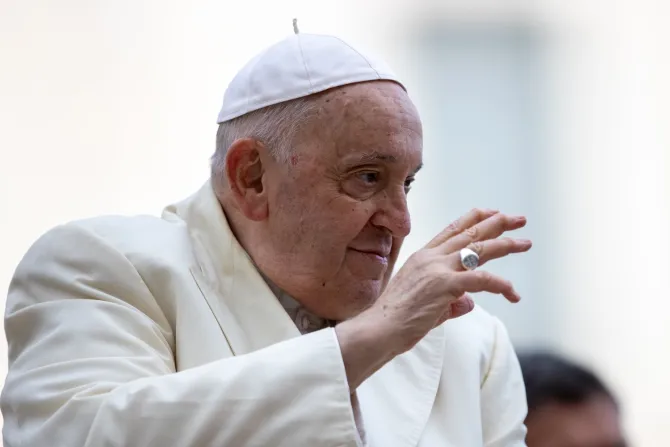
This Thursday, November 23, Pope Francis met with members of the Italian Federation of Catholic Weeklies and the Union of Italian Periodical Press, providing them with three key tips for effective communication: education, protection, and testimony.
At the start of his address, the Holy Father explained that communication is about “bringing people closer, weaving threads of communion, and building bridges without erecting walls.”
In light of recent technological advancements affecting the sector, the Pontiff urged communicators to renew their commitment to “promoting human dignity, justice, truth, legality, and educational co-responsibility.”
To achieve this, the Holy Father suggested 3 “paths to follow.”
Educating Citizens
Pope Francis noted that education is not an easy task and is a “vital issue” because “the future of society is at stake.” He believes that educating the youth is crucial today and hence invited the federation to communicate with “prudence and simplicity,” which he described as “basic educational ingredients to navigate today’s complexity, especially online, where it’s necessary not to be naive —not to be credulous— and at the same time, not to yield to the temptation of sowing anger and hatred.”
“Catholic weeklies bring this wise vision into homes: they do not limit themselves to just delivering the news of the moment, which is quickly consumed, but they transmit a human, Christian vision aimed at shaping minds and hearts, so that they are not distorted by shouted words or by reports that, with morbid curiosity, move from dark to pink, neglecting the clarity of white.”
In this context, Pope Francis encouraged them to promote “an ecology of communication” and emphasized that Catholic communicators have “the vocation to remind us, in a simple and understandable style, that beyond the news and scoops, there are always feelings, stories, flesh-and-blood people who must be respected as if they were your own family.”
“Communicating is educating the person. Communicating is forming society. Do not abandon the path of education: it will take you far!” advised the Holy Father.
Protecting Dignity
As a second “path” to follow, Pope Francis proposed protection, especially against digital intrusion and the “seductions of provocative and polemical communication.” He affirmed that in the digital world we live in, it is fundamental “to promote tools that protect everyone, especially the most vulnerable, minors, the elderly, and people with disabilities.”
“Your realities, committed to this sector, can grow a protected media citizenship, can support informational freedom groups, and promote civic consciousness, so that rights and duties are also recognized in this area.”
He also encouraged them to do so “without fear” and to think “big,” because “you are called to a great task: to protect, with words and images, the dignity of people, especially the dignity of the small and the poor, God’s favorites.”
Bearing Witness
Finally, the Pontiff cited the example of Blessed Carlo Acutis, who understood well “that these communication mechanisms, advertising, and social networks can be used to turn us into numbed subjects, addicted to consumption and to the novelties we can buy, obsessed with leisure, closed off in negativity.” However, “he knew how to use new communication techniques to transmit the Gospel, to communicate values and beauty.” The Holy Father pointed out that “that young man did not fall into the trap but became a witness of communication.” “Testimony is prophecy, it is creativity, which frees and propels us to roll up our sleeves, to step out of our comfort zone to take risks.” He reiterated that “faithfulness to the Gospel postulates the ability to risk for good,” which means “going against the current: talking about fraternity in an individualistic world; about peace in a world at war; about concern for the poor in an intolerant and indifferent world.” But this, concluded Pope Francis, “can only be done with credibility if one first bears witness to what is spoken.”