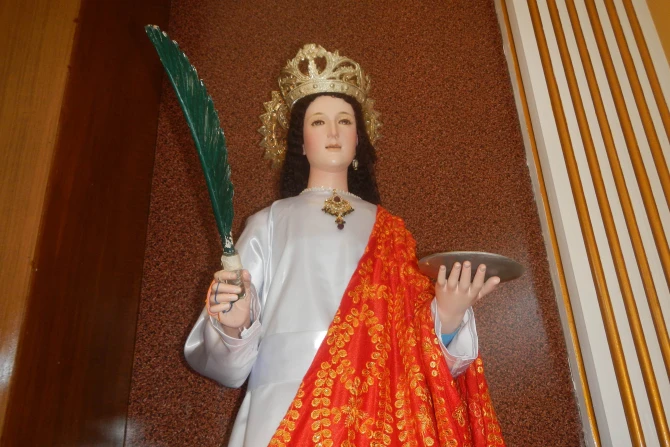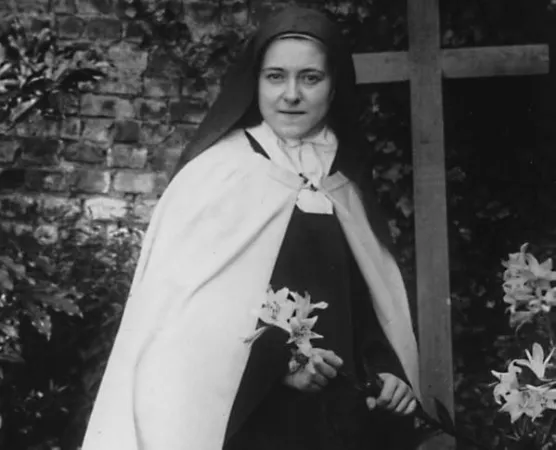
Saint Thérèse of the Child Jesus and the Holy Face proclaimed co-patroness of the missions along with St. Francis Xavier by Pope Pius XI, spent a significant portion of her short and fragile life (she died at the age of 24 from tuberculosis) within the walls of a monastery. But before she began her period of seclusion, the saint from Lisieux, whose liturgical memorial was celebrated on Sunday, October 1, had the opportunity to draw inspiration from the apostolic and martyrdom memories of the Church of Rome, a city she had visited.
Among the numerous pilgrimages organized to pay homage to Pope Leo XIII, there was one promoted by the French Diocese of Coutances. Thérèse Martin, accompanied by her father, Louis, and her sister, Céline, participated in this pilgrimage.
Therese departed for Rome with a specific plan in mind: if she had the chance, she wanted to speak with the pope and ask him directly for permission to become a Carmelite at the age of fifteen. Her diary, “Story of a Soul,” contains an account of her trip to Italy, and it is best known for the pages in which Teresa describes her meeting and conversation with the pope.
However, the most evocative details in the saint’s account are those that describe her pilgrimage to the Christian memorials scattered throughout Rome. She wrote, “Ah, what a journey! It taught me more than the long years of study… I saw beautiful things, contemplated the wonders of art and religion, but most of all, I walked on the very ground of the apostles, a land soaked with the blood of the martyrs, and my soul expanded in contact with holy things.”
This is a passage from a meeting on the last Saturday of September at the Convent of the Discalced Carmelites in Tolentino with Father Massimo Giustozzo, prior to the Sanctuary of Saint Rita da Cascia in Milan. He described the last hours of Thérèse of Lisieux’s life: “Then, at about seven minutes to seven, as she looked at the crucifix, her last words: ‘Oh… I love you!… My God… I love you!’
As soon as she had uttered these words, Thérèse gently fell back, her head slightly tilted to the right. Mother Maria di Gonzaga quickly summoned the community, who had been momentarily away when the patient’s condition seemed stable. All the sisters witnessed an expression of joy, admiration, and tranquility on the face of the dying nun, strangely restored to her natural color for the duration of the Creed. Her eyes were fixed upward above the Madonna of the Smile statue. Then, serenely, she took her last breath.”
In short, she ‘saw the ‘eyes of Jesus,’ as Father Augustinian Massimo Giustozzo explained when we asked him to explain the meaning: “I used this expression when I read the letters of St. Thérèse, especially in the final moments of her life: she does not see them physically, but she sees Jesus within her. She speaks confidently in a moment of great anguish, such as death. In her final letters, I noticed that she sees what cannot be seen in a way that is proposed to everyone.”
While living in seclusion, how was it possible for her to ‘desire everything’?
“She desired everything because she was aware of her inability to do anything. The experience of weakness marked her from an early age. But her great trust in that immense desire allowed her to overcome all the obstacles that gradually arose.”
Could it be said that her spirituality was a response intended to counter Jansenist spirituality?
“It was a response in the sense that she changed her focus, placing not so much the effort of man at the center but rather the mercy of God, who humbles Himself to reach the smallest creature (a ‘nullity,’ as she called herself). She ‘violated’ the love of God, asking Him to do even more, bowing down to such a small creature.”
So, what was her spirituality?
“It is the spirituality of God’s mercy, which places divine condescension and God’s desire at the center, elevating human desire.”
In what way did the love of God consume her?
“It consumed her because it was at the origin of her aspirations. It was not she who desired but rather God Himself, who continually consumed her by giving her His desire for her. She was consumed not because she performed heroic and miraculous deeds but because nothing on Earth could match the figure she had within herself. She was consumed by this desire that God had placed in her heart since she was a child: to love God. This desire consumed her.”