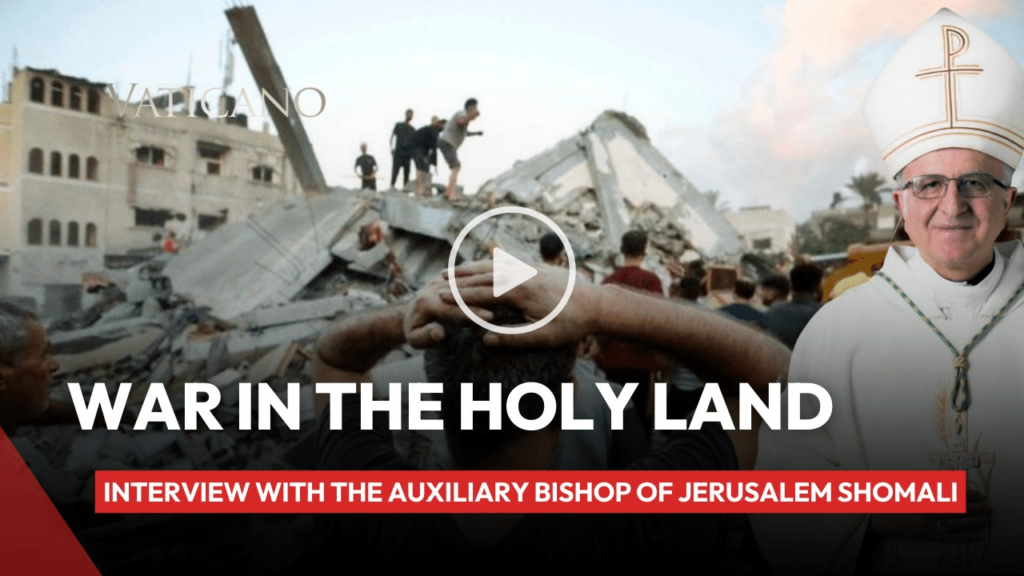
With “tears and apprehension,” Pope Francis said he had followed the developments in the Holy Land and called for peace during his General Audience on October 11. In the same address, the Pope called for peace, “Terrorism and extremism do not help to achieve a solution to the conflict between Israelis and Palestinians, but rather fuel hatred, violence, revenge, and only bring suffering to both sides. The Middle East does not need war but peace, a peace built on justice, dialogue, and the courage of fraternity.” Briefly after the Holy Father’s appeal, EWTN Vatican Bureau Chief Andreas Thonhauser spoke with the Auxiliary Bishop of Jerusalem, His Excellency William Hanna Shomali, about the present situation on the ground and what might come in Jerusalem.
Your Excellency, you are the auxiliary Bishop of Jerusalem, where you are also based. Could you describe to us the situation there right now?
You know that the war started on Saturday with an attack from Hamas to the south of Israel, killing and slaughtering. Now Israel is retaliating, shelling some quarters of Gaza. There is a lot of fear, worries, and panic in Gaza. In the West Bank, which is closed now, there is no communication between the West Bank, Israel, and Jerusalem. There are many worries about what will happen.
Jerusalem is a little further away from the Gaza Strip, where most of the atrocities and the invasion happened, but in the city of Jerusalem, are people afraid?
Sure, and they are in expectation of what may happen in the future. Yes, we are anxious.
During the terror reign of ISIS, we’ve seen an unparalleled exodus of Christians from Iraq from the whole region. Do you fear the same now, also for the Holy Land, that soon hardly any Christians will be left?
Now, they cannot leave. The airport is closed for them, and the bridges from Palestine to Jordan are closed currently. No one can escape. Even there are 500 checkpoints in the West Bank. No Palestinian can leave the West Bank. But in the future, if the economic and political situations remain as fragile and vulnerable as it is now, I’m sure that more people will seek refuge elsewhere.
What can the international community or what can the Church do to help bring peace?
Our bishops in the Holy Land asked people on October 20 to have a day of abstinence and fasting and prayer for peace and reconciliation in the Holy Land because we believe that prayer is more efficient than anything else. So we will have this day, but on the international level, we expect the Security Council to ask for a truce to hold (stop) the violence between Israel and the Palestinians.
In his general audience, Pope Francis today (Sunday) also asked the faithful to pray for peace in the Holy Land. How likely is it that there will be peace soon?
Soon, I don’t believe it. But we pray that a truce occurs, a stop hold of violence, of attacks. After that, when there is this hold and a more peaceful situation, both sides can negotiate for the two-state solution and solve the issue of Jerusalem and the holy places.
Excellency, thank you for your time in this very difficult situation. Please be assured of our prayers. Thank you.
Adapted by Jacob Stein