The next stage of the Vatican’s Synod on Synodality opened Wednesday with a call to focus on authority, decentralization, the co-responsibility of the laity, and concrete changes to the institutional Church.
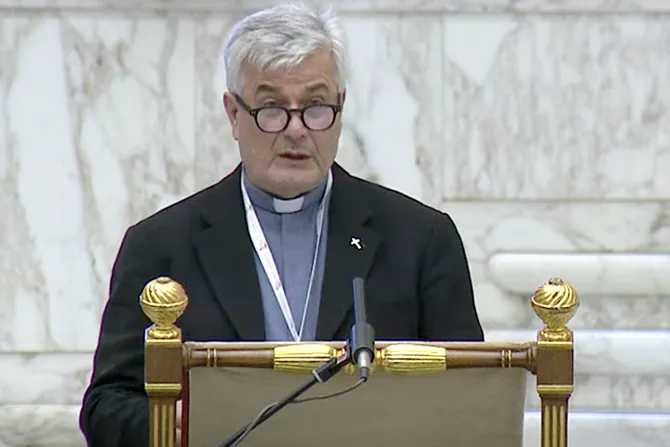
Before beginning discussions Oct. 18, delegates were presented with a sweeping vision for the hierarchical Church in a theological exposition from Father Dario Vitali.
“When we reach the consensus that the Church is constitutively synodal, we will have to rethink the whole Church, all the institutions, the whole life of the Church in a synodal sense,” the Italian theologian said.
Father Timothy Radcliffe, OP, also spoke about “new processes, institutions, and structures,” and Cardinal Jean-Claude Hollerich asked what concrete changes the synod assembly can bring about for lay Catholics.
“Big media” will evaluate the synod based on possible changes “on a very limited number of subjects,” Hollerich told synod delegates as he introduced the next topic for discussion: “Participation, governance, and authority.”
Instead, people in parishes and on pastoral councils, the relator general said Oct. 18, “are wondering what will change for them, how they will be able to concretely experience in their lives that missionary discipleship and co-responsibility on which we have reflected in our work.”
Delegates to the Oct. 4–29 assembly of the Synod on Synodality began discussing the last part of the Instrumentum Laboris, or working document, on Wednesday afternoon.
Section B3 of the document says one of the priorities addressed during the continental stage of the synod was “the question of authority, its meaning, and the style of its exercise within a synodal Church.”
It also asks: “How can we imbue our structures and institutions with the dynamism of the missionary synodal Church?”
‘Rethink ecclesial institutions’
Vitali, coordinator of expert theologians at the synod, told the assembly Wednesday that “the possibility of developing a style and a synodal form of Church depends on the virtuous circularity of ‘sensus fidei’ [sense of the faith], magisterium, and theology.”
“Having broken this alliance has left the Church to navigate by sight,” he said, while “a true exercise of synodality will allow us to think with patience and prudence about the necessary institutional reforms and decision-making processes that involve everyone in an exercise of authority that is truly suitable for the growth of the people of God, a mature and participating people in this horizon.”
Lay Catholics, Hollerich said in his remarks, “are wondering how this is possible in a Church that is still not very synodal, where they feel that their opinion does not count and a few or just one person decides everything.”
People are interested “in the small but sensitive changes to the issues we are preparing to tackle,” he added.
Vitali addressed the topics of authority and decentralization in the Church in light of synodality in a theological reflection for synod delegates.
“The synod process can be understood as the most complete exercise of synodality in the Catholic Church,” he said, and “starting from here we can begin to rethink ecclesial institutions.”
“But rather than listing individual reforms, criteria must be indicated that can inspire a reform of the Church itself in a synodal sense,” the Italian theologian said.
Synodality, he continued, “does not unilaterally emphasize the role of the people of God or that of the pastors, but of all the subjects — the people of God, the College of Bishops, the bishop of Rome — articulating dynamic unity, synodality, collegiality and primacy.”
In his own address to the assembly, Radcliffe said in its last module the Synod on Synodality will now consider “what new processes, institutions, and structures are needed.”
“These will not be solutions to management problems but fuller expressions of who we are,” he said.
“What institutions do we need to express who we are as men and women of peace in an age of violence, inhabitants of the digital continent?” the priest said. “Every baptized person is a prophet. How do we recognize and embrace the role of prophecy in the Church today? What about the prophetic voice of women, still often seen as ‘guests in their own house’?”
“The history of the Church is of endless institutional creativity,” Radcliffe underlined.
This article was originally published on CNA.