In the quest for extraterrestrial life, the Vatican Observatory leads the scientific exploration beyond our solar system. Father Richard D’Souza, S.J., an expert astronomer, shares insights on studying distant planets, analyzing atmospheres, and searching for signs of life.
“Our work focuses on scientific research to understand the cosmos, its origin, and its destiny, and to answer the question of whether we are alone in the universe,” Father D’Souza, also the head of the Vatican Observatory community, told ACI Prensa.
Is there life beyond Earth? “We investigate the activity of extrasolar planets, meaning planets outside the solar system. While others study planets within our solar system, we look beyond,” explains Father D’Souza, specializing in the study of galaxy formation and evolution.
“Currently, science has reached the point of studying the atmospheres of these distant planets, a very complex observation. We are searching for signs of any type of life in these atmospheres. Science can only take us so far; the rest is pure science fiction,” he added.
“So far, we haven’t found indications pointing to the existence of life. Perhaps we will discover something in the coming years—indirect signs of some form of life,” assured the Vatican’s expert astronomer.
Are we talking about intelligent life? “That’s another matter. We are not talking about intelligent life. So far, there are no signs of intelligent life outside the solar system. We’re talking about very simple life—organisms or plants that can capture oxygen in atmospheres,” Father D’Souza confirms to ACI Prensa.
Visiting the Vatican Observatory
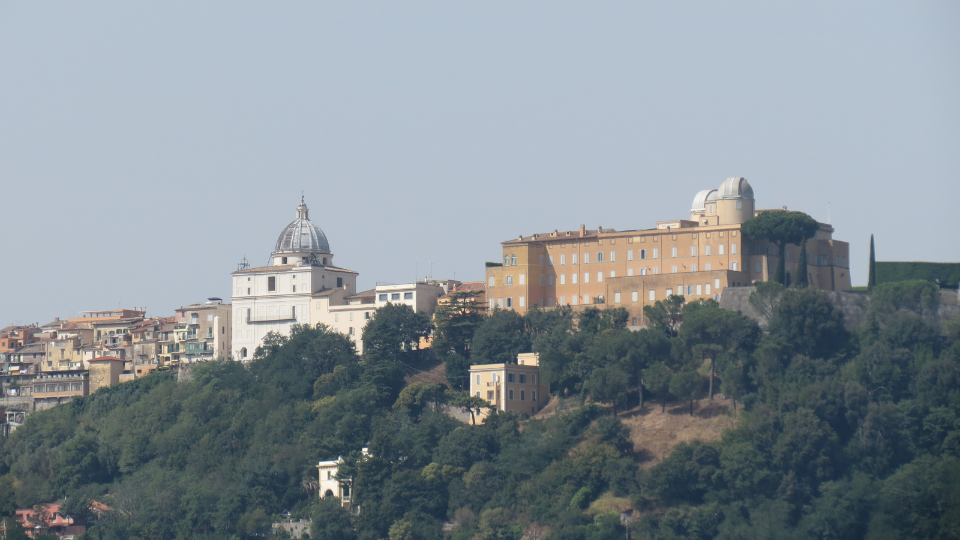
The Vatican Observatory in Castel Gandolfo has reopened to the public with a new registration system for museum visits starting from August.
“It is now possible to book guided tours of the Vatican Observatory through the Vatican Museums’ website. This was possible before, but it was done through email,” says the community’s head. Visitors will encounter a museum built in the domes housing two historic telescopes: one from 1890 and another from 1960.
Guided tours help understand why the Church founded the astronomical observatory and the Popes’ contributions to the development of astronomy in general. The average duration is one hour, according to Father D’Souza.
Enlarged photographs on the walls bear witness to papal visits to the Observatory. A striking image taken on July 20, 1969, shows Pope Paul VI observing the Moon through a telescope hours before the Apollo 11 moon landing. At night, curious visitors can observe stars and planets through two powerful telescopes upon request to the Vatican Museums.
Advanced Technology Vatican Telescope
The Vatican Observatory, also known as Specola Vaticana, is a scientific research institute under the Holy See. It has its roots in the 16th century when Pope Gregory XIII established the Tower of the Winds at the Vatican, collaborating with Jesuit astronomers on calendar reform.
This tradition was strengthened in the 20th century with figures like Jesuit astronomer Father Angelo Secchi. To counter accusations of opposition to scientific progress, Pope Leo XIII officially founded the Observatory in 1891 in Castel Gandolfo.
Facing light pollution in Rome, the Specola moved to Castel Gandolfo in the 1930s and later established a second research center in Tucson, Arizona, in 1981.
The Vatican Observatory collaborates on research regarding cosmological models, variable stars, and other topics with institutions worldwide. Its library houses a rich collection of ancient books and meteorites.
Funded by the Holy See, the Observatory also receives support from the “Vatican Observatory Foundation” for projects such as the advanced technology Vatican Telescope, confirmed Father D’Souza.
The Specola strives to harmonize science, philosophy, and theology, as requested by St. John Paul II, conducting interdisciplinary research on divine action in a scientific context.