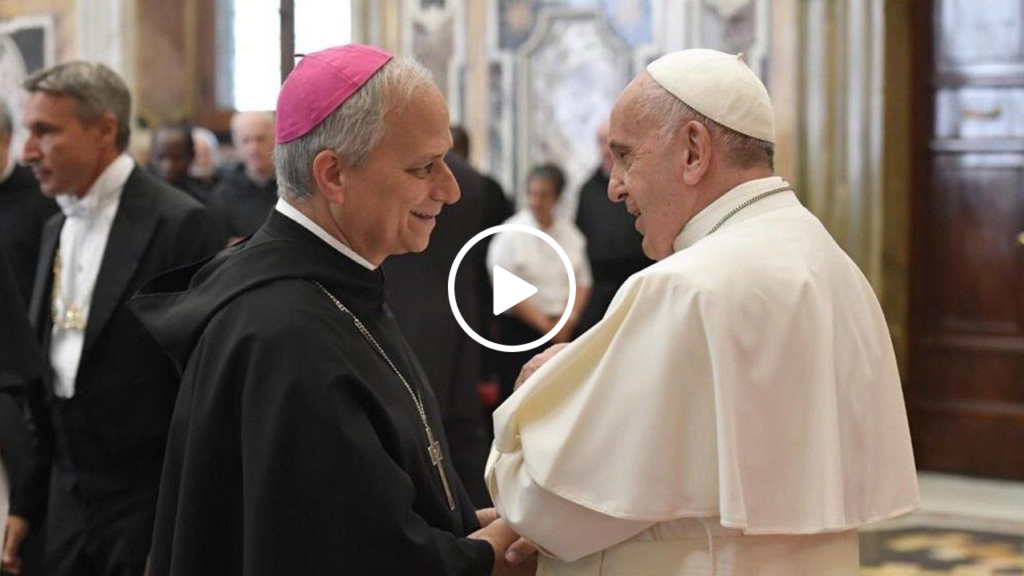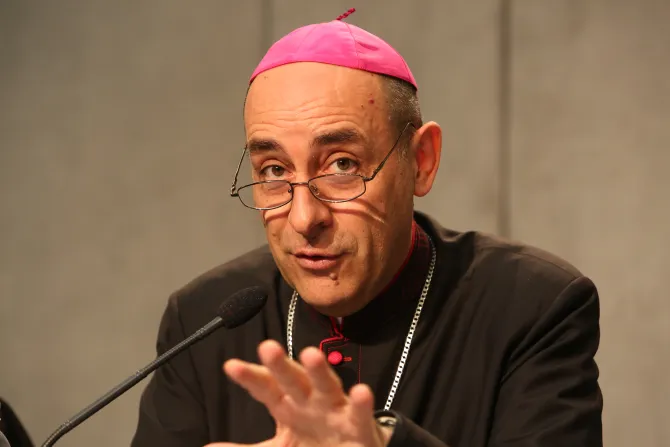
When asked about the controversy surrounding his recent appointment as the Vatican’s doctrinal chief, Archbishop Víctor Manuel Fernández responded: “I will do it ‘my way.’”
In his first interview since being named the new prefect of the Dicastery for the Doctrine of the Faith, Fernández spoke about handling clerical abuse, the German Synodal Way, same-sex blessings, and how he plans to approach his new role.
The archbishop of La Plata, Argentina, said that he had written a letter to the members of the Vatican’s doctrine dicastery explaining how he admired the current prefect Cardinal Luis Ladaria Ferrer, SJ, as a theologian and for his style of work, but “added that I will do it ‘my way’ as the Italian song says.”
“Taking into account the pope’s call to synodality, I will first have to listen a bit before making any decisions, but there are certainly considerations from the letter the pope sent me that we will have to apply in some way,” Fernández said in the interview with the Spanish Catholic website InfoVaticana published on July 5.
InfoVaticana asked Fernández about what he would say to people who are opposed to his appointment for fear that he could carry out a role far removed from what the prefect of the dicastery should be.
Fernández responded: “Does it not seem good to you that for some time in history a Latin American who has been a parish priest of the peripheries, who grew up in a small town in the countryside, with a sensitivity close to the pain of the discarded of society, with a life story very different from that of a European or American, but who at the same time is a doctor in theology, occupies this position?”
“Once again, I tell them that I will learn from history, I will respect the processes, I will dialogue, but I will do it “my way.”
Handling abuse
Fernández said that when Pope Francis first offered him the position of prefect, he turned the pope down. “First of all because I did not consider myself suitable to lead the work in the disciplinary area,” he said. “I am not a canonist, and in fact when I arrived in La Plata I had little idea of how to deal with these issues.”
“It is complex because in principle one has to believe those who present accusations of child abuse, you have to believe them, and on the other hand you cannot condemn the priest without due process, which takes time. And in between come all the claims to which one has to respond by saying as little as possible so as not to interfere. At that time I let myself be guided by the canonists and I was learning, but with enormous suffering for fear of being unjust to one or the other,” he said.
Fernández added that he felt “more confident” once Pope Francis told him that “what he wanted was for the prefect to delegate this task to the Disciplinary Section” and asked the Argentine archbishop to dedicate his personal commitment to theology and the transmission of the faith, as the pope also said in a letter published at the time of his appointment.
BishopAccountability.org, a group that tracks sexual abuse in the Catholic Church, has voiced serious concerns about the pope’s appointment of Fernández due to his “recent handling of a clergy sex abuse case in his home archdiocese of La Plata.”
A spokesperson for Fernández at the Archdiocese of La Plata responded to accusations that he has been soft on sex abusers by firmly denying the allegations.
Germany’s Synodal Way
When asked how he intends to handle the German Synodal Way as DDF chief, Fernández said that it is now time for him to “catch up on the matter, to listen, to talk, to consult.”
“For the time being, I must tell you that I don’t believe that there isn’t something good in this German ‘movement,’” he said.
“Cardinal Ladaria once told me that he wished there were some heretic who would force us to deepen our faith,” he elaborated. “This historical question will leave us with something good, even if it may be necessary to polish things, to clarify them, to mature them.”
Same-sex blessings
In response to a question about whether he agreed with the Dicastery for the Doctrine of Faith’s 2021 declaration that the Church cannot bless same-sex unions, Fernández said that if a blessing can be given in a way “that does not cause confusion,” it will have to “be analyzed.”
“Look, just as I am firmly against abortion … I also understand that ‘marriage’ in the strict sense is only one thing: that stable union of two beings as different as male and female who in that difference are capable of engendering new life,” he said.
“There is nothing that can be compared to that and to use that name to express something else is neither good nor right,” he said. “At the same time, I believe that we must avoid gestures or actions that could express something different. That is why I think that the greatest care to be taken is to avoid rites or blessings that could feed that confusion.”
“Now, if a blessing is given in such a way that it does not cause that confusion, it will have to be analyzed and confirmed,” he added.
“As you will see, there is a point where we leave a properly theological discussion and move on to a question that is rather prudential or disciplinary.”
‘The Art of Kissing’
Fernández said that he did not regret publishing the book he wrote as a priest in the mid-1990s called “Heal Me With Your Mouth: The Art of Kissing.”
“It was not a theology manual, it was a pastoral attempt that I will never regret,” Fernández said, before noting that he had asked the publisher not to reprint it.
The Argentine archbishop said that he wrote the book out of concern for young people who struggled to explain to their peers why premarital sex should be avoided. He added that kissing was “an example of one of those expressions of affection that can occur without the need for sex.”
“Don’t you think it is bad form to take that little book, to use single phrases from that youthful pastoral booklet to judge me as a theologian?” Fernández said.
This article was previously issued on CNA.