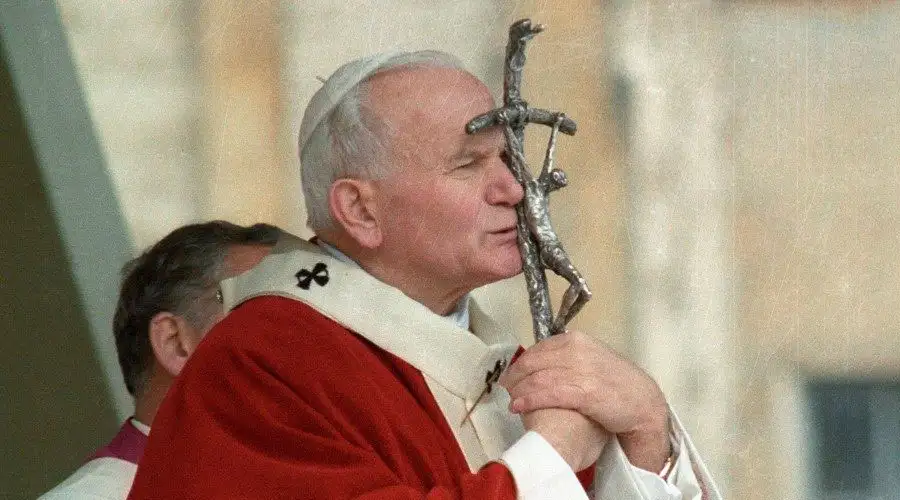
Who was Saint John Paul II? This article presents 10 facts about the life of the ‘pilgrim Pope’, who is remembered as one of the most influential leaders of the 20th century.
1. Saint John Paul II was born in Poland.
He was born in Wadowice on May 18, 1920, in a small town 50 kilometers from Krakow. He was the youngest of three children of Karol Wojtyla and Emilia Kaczorowska. His mother died in 1929. His older brother, Edmund (a doctor), died in 1932, and his father (a non-commissioned officer in the army) in 1941. His sister Olga died before he was born.
2. The patron saint of Karol Wojtyla was St. Charles (Karol) Borromeo.
Although they lived in different times, the two are united by having similar stories, which Saint John Paul II highlighted in a general audience on November 4, 1981. The first similarity is in their shared name. Saint John Paul II’s name “Karol” is “Carlos” in Spanish. They also both survived assassination attempts, participated in councils, and shared a love for the poor and sick.
3. Saint John Paul II set records and achieved important accomplishments.
Pope Saint John Paul II was the first non-Italian Pope since Adrian VI (1522-1523). He made the most apostolic trips of any pope, visiting 129 countries. He was also the first pontiff to visit a synagogue, the White House (United States), and Cuba.
4. The pilgrim Pope was a great diplomat.
During his pontificate, Saint John Paul II increased the number of nations that have diplomatic relations with the Holy See, from 85 countries in 1978 to 174 in 2003. This included the United States (which previously only had delegation status), the European Union, the Sovereign Military Order of Malta, and most of the nations of the former communist bloc. He also established “special nature relationships” with the Russian Federation and the Palestine Liberation Organization.
5. John Paul II created World Youth Day.
His love for young people prompted him to start World Youth Day (WYD) in 1985. In the 19 editions of WYD held during his pontificate, millions of young people from around the world gathered.
His emphasis on the family was also evident through the World Meeting of Families, which he inaugurated in 1994.
6. He had two doctorates.
In 1948, he earned a doctorate in theology from the Pontifical University of St. Thomas Aquinas, with a thesis on the subject of faith in the works of Saint John of the Cross. In 1953, he earned a doctorate in philosophy from the Catholic University of Lublin with a thesis entitled “An Evaluation of the Possibility of Constructing a Catholic Ethics on the Basis of the Ethical System of Max Scheler.”
7. Saint John Paul II survived more than one assassination attempt.
On May 13, 1981, he was shot in St. Peter’s Square by Turkish national Mehmet Ali Agca. On May 12, 1982, in Fatima, Portugal, where the Pope went to thank God for his life after the assassination attempt, a schismatic priest tried to stab him with a knife but was stopped a few meters away. There was also another attempt on his life by Muslim terrorists who tried to blow up the plane the Pope was traveling on during his visit to the Philippines; authorities foiled the elaborate plan.
8. Pope Wojtyla asked for forgiveness on behalf of the Church.
On March 12, 2000, he asked for forgiveness for the human failings committed in the Catholic Church throughout its history, with special reference to discrimination against women, the poor, and ethnic groups. On June 15, 2004, he also asked for forgiveness for the Inquisition, “for the errors committed in the service of truth through the use of methods that had nothing to do with the Gospel.”
9. John Paul II promulgated the Catechism of the Catholic Church.
He promulgated the Universal Catechism of the Catholic Church, promoted by the Special Synod of Bishops in 1985 dedicated to the Second Vatican Council. He also reformed the Code of Canon Law, the Code of Canons of the Eastern Churches, and reorganized the Roman Curia. Among his magisterial documents are 14 encyclicals, 15 apostolic exhortations, 11 apostolic constitutions, and 45 apostolic letters.
10. The beatification of John Paul II was the fastest in modern times.
Saint John Paul II died on April 2, 2005. On April 28 of the same month, Pope Benedict XVI waived the usual five-year waiting period after his death to begin the canonization process. Cardinal Camillo Ruini, the vicar general for the Diocese of Rome, officially opened the cause on June 28, 2005. Benedict XVI beatified him on May 1, 2011, and Pope Francis canonized him, along with John XXIII, on April 27, 2014.