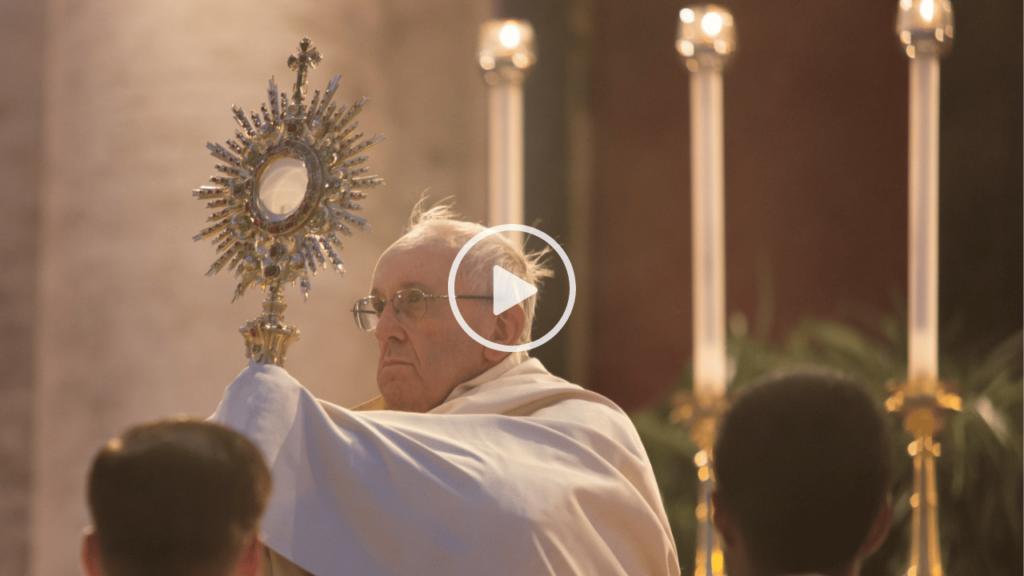
The solemnity of the Corpus Christi was established by Pope Urban IV more than 700 years ago and is celebrated every year by the Church.
In this video, we will delve into the origins of this feast, which began in the 13th century with a German priest who was tormented by his doubts about the real presence of Christ in the Eucharist. He decided to make a pilgrimage to Rome to pray at the tombs of the apostles Peter and Paul, and on his return journey, he wanted to stop in a small town in central Italy called Bolsena.
While celebrating Mass in the church dedicated to Saint Catherine, something extraordinary happened. At the moment of the consecration, while raising the host over the chalice, the priest saw that the particle began to bleed, and the blood began to fall on the corporal and on the other linen cloths on the altar. Frightened, the priest didn’t have the courage to go on and hastily took the host, the chalice, the corporal, and all the other objects that had been stained by the blood and ran to the sacristy, placing everything inside the tabernacle.
It was only later that the priest decided to tell the pontiff who was in the nearby city of Orvieto at the time. Pope Urban IV ordered the bishop of Orvieto to bring him the corporal on which the drops of Christ’s blood had fallen. The bishop obeyed the pope, and together with a crowd of people, he brought the proof of the miracle to the bridge over the Rivo Caro river, where the pope was waiting for him, along with cardinals, clerics, religious, and all the people of Orvieto.
After these events, on August 11th, 1264, Pope Urban IV, with the bull Transiturus, established the Feast of Corpus Christi for all of Christendom, setting the day of its celebration on the Thursday of the octave of Pentecost.
Instituting the feast of Corpus Christi, the pope also wanted to address Saint Juliana of Mont Cornillon, the mystic who had visions connected with the birth of this feast. In the interpretation given by the mystic herself, the moon disc represents the militant church, and the bandage that partly hides it means that a feast is missing. God wants its creation, the Feast of the very august and very sacred sacrament of the altar.
Today, this memory is still preserved in the majestic Duomo of Orvieto, where the corporal of the so-called miracle of Bolsena is exposed on the day of the solemnity of Corpus Christi. The historian Luigi Fumi defined this cathedral as a miracle of art that arose to guard a miracle of faith.