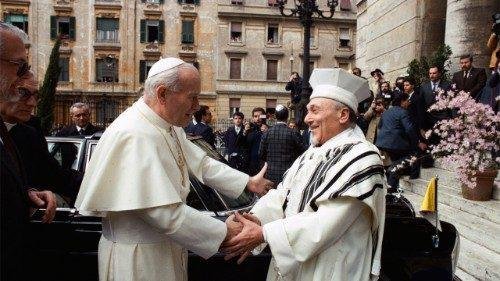
On April 13, 1986, St. John Paul II visited the Synagogue in Rome.
For the first time in history a pope crossed the threshold of the Great Temple, making a gesture that his successors would later repeat.
The Chief Rabbi of Rome, Elio Toaff, welcomed St. John Paul II expressing “lively satisfaction” with the visit, describing it as a “gesture destined to go down in history.”
In his speech, St. John Paul II explained how the Jewish religion was in a way “intrinsic” to the Catholic religion. “We therefore have relations with you that we do not have with any other religion. You are our beloved brothers and in a certain way one could say our elder brothers,” the pope affirmed.
For many Jews, Karol Wojtyla remains the pontiff who did the most to initiate fruitful Jewish-Christian dialogue. He had had many Jewish friends in his Polish youth, and his memory had been forever marked not only by communism but also by the tragedy of World War II and the deportation of Israelites to Nazi concentration camps, especially Auschwitz, which stood on Polish territory.
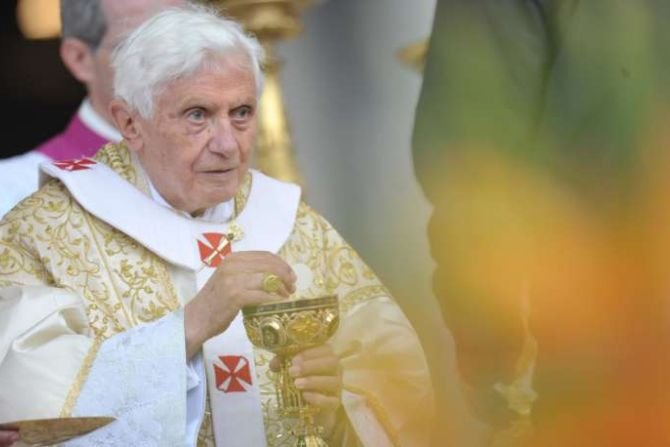
Twenty-four years later, on Jan. 17, 2010, Benedict XVI went to the Synagogue emphasizing the irrevocability of the path of friendship between Jews and Catholics started during the Second Vatican Council. In his speech, Benedict XVI remembered the tragedy of the Shoaw, with hopes that the wounds of anti-Semitism and anti-Judaism could be healed forever, pointing to the recognition of the one God.
In 2016, on exactly the same day as Benedict XVI’s visit, Pope Francis went to the Synagogue and spoke. “Jews and Christians”, the Holy Father said, must “feel that they are brothers, united by the same God and by a rich common spiritual heritage.”
The pontiff’s visit, in a way, concluded a journey of closeness which had begun with the apostolic journey to Israel in 2014, and with the apostolic exhortation Evangelii gaudium which laid out the grammar of fraternal and fruitful dialogue between Jews and Catholics. A dialogue, taking from theology and ethics, that aimed at promoting peace and understanding of people of different faiths. … which is followed to this day.