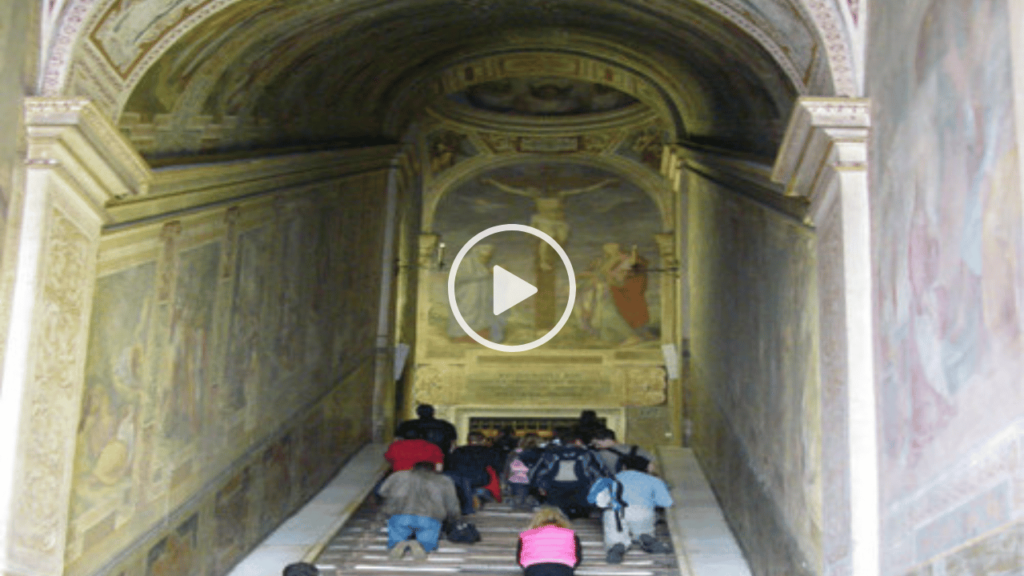
Rome is a city full of religious and cultural treasures that have endured over time, but one of the most important is often overlooked. Tucked away on the right side of the Basilica of St. John Lateran is a building that holds one of the most significant relics in all of Christianity – the Holy Stairs.
Christian tradition holds that Jesus Christ climbed these stairs before his crucifixion, and they led to the praetorium of Pontius Pilate in Jerusalem. For the first time in 300 years, the bare marble stairs have been uncovered a few days before Easter. Now, they are available for pilgrims to climb, uniting their sufferings with the sufferings of Christ.
Passionist fathers are in charge of the Shrine, and they are the first witnesses to the importance of the relic for pilgrims. Padre Salvatore Viola, the Vice Rector of the Holy Stairs Shrine, says, “It is a stairway that I, personally as vice-rector, have also heard the testimonies of people who have had miracles. A couple who couldn’t have children entrusted themselves to the Lord, and now every year, they come from India with their two children and walk down these stairs on their knees with their children in their arms.”
The complex has been undergoing almost 30 years of restoration, and the renewal of the wooden planks over the stairs was the final step. Paolo Violini, the Head of the Restoration team, was the first to witness the original state of the stairs. “It was a surprise for all of us to see the state of conservation of these steps with this central consumption that digs a rather deep groove to the point that some of them are consumed throughout the thickness, but going forward with the rediscovery of the steps, we realized that it is nothing more than the sign of the use of the consumption of the Pilgrims who went up on their knees, and the central groove was caused by the tip of the shoe on the lower step, served to give you the push to climb the next step.”
According to tradition, the stairs were brought to Rome by St. Helena in the 4th century, but there are no historical accounts of the authenticity of the stairs. There is hope the restoration works will shed more light on it. Paolo Violini says, “It is difficult to give certainty in this kind of situation analysis because they made every single step to determine the type of marble and classify the different types, but what experts have already noticed is that these marbles are grouped into several groups. They are not completely homogeneous, but they all come from Greece or Asia Minor.”
The Vatican Museums have been entrusted with the care of the restoration work. Mary Angela Schroth, Coordinator of the Holy Stairs Project, says, “Patrons of the Vatican Museums donated funds to restore the ancient papal chapel of the Sancta Santorum, and in 2000, a project was started to restore all the frescoes and decorations made in the rooms that Sixtus V built between 1588 and 1590, starting with the Chapel of San Silvestro.”
For Natalia Zarkova, a Russian pilgrim, “This staircase is like a way for the spiritual purification, the spiritual purification through the sufferings.” For Alex Estrella, a pilgrim from the USA, “It was a very powerful moment, a big part of history that we get to be a part of again.” And for Gabriel Bentin, another pilgrim from the USA, “Putting yourself in that position is really much putting yourself in someone’s shoes to another level, like going through that experience the same way.”