“Incomprehension was a constant factor in the life and mission of this man,” Cardinal Mario Grech said.
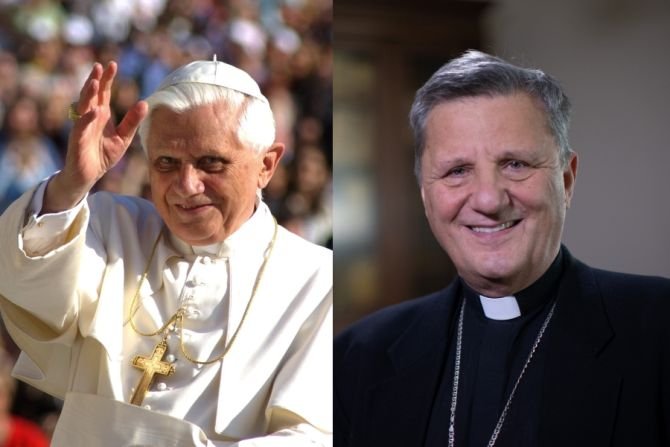
Pope Benedict XVI was misunderstood throughout his life and ministry, Cardinal Mario Grech wrote in an essay this week in the Vatican newspaper.
Writing in the Jan. 17 Italian edition of L’Osservatore Romano, Grech said Benedict XVI “often remained a misunderstood voice. And this has been a constant in Joseph Ratzinger’s life, theology, and papacy.”
Grech is secretary general of the Synod of Bishops and the chief organizer of the Catholic Church’s Synod on Synodality, currently in progress.
The Maltese cardinal compared Joseph Ratzinger — the future Pope Benedict XVI — to the clown in a famous story of the philosopher Kierkegaard: When a clown tried to sound the alarm that a dangerous fire had broken out in the circus and threatened the town if not extinguished, the townspeople did not take the clown seriously but laughed at what they thought were only his attempts to get them to come to the circus.
Grech pointed out that Professor Joseph Ratzinger, as the young theologian was known then, opened his 1968 book “Introduction to Christianity” with this same story, comparing the experience of Christian believers of the day to the experience of the misunderstood clown.
“Although Ratzinger never said so explicitly, I glimpse an identification, or at least a similarity, indeed, between the story of the clown and the personal story of the Bavarian theologian pope,” the cardinal said.
Ratzinger and his family were not understood when they resisted Nazi Germany, Grech said. Nor was Ratzinger the theologian understood when, in the period after the Second Vatican Council, he questioned whether certain proposed reforms were for the good of the Church — losing friends and positions along the way.
Grech said Cardinal Ratzinger was misunderstood in Rome, too, where, as prefect of the Congregation for the Doctrine of the Faith, he had a reputation of being rigid and inflexible.
“Ratzinger was not understood even when he resigned [as pope],” the cardinal continued. “His figure and memory are sometimes used and politicized to create an antagonism between Pope Benedict and Pope Francis.”
“These few examples clearly show how incomprehension was a constant factor in the life and mission of this man,” he said.
Ratzinger, therefore, had two choices before him, Grech said: To continue to search for the truth, that is for Jesus Christ himself, with the risk of not being understood by the contemporary world; or to compromise with the truth and no longer be seen as the clown in Kierkegaard’s story.
“For Ratzinger, the answer was obvious. He was never willing to compromise with the truth, to cease searching for the truth, whatever the cost,” Grech underlined.
In his search for the truth, Pope Benedict XVI was not seeking philosophical concepts but Jesus Christ, the Maltese cardinal said.
“It was his love for this God, his encounter with Jesus, that guided his whole life,” Grech said. “In fact, as he used to say, ‘at the beginning of being a Christian there is not an ethical decision or a great idea, but the encounter with an event, with a Person, who gives life a new horizon and thereby the decisive direction’ (Deus caritas est, 1). This Person is Jesus Christ.”
This article was originally published by EWTN News English.