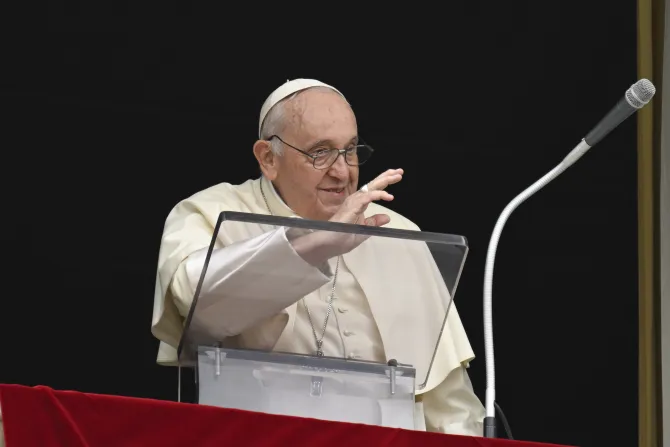
On February 7, the Church celebrates the memory of Blessed Pius IX, a determined Pope who made important proclamations and died “prisoner” in the Vatican for the freedom of the papacy and the Church.
1.- The dogma of the Immaculate Conception
Pope Pius IX proclaimed the dogma of the Immaculate Conception of Mary on December 8, 1854.
For the faithful, the belief that they had held for centuries – that the Virgin was conceived without original sin – was finally confirmed by the Church and became a truth of faith through this dogma.
2. The First Vatican Council and the dogma of the Pope’s infallibility
Pius IX convened the First Vatican Council, which was inaugurated on December 8, 1869, in St. Peter’s Basilica. In this great event, the dogma of the infallibility of the Pope was proclaimed.
This truth of faith indicates that when the Successor of Peter speaks “ex-cathedra,” that is, when he defines a doctrine on faith and morals with all his authority, it becomes a truth that cannot be changed and that Catholics assume as a definitive certainty.
3. Saint Joseph, Patron of the Church
On December 8, 1870, Pope Pius IX issued a decree proclaiming St. Joseph as the Patron Saint of the Catholic Church.
4.- Precious Blood of Christ
It was also Pius IX who, in 1849, instituted the feast of the Most Precious Blood of Our Lord Jesus Christ. At first, the feast was celebrated on the first Sunday of July.
Decades later, St. Pius X moved it to July 1, but with the reforms of the Second Vatican Council, the feast of the Body and Blood of Christ is now celebrated on the Solemnity of Corpus Christi.
5.- “Prisoner in the Vatican.”
When Pius IX assumed the pontificate in 1846, the Papal States were still in existence, located in the center of Italy. At that time, the Italian territory was divided into kingdoms, but political and military interests fought for its “unification.”
The lands under the Pope’s rule created a barrier for this objective, and so a series of revolts began, forcing the Pontiff into exile in Gaeta, south of Rome.
In 1850 he returned to that city, but had lost the Papal States. Those who worked against him proclaimed the Kingdom of Italy in 1861, and Rome became the Italian capital in 1871.
Pius IX declared himself a “prisoner” during this time and died without being able to leave what is now known as Vatican territory. The Popes who succeeded him also considered themselves “imprisoned.”
This territorial and sovereignty problem, called the “Roman Question,” ended with the signing of the Lateran Pacts between the Italian government and the Holy See in 1929. Under these agreements, the Vatican State was recognized as an independent country under the autonomous sovereignty of the Pope.
This story was first published by ACI Prensa, the Spanish-language sister service of EWTN News.