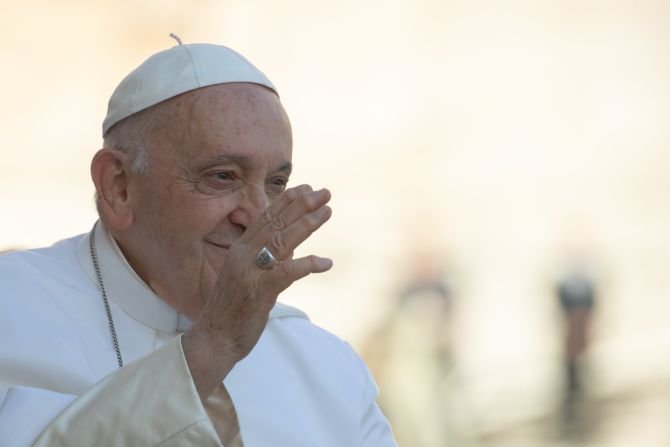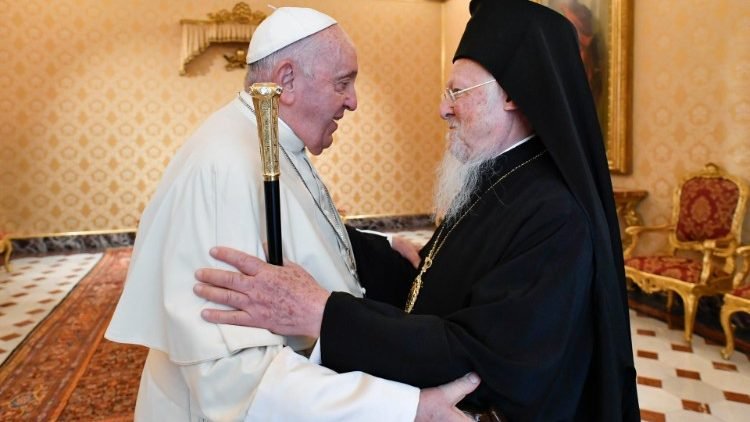
The first thing to do at Christmas is to believe in God’s love for man. This, in summary, is the message at the center of the third and final Advent sermon given today in the Paul VI Hall by Capuchin Cardinal Raniero Cantalamessa, in the presence of Pope Francis. “The traditional act of charity, at least in private and personal recitation,” the cardinal explained in this regard, “should not begin with the words, ‘My God, I love you with all my heart,’ but ‘My God, I believe with all my heart that you love me.'”
The preacher of the Papal Household chose for this year, as is well known, the verse taken from Psalm 24:7 – “Lift up, you gates, your frontals, open, ancient gates, and let the king of glory enter” – meaning “by the gates to be opened those of the theological virtues: faith, hope and charity.” And it is precisely the latter, “the innermost door of the ‘inner castle,'” once opened, that allows “the door of love to be opened to Christ.”
But what does this mean? There are countless treatises on the duty and degrees of God’s love, in other words, on “God to love.” Only one path, however, is the way for the faithful to follow: to accept the Father’s love and to believe in it firmly, since “Christmas is the manifestation — literally, the ‘epiphany’ — of God’s goodness and love for the world.” At first glance it seems easy, the cardinal warned, but in reality “it is among the most difficult things in the world. Man is more inclined to be active than passive, to do rather than to let himself be done. Unconsciously we do not want to be debtors, but creditors; we want, yes, God’s love, but as a reward, rather than as a gift.”
To avoid this, Cantalamessa advised, we need to become children again, who “believe in love, but not on the basis of reasoning.” So much so that “Jesus often recommends becoming like them in order to enter his Kingdom.” To become children: something not easy but something that every believer, as a baptized person, is invited to do, in a kind of “rebirth and a baptism ‘in the Spirit,’ or ‘from above’ (Jn. 3:3), which can be renewed several times throughout life.” Like what the apostles and disciples experienced at Pentecost – the cardinal brought up as an example – and which “we too should desire in order to know to some extent that ‘new Pentecost’ that Pope St. John XXIII asked God for the whole Church in announcing the Council.”
God’s love, the preacher of the Papal Household continued, thus has an objective aspect that we call sanctifying grace, or infused charity; but it also involves “a subjective element, an existential repercussion, as is in the very nature of love.” We must not then forget, he stressed, the edifying aspect of charity, which is “what constitutes the invisible reality of the Church, the societas sanctorum, or communion of saints, as Augustine calls it.” It “is the only one that remains ceased Scripture, faith, hope, charisms, ministries and all the rest.”
Charity, however, not only builds the spiritual society that is the Church, but also civil society, in which what the saintly bishop of Hippo calls amor socialis, that is, “love of the common good,” must prevail. A concept, this one, that requires all Christians to act so that the gap “between a small number of the very rich and the boundless number of the dispossessed of the earth” is reduced.
With the Savior’s birth, the preacher concluded, the Father’s love “has really become a child, we know that it is now a reality, an event, indeed a person.” The most beautiful thing one can do at Christmas, then, is not just to offer something to God “but to welcome with wonder the gift that God the Father gives the world of his own Son.”