The end of a reigning pope’s life is observed by a series of very well-timed and well-understood rites. But what are the protocols when a pope emeritus dies?
The anticipated death of Pope Emeritus Benedict XVI raises important ceremonial questions that at this moment cannot be fully answered.
The end of a reigning pope’s life is observed by a series of very well-timed and well-understood rites: from the certification of the pope’s death and the breaking of the fisherman’s ring to the public display of the pope’s body and the funeral celebration itself.
But what are the protocols when a pope emeritus dies?
The question remains open because of the unprecedented nature of Benedict’s retirement.
He was the first pope to renounce the papacy in nearly 600 years, of course, but he also has lived longer in retirement than any pope in history. Benedict is also the first to take the title Pope Emeritus.
What is clear is that in stepping down as he did in 2013, Benedict’s offices ceased.
In a real sense, then, his papacy “died” with his resignation. To continue the analogy, while they normally happen at the same time, the death of a pontificate is distinct from the death of the man himself. This idea used to be manifested dramatically in the old custom in which the camerlengo would strike the body of the deceased pope three times with a gavel, calling him, not by his name as pope, but by his baptismal name.
The last time this ritual was applied was on the death of John XXIII. Twice, the camerlengo, after striking the hammer, said: “Angele, mortuus est?” (“Angel, are you dead?”) On the third time, there came a final confirmation: “Vere Angele mortuus est,” meaning, “Really, Angelo is dead.”
Indeed, some of the rituals associated with the actual death of a pope already have taken place in Benedict’s case. At the end of Benedict’s pontificate, Cardinal Tarcisio Bertone, Secretary of State and then-Camerlengo of the Holy Roman Church, closed the papal apartment and broke the fisherman’s ring Benedict wore for nearly eight years as the Successor of Peter.
What, then, will happen when Benedict dies?
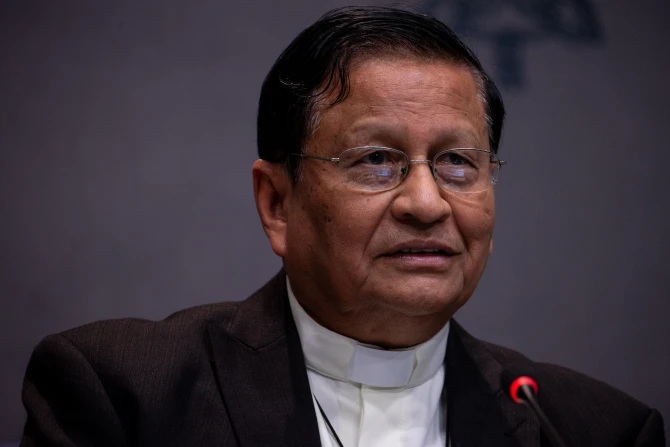
Monsignor Stefano Sanchirico, an official of the Vatican Apostolic Archive and expert in pontifical ceremonial, presented CNA with a series of possibilities while emphasizing that what ultimately takes place in the end depends on various factors — not the least of which is Benedict’s own wishes for his funeral arrangements.
“It is clear that Pope Francis will make the final decision,” the monsignor stressed. However, he added, based on “the tradition of the Roman ceremonial and considering some analogy with similar offices, we can make an educated guess of how things will be handled.”
First of all, Sanchirico explained, the office of the pope emeritus “could be considered in the tradition of the Roman prelature.”
In the various colleges of the prelature, “once the exercise of the authority of the college, such as the judicial and administrative authority, was renounced, the aggregation and privileges were preserved, even though the jurisdiction was no longer exercised,” he said.
And so it would be for the pope emeritus, who “no longer exercises authority, but retains aggregation and privileges,” and therefore also the white cassock, he said.
While no set ceremonial structure exists for the funeral of a pope emeritus, Sanchirico believes the event will “most likely be celebrated with the characteristics reserved for the reigning Pope: the coffin, the insertion in the coffin of the deed indicating the official acts of the papacy, coins for his papacy, and medals of the pontificate.”
In the same way, he said, “the Pope will be buried like a pope, that is, in the Vatican grottoes, and the place where John Paul II’s tomb was would already have been indicated, before he was canonized and the tomb moved to the basilica.”
What will be missing, he pointed out, are “the elements linked to the transfer of papal power, and therefore linked to the beginning of the vacant seat.”
Notably, the Secretariat of State will not relinquish his office, as happens when a reigning pope dies. For this reason, Sanchirico explained, one can expect that it will be the Secretariat of State who announces the death of the pope emeritus, probably using the Press Office of the Holy See, which is the means of official communications.
Relatedly, condolences “should be addressed to the reigning Pope through the Secretariat of State,” the monsignor said.
Why shouldn’t condolences be addressed directly to the pope?
“This public aspect,” Sanchirico explained, “results from the fact that the Secretariat of State is today erroneously conceived as a Papal Secretariat, but it is forgotten that in 1973 it absorbed the duties of the Apostolic Chancellery, a body delegated for centuries to the public correspondence of the dicasteries of the Holy headquarters, such as the bulls of appointment of bishops.”
Other ceremonial details, such as the arrangements for heads of state who wish to attend the funeral, remain an open question, the monsignor acknowledged.
And what of “novendiali,” that is, the nine days of mourning following the death of a pope?
The novendiali consists of a series of solemn Masses for the repose of the pope’s soul, beginning with the pope’s funeral Mass, that precede the General Congregations, or pre-conclave meetings.
Regardless of whether the novendiali is observed in Benedict’s case, his funeral would take place within a few days of his death. As with other ceremonial details surrounding the death of a pope emeritus, we must wait to see what transpires.
This article was originally published by EWTN News English.