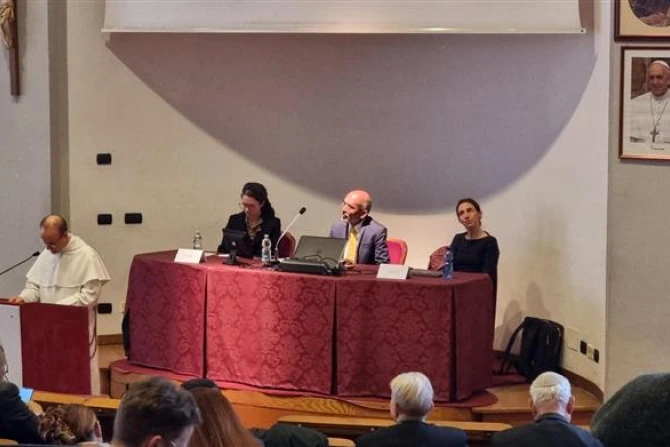
The Vatican in collaboration with the Camille and Sandy Kress Project launched the first in a series of conferences titled “Jews and Catholics on Ethics: A Light to the Nations” this week, highlighting the significance of faith traditions in the world today.
The April 1–2 conference in Rome brought together Catholic and Jewish scholars from around the world to the Pontifical University of St. Thomas Aquinas, also known as the “Angelicum,” to deepen the theological foundations of Jewish-Catholic dialogue as proposed by Pope Paul VI in his 1965 declaration Nostra Aetate.
In a message to conference participants, Cardinal Kurt Koch, president of the Commission for Religious Relations with the Jews, said joint reflection on ethics is more urgent now than in the past as both religions — “which have their common origins in revelation” — face being undermined in societies that “marginalize our moral values.”
“As Pope Francis stated: ‘Jews and Christians share a rich spiritual heritage which allows us to do much together. At a time when the West is exposed to a depersonalizing secularism, it falls to believers to seek out each other and cooperate in making divine love more visible for humanity,’” Koch said in his April 1 message.
Both conference guest speakers — Shira Billet, assistant professor of Jewish thought and ethics at the Jewish Theological Seminary of America, and Judith Wolfe, professor of philosophical theology at the University of St. Andrews in Scotland — said the shared belief that each person is made in the “image of God” provides Catholics and Jews a foundation for common ethics, norms, and values.
“Beloved is the human being who was created in the image of God,” Billet said, commenting on the writings of Rabbi Akiva, a first-century Jewish scholar and martyr. “God loves human beings insofar as human beings are created in the image of God.”
“When God said to Noah and his sons, ‘In the image of God, the human being was created,’ the verse is a prohibition against murder,” Billet added, citing Genesis 9:6.
“God also spoke the moral norm that follows from it, which is, you cannot destroy the image of God in another human being,” she continued.
Describing the love of a trinitarian God that “already defines the divine life in itself; the love between the Father and the Son and the Holy Spirit” that draws human beings to participate in “that divine life of love,” Wolfe said Christians are called to express “the plenitude and generosity of God” toward others.
“The entire ethic propounded in the Sermon on the Mount speaks to this directly … [of] holding the other cheek, of going the extra mile, of giving your tunic,” Wolfe said, commenting on Chapter 5 of St. Matthew’s Gospel.
“All of those actions, in a sense, can only be performed out of a profound conviction that there is enough [and] that we can give all those things away and yet God’s love and plenitude will suffice.”
Having received the command by God to be a “light for the nations,” both Billet and Wolfe said Jews and Christians hold a responsibility to be witnesses of their religious beliefs, particularly in a world in which scarcity, competition, and conflict are dominant forces.
As part of the Vatican’s three-year collaborative project with the Camille and Sandy Kress Project, the Angelicum will host two additional conferences in 2026 and 2027 to foster Jewish-Catholic dialogue on theology, anthropology, and ethics.
This article was originally published on Catholic News Agency.