The pontiff will visit one of the world’s smallest countries on Aug. 22. Here’s what to know about San Marino’s deep Catholic roots.
Pope Leo XIV will make a pastoral visit to the Republic of San Marino on Aug. 22, becoming only the third pontiff to visit the country after Pope Benedict XVI and St. John Paul II.
During his visit, the pope will meet with authorities, lead Eucharistic adoration, and meet the faithful gathered before traveling to the nearby city of Rimini, Italy, for the “Meeting for Friendship Among Peoples.”
Here are 10 things to know about San Marino’s ancient history and deep Catholic heritage.
1. San Marino was founded at a time of Christian persecution.
San Marino is said to have been founded in A.D. 301, roughly 270 years after the death and resurrection of Christ. It was also founded at a time when early Christians in Rome still faced widespread persecution, producing martyrs such as St. Agnes, St. Pancras, and St. Lucy. The Great Persecution under Emperor Diocletian occurred soon after the country’s founding and lasted nearly a decade (A.D. 303-311).
2. San Marino is among the world’s oldest and smallest republics.
The country’s founding in A.D. 301 also makes it the world’s oldest continuing republic. Like Vatican City, it is completely surrounded by Italy and is one of the world’s smallest states by both land area and population.
The land area measures 23.63 square miles, which is 20 times smaller than New York City by land area. Its population is approximately 34,000, about the same as Ithaca, New York.
3. The name San Marino comes from a hermit saint.
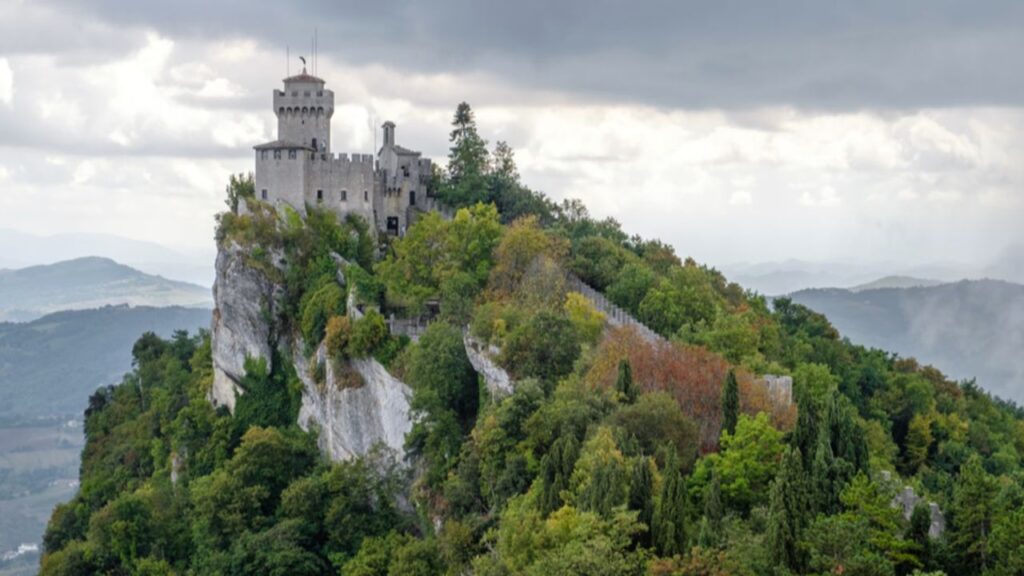
St. Marinus, after whom the country is named, was a third-century deacon who fled the Great Persecution under Diocletian. According to tradition, he settled on Monte Titano, where San Marino now stands, and founded a monastery there.
His reputation for holiness began to spread in his old age, leading many to join his monastery. The owner of Monte Titano also offered him the mountain as a gift. It has remained the highest point of the sovereign state ever since.
4. San Marino has been protected by popes and has never been annexed.
Though landlocked by Italy today and occupied several times throughout its more than 1,000-year history, San Marino has never been annexed by another nation.
By the 17th century, it was even surrounded by the Papal States, the region of Italy ruled by the popes until the Kingdom of Italy permanently absorbed it in 1870. Pope Urban VIII placed San Marino under papal protection through the 1631 treaty while recognizing its full sovereignty.
5. San Marino is governed by two captains who serve for only six months.
San Marino has two heads of state, the captains regent, who are currently Alice Mina and Vladimiro Selva. For nearly 800 years, they have been elected by the country’s 60-member parliament, the Grand and General Council.
The captains regent serve only six-month terms, among the shortest constitutional terms for any political office in the world. They cannot serve a second consecutive term but can return to office after three years.
6. Pope John Paul II and Pope Benedict XVI have been there.
Despite being in Italy, San Marino has only been visited by two popes.
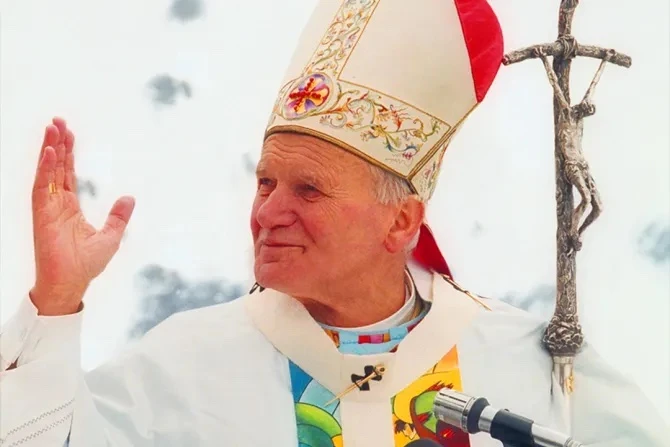
St. John Paul II visited the country on Aug. 29, 1982. During his visit, he met with the only communist head of state in Western Europe, Captain Regent Giuseppe Maiani.
Benedict XVI visited on June 19, 2011, as part of his pastoral visit to the nearby Diocese of San Marino-Montefeltro.
During their visits, both popes venerated the relics of St. Marinus, the country’s patron, at the Basilica of San Marino.
7. The official language of San Marino is Italian.
Italian has remained San Marino’s only official language since the Middle Ages, reflecting its shared history with the Italian peninsula.
The country also has a regional dialect called Sammarinese, a local variant of Romagnol spoken in the nearby Romagna region of Italy.
8. San Marino’s most famous cake represents its three towers.
The country’s cuisine has been heavily influenced by Italy. But one can visit there to try its most famous dessert: the Torta Tre Monti (“the cake of the three mountains”).
The cake is made up of three layers of wafer and chocolate-hazelnut cream, representing the three towers that make up San Marino: the Guaita, the Cesta, and the Montale.
9. Abraham Lincoln was made an honorary citizen of San Marino.
Shortly after becoming U.S. president in 1861, Abraham Lincoln received a letter from the captains regent of San Marino granting him honorary citizenship as the U.S. prepared for the Civil War. Lincoln replied later that year, accepting the honor.
The original letter from the captains regent can still be viewed at the U.S. National Archives in Washington, D.C.
10. San Marino hosts an annual event, which Leo XIV will attend.
On Aug. 22, Pope Leo XIV will become only the third pope in history to visit San Marino. He is scheduled to meet with civil and religious leaders during his visit and to greet the faithful who will gather in the country’s main squares.
At 12:45 p.m. that day, he will travel to the nearby city of Rimini for the “Meeting for Friendship Among Peoples,” an annual international Catholic cultural festival organized by the lay movement Communion and Liberation.
He will then meet the sick and elderly at Rimini Cathedral and celebrate Mass before returning to Rome at 8 p.m.
This article was originally published by EWTN News English.