The Joseph Ratzinger-Benedict XVI Vatican Foundation awarded its annual Ratzinger Prize this week to two Spaniards, the theologian Father Pablo Blanco Sarto and the philosopher Professor Francesc Torralba, the first time the award was held since the passing of the late pontiff last December.
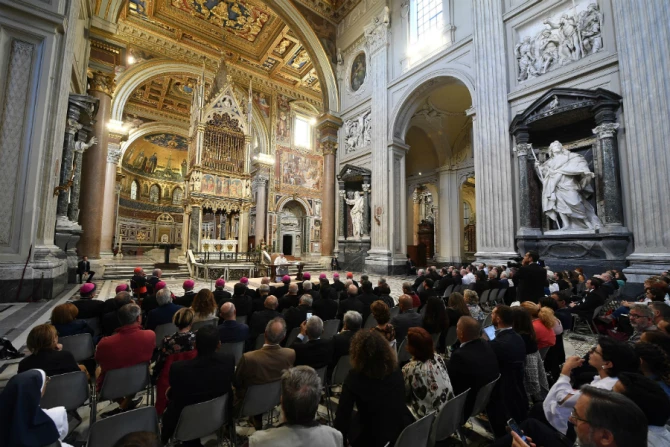
The award ceremony took place in the frescoed state hall of the Sala Regia of the Apostolic Palace on the evening of Nov. 30 and discussed the legacy of Pope Benedict’s rich theological works, focusing specifically on the theme of dialogue between faith and reason, one of the major concerns of his pontificate.
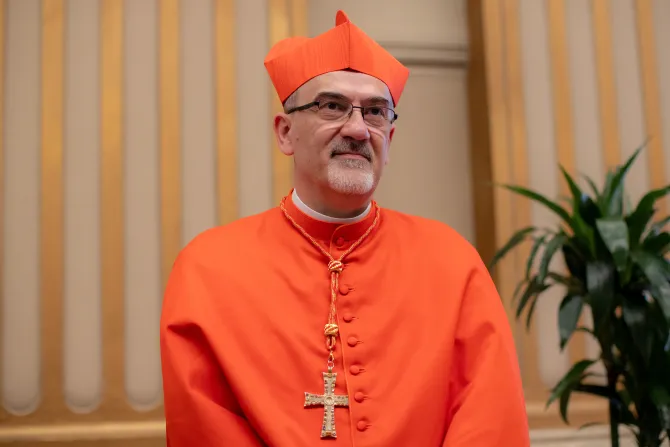
“The legacy of Pope Benedict XVI is alive and will continue to bear important fruits to the path of the Church,” Vatican Secretary of State Cardinal Pietro Parolin said at the event.
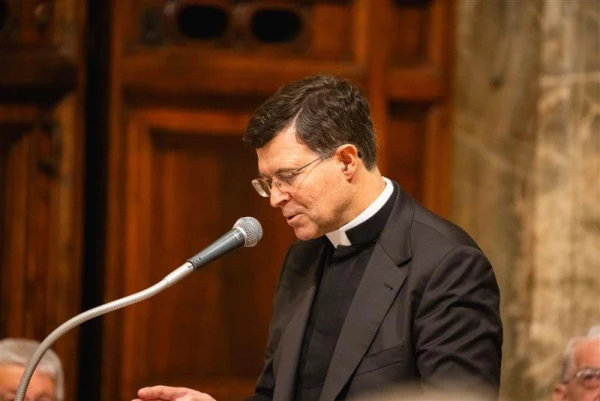
Father Federico Lombardi, president of the Ratzinger Foundation and Vatican spokesman during Benedict’s pontificate, opened the event reflecting on Benedict’s deep contribution to the understating of the relationship between faith and reason.
“Joseph Ratzinger never wanted to build his own system of thought or establish his own school but taught us to seek the truth with the power of reason and the light of faith, always keeping reason ‘open,’ in dialogue between people, disciplines, and the great religious traditions,” Lombardi said.
The pope “was well aware of the possibilities and risks of humanity’s journey, as well as of the Church’s mission for its salvation. He leads us to enter with humility and courage at the deepest level to find and rediscover points of reference and solid and inalienable communities,” Lombardi continued.
The Joseph Ratzinger-Benedict XVI Vatican Foundation, established in 2007, aims at “the promotion of theology in the spirit of Joseph Ratzinger.” There have been a total of 28 recipients of the award — usually two recipients per year — since it was first bestowed in 2011.
The recipients this week were introduced by Cardinals Gianfranco Ravasi and Luis Francisco Ladaria Ferrer, with each reflecting on their work on Benedict’s theology.
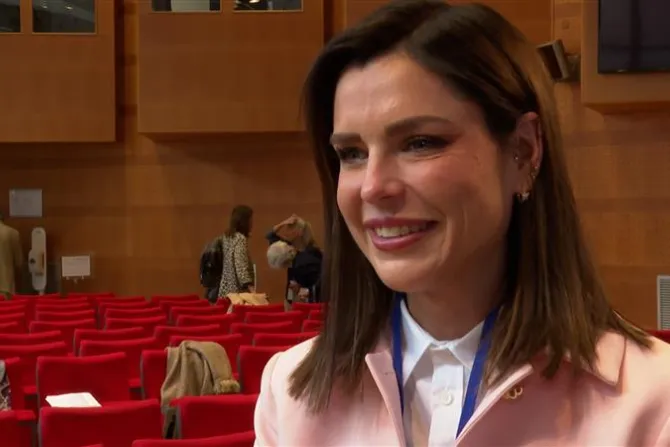
“Ratzinger defined Christianity as the religion of the words but also the religion of ‘agape’ and, therefore, both are key,” Torralba said in an interview with EWTN. “We have to introduce rationality in our public life because it is very marked by emotionalism and sometimes by fanaticism and fundamentalism, but on the other hand, the world needs agape and agape is donation, it is gratuitous love.”
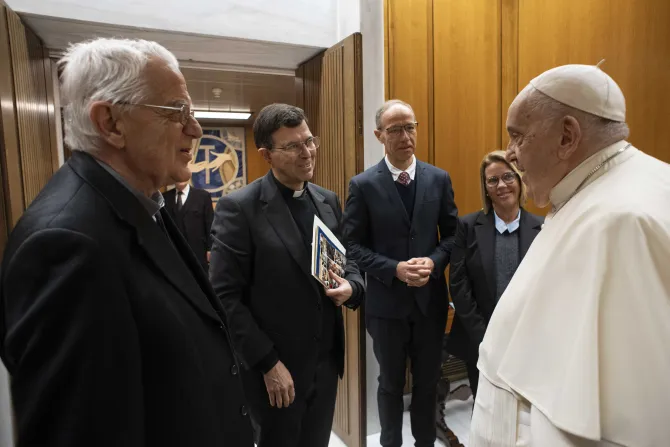
The morning of the award ceremony, the recipients celebrated Mass in the Vatican Grotto, where they then prayed before the tombs of St. Peter and of Pope Benedict XVI. They were then received by Pope Francis in a private audience.
The award ceremony of the Ratzinger Prize was preceded by a conference held at the Pontifical Gregorian University on Nov. 29 titled “Benedict XVI’s Legacy: Unfinished Debates on Faith, Culture, and Politics,” which featured a range of speakers and scholars, both from Italy and the United States.
The event was co-sponsored by the foundation as well as the University of Notre Dame’s De Nicola Center for Ethics and Culture.
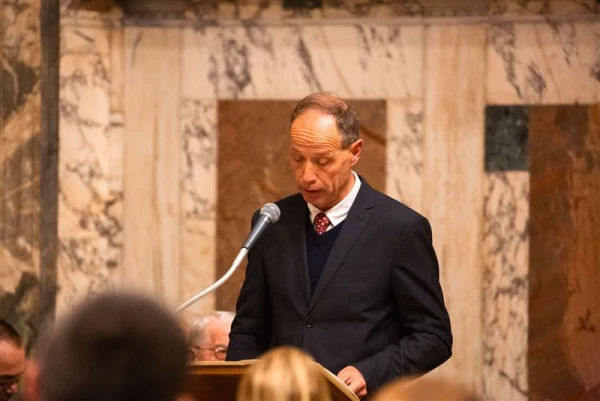
For Father Roberto Regoli, professor of history at the Pontifical Gregorian University, the conference was an opportunity to evaluate the legacy of the late pope on both the present moment and for posterity, with Regoli describing Benedict’s pontificate as one not of “restoration” but rather characterized by ecclesial reforms and “consolidation” and of “dialogue.”
“One of the characteristic elements of Benedict XVI’s pontificate was that of an intellectual opening and a meeting with exponents of other cultural and religious traditions,” Regoli said.
“This attitude allowed for various cultural repositioning by those with whom he established a dialogue,” he said. “This dialogue responded to a frequent preoccupation that ‘a civilization cannot survive without a great religion to sustain and animate it.’ But the pope’s motivation for dialogue is much more profound, because it is primarily a pastoral concern.”
“Benedict XVI’s legacy is thus simple and full of faith; it is the vision of a beautiful Church that is the work of God and not of man,” Regoli continued.
“His heritage is this radical faith in God. It is an aspect of no little importance in a tired and self-destructive era which exalts man but, in the end, it continuously humiliates him. Benedict XVI chose both faith in God and in man. He chose the harmony between faith and reason. This is his heritage.”
This article was originally published on Catholic News Agency.