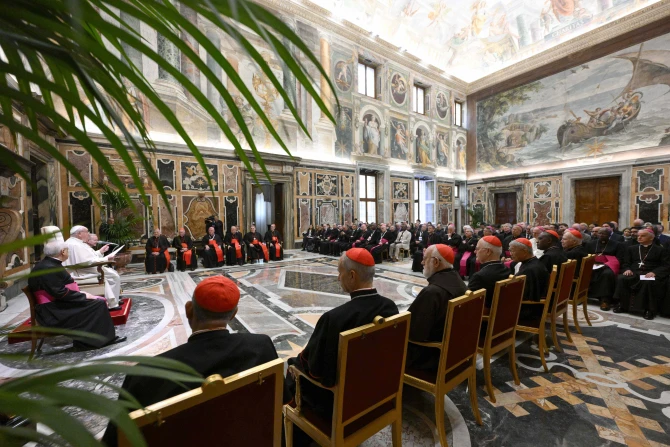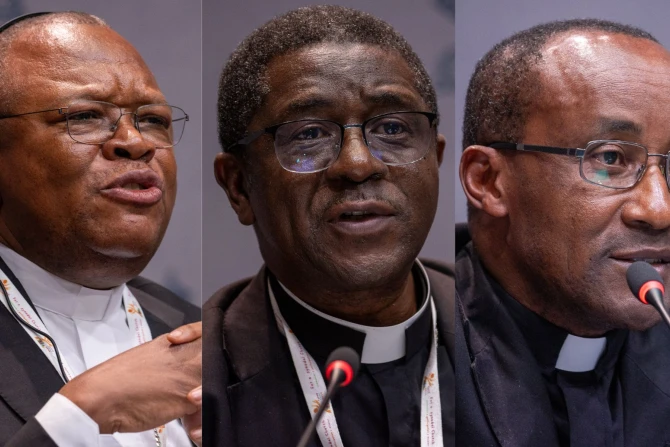
As the Vatican draws closer to the end of the global four-year discernment phase of the Synod on Synodality, high-ranking African delegates participating in this year’s meetings shared their perspectives on the journey of “walking together as the people of God” and its impact on the life of the Church in Africa.
Congolese Cardinal Fridolin Ambongo Besungu, president of the Symposium of Episcopal Conferences of Africa and Madagascar (SECAM) told journalists on Tuesday of his satisfaction with this year’s global synodal talks taking place in the Vatican.
“I must say that I am happy with the synod, which had been convened to develop a new way of being Church and not to solve specific issues which exist in the Church,” Ambongo said during the Oct. 22 press briefing.
But how has the Synod on Synodality actually impacted the Catholic Church in Africa? And, in turn, how has the Church in Africa impacted the global synodal process, when proportionately few Africans are participating in the Oct. 2–27 session at the Vatican?
Small Christian communities: a grassroots Church
Archbishop Andrew Nkea Fuanya from Cameroon told journalists at the press briefing that synodality is an “eschatological sign” in the Church today and stressed the importance of small Christian communities as “a very big treasure for Africa.”
“We are going through a moment of a boom of Catholicism in Africa,” the Cameroonian prelate said. “Synodality comes very alive in the small Christian communities because you don’t live in anonymity as a Catholic.”
Father Don Bosco Onyalla, editor-in-chief of ACI Africa, CNA’s news partner in Africa, told CNA in an interview that the theological concept of synodality “where people come together” is a reality and tradition that is already lived among Catholics across the continent.
“In Africa, the Church has been conceived as a group of families — the small Christian communities,” Onyalla explained. “The structure of the Church in Africa is from grassroots families coming together.”
Onyalla added that “the institution of the family” — which extends beyond the Western concept of the nuclear family — could “be a source of inspiration for other parts of the world.”
Communion, unity, and reconciliation
According to Bishop Edouard Sinayobye of Rwanda, the synodal process launched by Pope Francis for the universal Church in 2021 provides the “biblical and theological foundations” for growing in communion and reconciliation with God and others.
Rwanda is on a journey of healing following the genocide 30 years ago that killed approximately 800,000 people belonging to the minority Tutsi ethnic group.
“For us in Rwanda to talk about fraternity and unity is truly a message which is very well received by people — it helps people walk together and journey together — because after everything that’s happened we are learning to be brothers and sisters,” the bishop told journalists at the Oct. 14 Vatican press briefing.
“We must accompany the victims and the perpetrators — this is something that we do in all parishes and this synod has helped us considerably,” he added. “It was a space in which we were truly capable of deepening the way in which we can address reconciliation.”
Care for the poor and vulnerable
Cardinal Stephen Ameyu Martin Mulla from South Sudan shared his plea for the Catholic Church worldwide to live in solidarity with the world’s poor and vulnerable living in different countries.
Mulla hopes the Synod on Synodality will promote active dialogue and collaboration among Catholics and help promote the social doctrine of the Catholic Church, including the principles of solidarity, the promotion of peace, and the preferential option for the poor.

“Synodality — going together — should be the way for us to resolve our own problems. And I hope that all of us together can resolve these problems,” the cardinal told journalists at an Oct. 18 Vatican press briefing.
“The problems that affect Sudan, or South Sudan, or Colombia, or other parts of Mediterranean countries are our problems,” he added. “We are related — interrelated — and dialogue has to happen. We must feel [compassion] about these situations.”
Aid to the Church in Need International reported that Africa is the priority region for its projects. In 2023, 31.4% of its activities were dedicated to supporting priests and local communities suffering persecution or persistent poverty throughout the continent.
This article was originally published on Catholic News Agency.