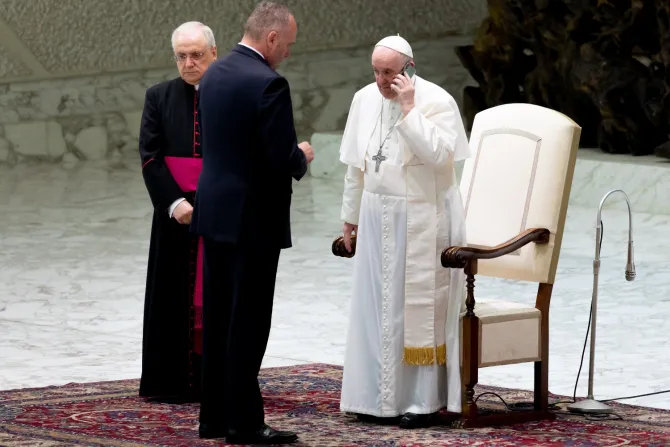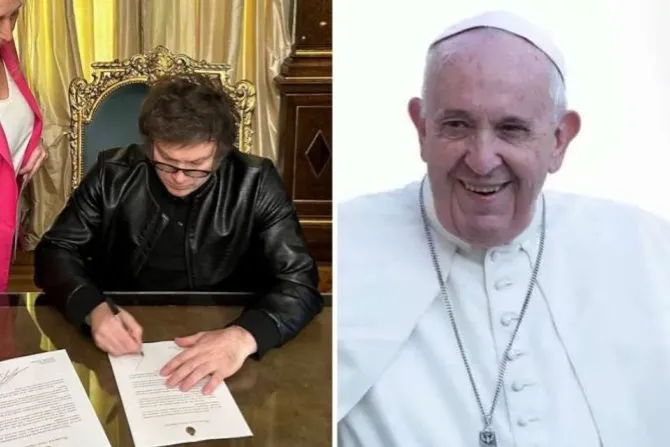
The president of Argentina, Javier Milei, has sent Pope Francis a formal invitation to visit his homeland and anticipated that the trip “will bring fruits of peace and brotherhood to all Argentines.”
After assuring Pope Francis that he “does not need an invitation to come to his beloved Argentina,” Milei extended his call “to visit our beloved homeland, according to the dates and places that will be indicated to us.”
In his Jan. 8 letter, Milei also thanked the Holy Father for his telephone call immediately following Milei’s election as president and emphasized that he values the pope’s “wise counsel” and the wishes for “courage and wisdom” conveyed during the call.
Argentina’s president went on to say the pope’s call strengthened Milei’s “conviction regarding the urgency of transforming the reality our country is experiencing, to ensure peace and prosperity” through necessary social and political reforms.
“Bearing in mind your advice to have the necessary wisdom and courage, in my first weeks of government I have proceeded to propose a series of government measures aimed at transforming the situation that the Argentine Republic has been suffering for decades,” he stated.
Milei said the top priority of his government “is to protect our most vulnerable compatriots” and thanked the Catholic Church for its collaboration, “whose action in the social field is invaluable.”
The Argentine president specified that a visit by Pope Francis to his homeland “will bring fruits of peace and brotherhood to all Argentines, anxious to overcome our divisions and conflicts.”
The pope’s presence and message, Milei said, will contribute to achieving “much-desired unity.” He closed his letter expressing the wish that the pope will be able to make the trip “for the general joy of all the Argentine people.”
Milei’s letter is the second formal invitation that Pope Francis has received from an Argentine president. The first one was made by Cristina Fernández in March 2013.
Since taking office on Dec. 10, Milei has announced major adjustments in public spending, the elimination of the Ministry of Women, and the repeal of the law legalizing abortion.
On Dec. 20, Milei issued a decree of necessity and urgency (DNU, by its Spanish acronym), which contains the “basis for the reconstruction of the Argentine economy” and which has sparked controversy.
Economic reconstruction
A DNU is a tool the president uses in situations that he considers require immediate measures and cannot wait for the regular legislative process. It grants the executive branch the ability to legislate in extraordinary situations without going through the traditional congressional process.
The DNU issued by Milei repeals laws on rentals (in Argentine pesos only with no increases in less than six months), gondolas (retail merchandising requirements supporting small and local suppliers); buying national (the requirement of the government to only buy Argentine products and services), and supply (price controls). In addition, the DNU repeals the Land Law, which placed limits on foreign ownership of rural land.
Ministry for Women and ‘comprehensive sex education’
The DNU established the creation of the Ministry of Human Capital, which absorbed the ministries of Education, Culture, Labor, Social Development, and Women and Gender.
Catholic pro-life activist Lupe Batallán criticized this measure, warning on X Dec. 25 that “Milei did not eliminate the Ministry for Women, he degraded it to a sub-secretariat, where according to the minister herself they have the intention of continuing with all the ministry’s programs.”
During the campaign, Milei had expressed opposition to the mandatory nature of sex education, stating that it “deforms people’s minds.”
However, his decree establishes the promotion and development of environmental and health education as well as comprehensive sex education.
Father Javier Olivera Ravasi pointed out on X Dec. 12: “Wasn’t it that they were going to get rid of [comprehensive sex ed]? They went from saying that it was going to be removed to promoting it by state decree.”
Omnibus Law
Another one of the Milei administration’s measures was to introduce the so-called “Omnibus Law” that is now being debated in Congress.
The law covers areas such as the economy, taxes, the energy sector, health, the electoral system, social issues, education, and security.
This has drawn both support and criticism from various sectors. The General Confederation of Labor (CGT) is organizing a national strike scheduled for Jan. 24 in which different unions have already announced their participation in opposition to the economic measures of Milei’s government.
Concern about ‘dismantling’ of the state
A month into Milei’s term, the Justice and Peace and Social Ministry departments of the Vicariate of Solidarity of the Diocese of Quilmes expressed concern about some decisions of the national government, which they believe “are far from being a contribution to consolidate true justice in the social body and also create a climate of tension and conflict that can threaten peace.”
Among the decisions, they cited the devaluation of the peso, the indiscriminate increase in prices, and the proposal to “scrap” the state, which recalls “that sad privatizing past that generated the tremendous crisis of 2001.”
The statement criticized both the DNU and the Omnibus Law, stating that they “overwhelm the legal system and the functioning of democratic institutions,” particularly in terms of economic deregulation.
This story was first published by ACI Prensa, CNA’s Spanish-language news partner. It has been translated and adapted by CNA. Later on, it was published by EWTN Vatican.