In the Land of the Lord, as in the whole world, peace is urgently needed.
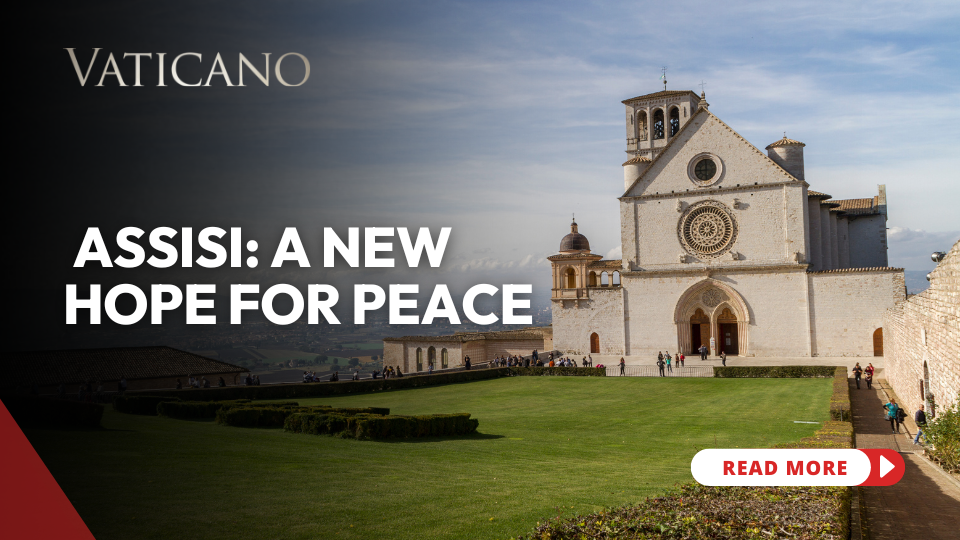
Amid the chaos of war, a beacon of hope emerges in the serene city of Assisi. This light, born of deep friendship, is fuelled by the shared experience of individuals of different faiths coming together in search of meaning and understanding.
Stefania Proietti, the Mayor of Assisi, lamented to the EWTN Vatican that “It’s unimaginable to think of children dying in the land where Jesus was born.”
Pope Francis, in his General Audience on February 7, said, “Let us not forget the wars, let us not forget the tormented Ukraine, Palestine, Israel, the Rohingya, so many, many wars that are everywhere. Let us pray for peace.”
Since the papacy of Pope Saint John Paul II, Assisi has been at the center of interfaith dialogue. The Elijah Interfaith Institute is led by Rabbi Alon Goshen and supported by various representatives of the Catholic Church and leaders of other faiths.
Rabbi Goshen emphasized that “You can’t have peace without friendship.”
He explained, “I have followed the situation in the Holy Land now for decades. There were many attempts at using religion to bring people together. At a certain point, those efforts failed, and they didn’t go beyond a certain point. With the recent events following October 7, many people turn to me and say, so, have all your relations come to a standstill?”
He continued, “Not at all. And they said, why not? Well, part of it is because my relations are not exclusive to the Holy Land. But even within the Holy Land, the reason is that once friendship is deeply established, things from the outside are not going to shake it up.”
Fra. Francesco Pilone, Provincial Minister OFM, residing in Assisi, noted, “I know that some are afraid of interreligious dialogue, but I understand that fear has been humanity’s first companion without God.”
He also shared, “I know that when I am afraid, it’s because I am hiding.” He further challenged, “So I believe that we shouldn’t be afraid of brothers and sisters who have a different expression of faith.”
Assisi has been considered The City of Peace and Encounter for several years.
Proietti further explained, “Assisi is the city of interreligious dialogue, the city of dialogue. And for this, we must give thanks. Certainly, to Saint John Paul II, who nearly forty years ago brought all the world’s religious leaders here to speak about peace. But Assisi’s greatest thanks must always go to its most famous fellow citizen, Saint Francis.”
In response to religious hatred and years of misunderstandings, Rabbi Goshen is seeking to establish a Museum for Interreligious Dialogue, called the House of Friendship and Hope, right in the heart of the city of Saint Francis.
Fra. Marco Moroni, Custodian of the Sacred Convent of Assisi, commented on the presence of such a museum in Assisi, saying, “Having it right here in Assisi, a place like this, can further ensure this spirit of hospitality and effectively and visibly convey this possibility of dialogue. Moreover, it will primarily be a place of prayer. So, what could be better than engaging in dialogue starting from our reference to the Lord?”
Piloni highlighted that “If this reality will be born near the Portiuncula, it is certainly a sign of testimony that there are still men and women who, I would say with a strong word, fight for what really matters.”
Mustafa Ceric provided his perspective invited to participate in this initiative, saying, “As a European and survivor of a genocide in Bosnia and as the Grand Mufti of Bosnia in peace and war, in a war, I am glad to be invited today in Assisi to witness an initiative for an institution or for a project that would devote what will be devoted to the idea of interfaith dialog.”
Rabbi Goshen expressed his hope and prayer “that everyone who joins and supports and participates and visits the House will be similarly touched to be an instrument of friendship, peace, and prayer.”
In this vein, Ceric said, “I will not die before I see that the Holy Land is the Holy Peace and not the Holy War.”
Adapted by Jacob Stein