Skip to content

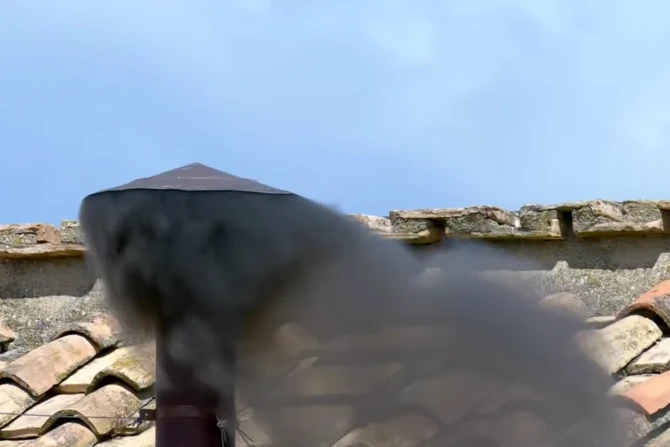
BREAKING: Black smoke rises from Sistine Chapel as Thursday morning voting concludes without a pope

Black smoke rose from the chimney of the Sistine Chapel at 11:51 am Rome time on Thursday, signaling that the cardinals voting at the conclave have not yet elected a new pope.

Black smoke rose from the chimney of the Sistine Chapel at 11:51 am Rome time on Thursday, signaling that the cardinals voting at the conclave have not yet elected a new pope.

SIGN UP FOR OUR NEWSLETTER HERE

The plume of dark smoke indicates that the 133 cardinal electors sequestered inside the chapel have not reached the required two-thirds majority — at least 89 votes — needed to elect a successor to Pope Francis, who died on April 21.

Thursday marks the second day of voting in the conclave, which began on the afternoon of May 7 with a first round of balloting that also produced black smoke.

Thousands of faithful are gathered in St. Peter’s Square, hoping to witness history.

The cardinals will hold four votes each day: two in the morning and two in the afternoon.

If the new pope is not elected on the first morning ballot, a second ballot is held immediately. Both ballots are burned together, leading to possible smoke around noon Rome time. If, however, the pope is elected on the first morning ballot, the white smoke will appear shortly after 10:30 a.m.

The same process is repeated in the afternoon. After a brief break, two more votes will be held. If neither is conclusive, the smoke is expected around 7 p.m. Rome time. However, if the pope is elected on the first ballot of the afternoon, white smoke would be seen shortly after 5:30 p.m.

Thus, on both Thursday and Friday, observers should be alert for four possible times when the smoke may appear each day: two around noon and two in the evening. 

The cardinals are following a structured regimen during the conclave, beginning each day with Mass in the Domus Sanctae Marthae, followed by transfer to the Sistine Chapel for voting. They remain completely sequestered from the outside world, with no access to phones, internet, or news media.

The historical average length for modern conclaves is approximately three days, though the conclave that elected Pope Benedict XVI in 2005 lasted only two days.

This article was originally published on CNA.

LIVE UPDATES FOR THE CONCLAVE

Receive the most important news from EWTN Vatican via WhatsApp. It has become increasingly difficult to see Catholic news on social media. Subscribe to our free channel today

Share

Would you like to receive the latest updates on the Pope and the Vatican

Receive articles and updates from our EWTN Newsletter.

More news related to this article

18 Seminarians Ordained to Diaconate at St. Peter’s Basilica

Eighteen seminarians from the Pontifical North American College in Rome take a significant step toward priesthood

Pope Leo XIV: ‘Christ’s tears are joined with ours’ on anniversary of Beirut explosion

With a silent march, moving testimonies, and the symbolic planting of 75 trees in honor of the victims, Lebanon commemorated on Aug. 4 the fifth anniversary of the devastating explosion.

Immigration is a ‘Gospel issue’ before a ‘political issue,’ U.S. bishop says

Bishop Mark Seitz of El Paso, Texas, said immigration is a “Gospel issue” before it is a “political

Pope Francis: Blessed Carlo Acutis is an Example for Young People Receiving Confirmation

Pope Francis received this Saturday the young people of the Archdiocese of Bari-Bitonto (Italy) who will receive the sacrament of Confirmation. He proposed the life of Blessed Carlo Acutis as an example, describing him as "a truly special type."

Cardinal Tagle at influencers jubilee: ‘Love cannot be generated by an algorithm’

Cardinal Luis Antonio Tagle urged Catholic content creators gathered in Rome for the first-ever Jubilee of Digital Missionaries and Catholic Influencers to “be discerning” in how they use their platforms.

Carlo Acutis film gains backing from National Eucharistic Congress, McGrath Institute

Castletown Media announced that the National Eucharistic Congress and Notre Dame’s McGrath Institute are partners for the film Roadmap to Reality: Carlo Acutis and our Digital Age.

LIVE
FROM THE VATICAN

Be present live on EWTNVatican.com