By elevating such testimonies without doctrinal commentary, the report effectively normalizes homosexual relationships within a Church context.
The recently published report from Synod Study Group 9 represents a troubling departure from the Catholic Church’s consistent moral teaching. While the authors claim they lack “the expertise or, above all, the necessary ecclesiastical authorization” to address individual moral issues definitively, the report’s methodology and framework systematically undermine the Church’s ability to proclaim and apply her moral doctrine. This is not merely a technical deficiency — it is a fundamental contradiction of Catholic teaching that demands a forceful response.
The most immediate concern involves the report’s treatment of same-sex relationships. The document presents testimonies from individuals with homosexual attractions without providing the Church’s moral framework for understanding these experiences. The report says that one witness “bears witness to the discovery that sin, at its root, does not consist in the (same sex) couple relationship, but in a lack of faith in a God who desires our fulfillment.” The authors of the report reproduce this claim without correction or clarification.
This witness’s thinking is fundamentally flawed. Homosexual acts are intrinsically evil — this is settled Catholic doctrine. A believing Christian who engages in such acts certainly falls short in faith, insofar as he fails to trust in God’s grace, which enables him to avoid sin. But this does not mean the sin lies primarily in lack of faith rather than in the act itself, as the witness suggests. The authors’ failure to clarify this point creates dangerous ambiguity.
A second testimony is even more problematic. This witness first sought help from Courage International, the Catholic apostolate that teaches people who experience same-sex attractions to live in accordance with Church teaching on chastity. The report portrays Courage negatively, suggesting it “separates faith and sexuality,” and falsely claiming that it provides conversion therapy. The witness ultimately finds refuge in Christian communities and with priests who welcome “people who are rejected for belonging to the LGBT community.” The clear implication is that this second witness, living in a homosexual relationship, is doing so with the support and approval of these priests and communities.
By elevating such testimonies without doctrinal commentary, the report effectively normalizes homosexual relationships within a Church context. This represents a clear attempt to weaken the proclamation of Catholic moral teaching.
The deeper problem lies in the report’s entire methodological framework. The authors subordinate everything to describing a “synodal process” focused on people’s practices and experiences. They explicitly reject what they call “abstractly proclaiming and deductively applying principles that are set out in an immutable and rigid manner.” Instead, they advocate for maintaining a “fruitful tension between what has been established in the Church’s doctrine and Her pastoral practice and the practices of life.”
This language sounds pastoral and Christ-centered, but it conceals a radical departure from Catholic moral theology. The authors invoke Jesus’s statement that “the Sabbath was made for humankind, and not humankind for the Sabbath” to suggest that moral norms cannot be absolute — that there must be exceptions based on individual circumstances and experiences. This is a fundamental misreading of Scripture.
Jesus’s teaching about the Sabbath concerned divine positive law — norms revealed in Scripture that are not intrinsically absolute unless they coincide with natural law. The Jewish liturgical laws have indeed lapsed in the New Testament. But the moral law concerning marriage and sexuality is of an entirely different character. These norms flow from the natural law, which reflects God’s purposes in creating human beings, marriage, and sexuality itself.
God created marriage as a mutual total self-giving between a man and a woman, through which they can transmit human life. Sexual differentiation and openness to life are essential elements of this total gift. Sexual acts between persons of the same sex cannot constitute such a total gift because they are closed to the transmission of life by their very nature. Any act that violates God’s creative intentions for marriage and sexuality is always impermissible, without exception. These are absolute norms of natural law, established to protect non-negotiable values.
The report creates deliberate ambiguity on precisely this point. The authors write that “the universal truth of the human, in its historical expression, cannot therefore be determined once and for all, but is found in the concrete forms of different cultures, in an unceasing dialogue.” They suggest that arriving at moral knowledge requires a long-term synodal process of listening across cultures and experiences.
This is simply false. The intentions with which God created the human person in the context of marriage and sexuality are universal truths, established once and for all, that human beings can know spontaneously through natural moral law, and can be found in Sacred Scripture. Saint Paul teaches that when Gentiles “do instinctively what the law requires, these, though not having the law, are a law to themselves. They show that what the law requires is written on their hearts” (Romans 2:14-15).
The report’s rejection of applying universal moral truths to specific actions becomes even clearer in its principle of “pastorality.” This principle guides the “discernment of emerging issues” within the synodal process. The commission prefers the phrase “emerging issues” to “controversial issues” because “the logic of emergence emphasizes the capacity of the entire People of God to ‘stay with the trouble’” rather than solve problems.
In practice, this means avoiding “a problem-solving perspective, or that of those who presume to deduce action from the simple application of norms.” The commission seeks not “a generalizable solution” but rather “concrete ways to initiate a process in the form of listening.” This represents “the overcoming of the theoretical model that derives praxis from a ‘pre-packaged’ doctrine.” In other words, the report sweeps aside the application of Church doctrine and classical moral theology in pastoral care and confession.
This stems from a persistent misunderstanding that has plagued pastoral theology since the 1960s: the notion that pastoral care consists in finding compromises between the Church’s moral teaching and the concrete reality of people’s lives. This approach assumes moral truth has a dual status — abstract doctrinal truth on one hand, concrete existential truth on the other — with priority given to the latter to create room for exceptions to universal norms.
Pope John Paul II forcefully rejected this approach in Veritatis Splendor: “On this basis, an attempt is made to legitimize so-called ‘pastoral’ solutions contrary to the teaching of the Magisterium, and to justify a ‘creative’ hermeneutic according to which the moral conscience is in no way obliged, in every case, by a particular negative precept.”
True pastoral care does not seek compromises with moral truth. The shepherd leads people to the truth, which is ultimately found in the Person of Jesus Christ. He must encourage those in his care to align their actions with the truth as set forth in moral norms. There is no genuine pastoral charity in obscuring moral truth or suggesting that universal norms admit of exceptions based on individual circumstances.
Study Group 9’s report fundamentally contradicts Catholic moral teaching and thoroughly undermines its application to moral conduct. It relativizes the Church’s moral doctrine, with consequences that extend far beyond questions of sexuality to the protection of human life itself. This report must be forcefully refuted.
In the meantime, the faithful can be assured that a number of cardinals and bishops will make their objections known to the Roman Magisterium.
The Church’s teaching is not obscure, nor is it subject to revision through synodal processes. It is the truth that sets us free.
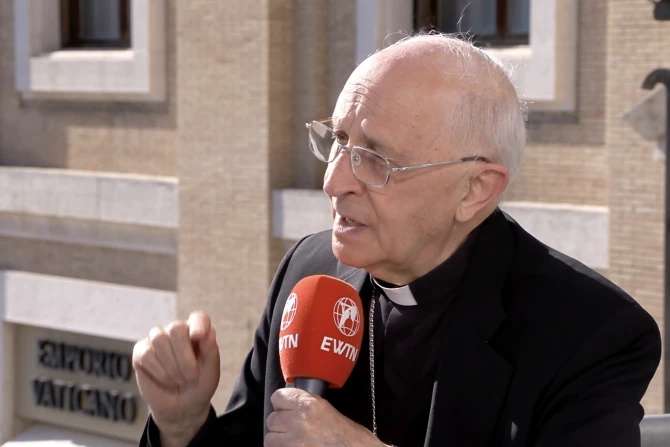
Cardinal Willem Eijk is the Archbishop of Utrecht, Holland. A former physician, he has served as a member of the Pontifical Academy for Life since 2004. He is the author of the 2025 book, The Bond of Love: Catholic Teaching on Marriage and Sexual Ethics, published by Emmaus Academic.
This article was originally published by NCRegister.