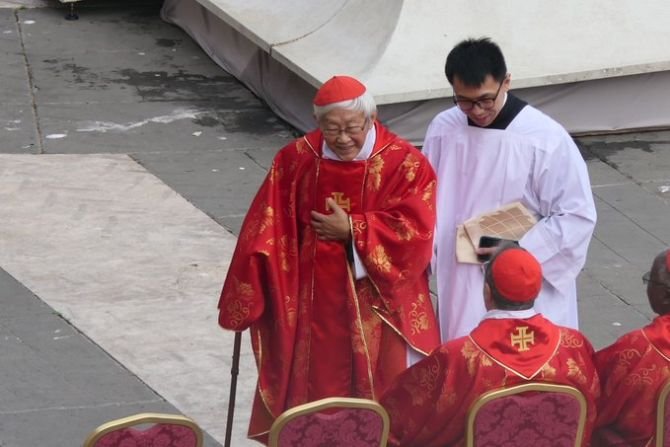
The 90-year-old cardinal from Hong Kong arrived in St. Peter’s Square dressed in red and walking with a cane to concelebrate the funeral Mass on Jan. 5.
Cardinal Joseph Zen attended the funeral of Pope Emeritus Benedict XVI on Thursday morning after Hong Kong authorities temporarily released his passport for five days to allow him to travel to Rome.
The 90-year-old cardinal from Hong Kong arrived in St. Peter’s Square dressed in red and walking with a cane to concelebrate the funeral Mass on Jan. 5.
The former bishop of Hong Kong, who was arrested last year under the city’s national security law, was allowed by a local court to travel to Italy to be present for the funeral of the late pope who made him a cardinal.
A magistrate ruled on Jan. 3 that the Chinese cardinal would be allowed to leave Hong Kong for five days with his previously confiscated passport temporarily returned to him.
Following the death of Benedict XVI on Dec. 31, Zen reflected on the legacy of the late pope emeritus.
The cardinal wrote on his blog that Benedict XVI was a “great defender of the truth” who took “extraordinary” actions to support the Church in China, despite many setbacks.
“As a member of the Chinese Church, I am immensely grateful to Pope Benedict for things he has done that he did not do for other Churches,” Zen wrote.
The Hong Kong cardinal recalled in particular Benedict XVI’s 2007 letter to China, which Zen called “a masterpiece of balance between the lucidity of Catholic ecclesiological doctrine and humble understanding with respect to civil authority.”
Zen also criticized “errors” in the Chinese translation of Benedict’s letter, which he said he believed contained “biased quotations against the obvious sense of the letter.”
“Another extraordinary thing he did for the Church in China is the establishment of a powerful commission to take care of the affairs of the Church in China; unfortunately under the new president of said commission it has been made to disappear quietly without even a word of respectful farewell,” the cardinal added.
Benedict XVI created Zen a cardinal in 2006 and selected the cardinal to write the meditations for the papal Stations of the Cross at the Colosseum in 2008, one year before Zen’s retirement as bishop of Hong Kong.
Zen underlined that he sees Benedict XVI as a pope who was “often misunderstood and sometimes not followed” but said that it is “precisely in these cases, which seem to be failures, that I was able to admire his great fortitude and magnanimity in the face of setbacks.”
“Despite his great efforts, Pope Benedict failed to improve the situation of the Church in China. He could not accept just any compromise,” the Chinese cardinal said.
The cardinal, who was born in Shanghai, added that he is “convinced that every effort to improve the situation of the Church in China [in the future] will need to be taken in line with the 2007 letter.”
“As we remember the great pontiff, let us remember that we now have him as a powerful intercessor in heaven. With his intercession, we pray that all, the Church in Rome, the Church in China, and the Chinese authorities will be moved by God’s grace to bring about true peace for the Church and our homeland,” Zen said.
This article was originally published by EWTN News English.