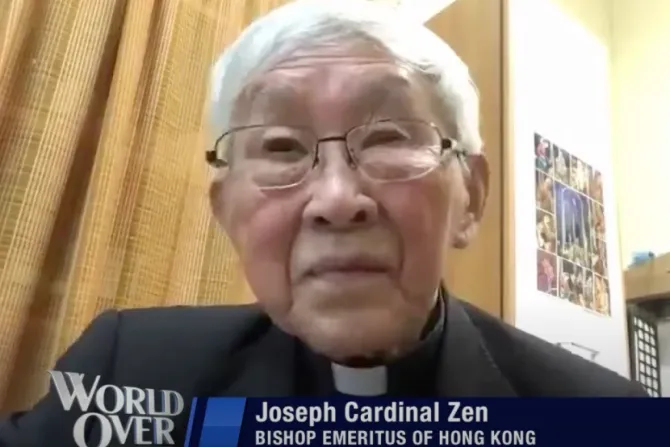
Cardinal Joseph Zen Ze-kiun, the bishop emeritus of Hong Kong, has released another critique of the Synod on Synodality, arguing that the ongoing discussion and discernment process offers “two opposing visions” of the nature, organization, and role of the Church.
“On the one hand, the Church is presented as founded by Jesus on the apostles and their successors, with a hierarchy of ordained ministers who guide the faithful on the journey toward the heavenly Jerusalem,” the 92-year-old cardinal observes in a nearly 3,600-word commentary posted on Feb. 15 titled “How will the Synod continue and end?”
“On the other hand, there is talk of an undefined synodality, a ‘democracy of the baptized,’” he continues, interjecting “Which baptized people? Do they at least go to church regularly? Do they draw faith from the Bible and strength from the sacraments?”
“This other vision, if legitimized,” he warns, “can change everything, the doctrine of faith and the discipline of moral life.”
Going into a deeper examination of these visions of ecclesiology, the cardinal writes that “in order not to see a contradiction in it, we must understand this invitation to synodality not as having to do something completely new but as giving a new impulse to something that has always existed in the Church.”
Zen acknowledges that synods have been a “historic reality” of the Church. Yet while earlier synods took place within the framework of the apostolic tradition and were guided by the “hierarchy of ordained ministers who guide the faithful on the journey toward the heavenly Jerusalem,” the current synod is characterized by an “undefined synodality” and a “democracy of the baptized,” he argues.
“They tell us that synodality is a fundamental constitutive element of the life of the Church, but at the same time they emphasize that synodality is what the Lord expects of us today. Participation and communion are obviously permanent characteristics of the one holy catholic and apostolic Church. But doesn’t saying that synodality is ‘the thing that the Lord expects of us today’ mean that it is something new?” he writes.
“In order not to see a contradiction in it, we must understand this invitation to synodality not as having to do something completely new but as giving a new impulse to something that has always existed in the Church.”
One of the cardinal’s main concerns is how the Synod on Synodality is being conducted at the universal level, beginning with the initial assembly at the Vatican in October 2023 and culminating later this year with a final assembly in October.
Referring to the Synod on Synodality’s call to “walk together,” he asks: “What is the goal of this journey? Is there a guide that ensures the right direction?”
In his essay the cardinal also takes issue with the synod’s incorporation of the “conversation in the Spirit,” a dialogic process he says was initiated by the Jesuits in Canada. “Imposing this method on the synod proceedings is a manipulation aiming at avoiding discussions,” he argues. “It is all psychology and sociology, no faith and no theology.”
The cardinal has already expressed his concern over the trajectory of the Synod on Synodality in a letter addressed to bishops that was sent out just days before the start of the first session of the synod in October.