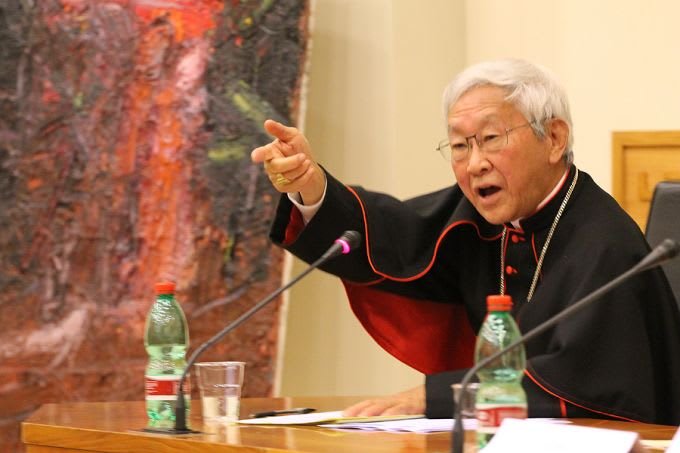
Cardinal Joseph Zen Ze-kiun delivered a forceful critique of synodality at the extraordinary consistory of cardinals this week, decrying the process as an “ironclad manipulation” that was an “insult to the dignity of the bishops.”
The bishop emeritus of Hong Kong also described the “continual reference to the Holy Spirit” during the 2021-2024 Synod on Synodality as “ridiculous and almost blasphemous.”
The cardinal, 93, made his remarks during one of two free discussion periods during the Jan. 7-8 consistory that drew together 170 of the 245 members of the College of Cardinals in Pope Leo XIV’s first major meeting with the sacred college since his election.
In impassioned comments, first reported Jan. 9 by the College of Cardinals Report, the bishop emeritus criticized Pope Francis for bypassing the college of bishops while at the same time Francis was insisting it was an appropriate means for “understanding the hierarchical ministry.”
The cardinal questioned the ability of any pope to listen to the entire People of God and whether the laity represent the People of God. He asked if the bishops elected to take part in the synodal process had been able to carry out a work of discernment.
“The ironclad manipulation of the process is an insult to the dignity of the bishops, and the continual reference to the Holy Spirit is ridiculous and almost blasphemous,” Zen said. “They expect surprises from the Holy Spirit. What surprises? That he should repudiate what he inspired in the Church’s two-thousand-year tradition?”
The cardinal also observed apparent inconsistencies in the synod’s final document: That it was declared to be part of the magisterium and yet it said it did not establish any norms; that although it stressed unity of teaching and practice, it said these could be applied according to “different contexts;” and that each country or region “can seek solutions better suited to its culture and sensitive to its tradition and needs.”
The cardinal also pointed to what he called “many ambiguous and tendentious expressions in the document,” and asked if the Holy Spirit guarantees that “contradictory interpretations will not arise.”
Zen openly wondered whether the results of what the document calls “experimenting and testing” of these “new forms of ministeriality” will be submitted to the Synod Secretariat and, if so, whether the secretariat will be “more competent than the bishops to judge different contexts” of the Church in various countries or regions.
“If the bishops believe themselves to be more competent, do the differing interpretations and choices not lead our Church to the same division (fracture) found in the Anglican Communion?” the cardinal asked.
Regarding the Orthodox Church, Zen said he believes their bishops “will never accept” what he called “Bergoglian synodality” as, for them, synodality is “the importance of the Synod of Bishops.”
Pope Francis, he said, “exploited the word synod, but has made the Synod of Bishops — an institution established by Paul VI — disappear.” Zen’s remark was an apparent reference to how the late pope had reshaped the institution by giving non-bishops a formal role, making the institution no longer simply an episcopal advisory body.
The Vatican press office and cardinals chosen to speak to the press made no mention of Zen’s remarks during the consistory.
In press statements, it was claimed there was no criticism of Pope Francis during the two-day meeting, although Cardinal Stephen Brislin did speak of a “divergence” of opinion, saying some cardinals wanted the concept of synodality to be further clarified.
The consistory was a closed-door meeting to which no media were admitted, and cardinals were asked to keep the proceedings confidential.
This article was originally published by CNA.