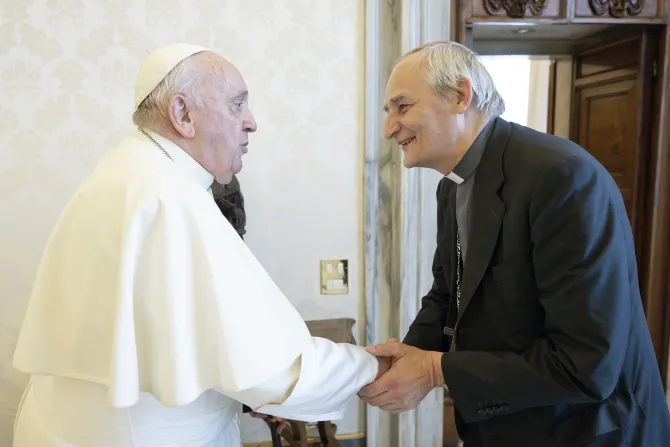
Cardinal Matteo Zuppi is traveling to Beijing this week to continue the Vatican’s diplomatic efforts to help bring peace in Ukraine.
Vatican spokesman Matteo Bruni confirmed on Tuesday that the cardinal will be in the Chinese capital as the pope’s peace envoy from Sept. 13–15.
“The visit constitutes a further step in the mission desired by the pope to support humanitarian initiatives and the search for paths that can lead to a just peace,” Bruni told journalists on Sept. 12.
Pope Francis has asked the Italian cardinal to serve as a papal envoy to “initiate paths of peace” between Russia and Ukraine.
During his time in China, Zuppi is expected to meet Chinese Premier Li Qiang, according to the Italian newspaper La Repubblica. The Vatican did not release details about the cardinal’s scheduled meetings.
Pope Francis has described Zuppi’s scheduled stop in Beijing as part of the Vatican’s “peace offensive,” which has already included visits to Kyiv, Moscow, and Washington, D.C. The pope said in an interview last month that he has also considered appointing a permanent representative to serve as a bridge between Russia and Ukraine.
The Vatican’s diplomatic efforts in Ukraine hit a road bump recently when Mykhailo Podolyak, an adviser to Ukrainian President Volodymyr Zelenskyy, called Pope Francis “pro-Russian” and “not credible” in comments to Ukrainian media on Sept. 8 following the pope’s invocation of imperial czars and “great Mother Russia” during a video conference with Russian youth in August.
The Vatican responded to Podolyak’s comments the following day, strongly refuting the Ukrainian’s claims that the Vatican Bank, or IOR, receives or invests money from Russia.
“In addition to being untrue, such an activity would also be impossible,” given the international sanctions and internal “stringent policies” of the bank, it said, including limiting its clientele to institutions or individuals who have close ties to the Catholic Church.
Pope Francis also acknowledged in his press conference with reporters on his return flight from Mongolia that his prior comments about “great Russia” were not appropriate and that he only intended them in a cultural sense to describe the country’s great literary and musical traditions, not imperial ambitions.
The Vatican also issued a clarification that the pope did not intend to exalt Russian imperialism after the leader of the Ukrainian Greek Catholic Church, Major Archbishop Sviatoslav Shevchuk, said the pope’s comments had caused “great pain and concern” among Ukrainian Catholics.
Zuppi told reporters on Monday that he does not think that the recent criticism of the pope by the Ukrainian presidential aide threatens his peace mission.
“I think that if there are any doubts they have obviously already been cleared up or will be cleared up: They are understandable in such a tense situation,” the cardinal said, according to Italy’s ANSA news agency.
“I think the Ukrainian government and people are aware of the support that they have always had from the Church and Pope Francis in their suffering,” he added.
The cardinal explained that the Vatican is not seeking to act as the mediator of the peace process in Ukraine in an official capacity.
“No one has ever talked about mediation,” Zuppi said.
“It has always been a mission; the pope explained this at the outset and has repeated what his expectation of this mission is and said precisely that it was not and is not ‘mediation,’ but rather to help.”
Zuppi, the archbishop of Bologna and president of the Italian Bishops’ Conference, has strong ties to the influential peace-building community Sant’Egidio.
Sant’Egidio is a Catholic lay association that has been involved in peace negotiations in many countries, including Mozambique, South Sudan, Congo, Burundi, and the Central African Republic.
Speaking on the sidelines of a Sant’Egidio conference in Berlin on Monday, Zuppi said that “clearly China is one of perhaps the most important factors” in achieving peace in Ukraine.
Zuppi told Italian television station TV2000: “We need the commitment of everyone, especially those with greater importance such as China. Peace requires the effort of everyone; it is never something that can be imposed by anyone.”
“The paths of peace are sometimes unpredictable; they need everyone’s commitment. We need a great alliance for peace and [to] push everyone in the same direction,” the cardinal said.
This article was originally published on Catholic News Agency.