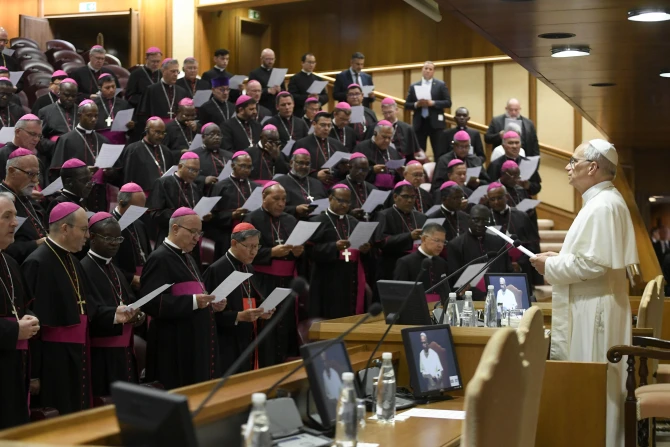
Every September, the new bishops of the Catholic Church gather in Rome to participate in a formation course, an initiative that, since its inception in 1994, has become a genuine tradition.
During these sessions, the prelates receive from the Dicastery for Evangelization and the Dicastery for Bishops guidance and tools to carry out with greater clarity and responsibility the mission entrusted to them by the Church, through conferences, discussions, and various working groups.
A total of 192 bishops from around the world gathered on Sept. 4 to participate in these sessions, which concluded Sept. 11, when the prelates were received by Pope Leo XIV at the Vatican.
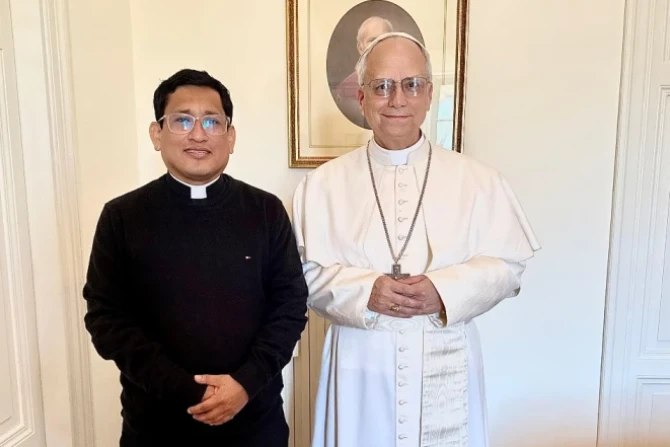
Dominican Xabier Gómez García, bishop of San Feliú de Llobregat in Spain since October 2024, is one of the prelates participating in this year’s course. Having been a bishop for only 10 months, from Rome he explained to ACI Prensa, CNA’s Spanish-language news partner, that during this time he has become aware “of what this service means.”
A time of hope and missionary conversion
He noted that the new bishops were appointed in the context of the jubilee year and at the end of the synodal process, so their service “is marked by a time of hope and missionary conversion, in a Church that journeys alongside its people.”
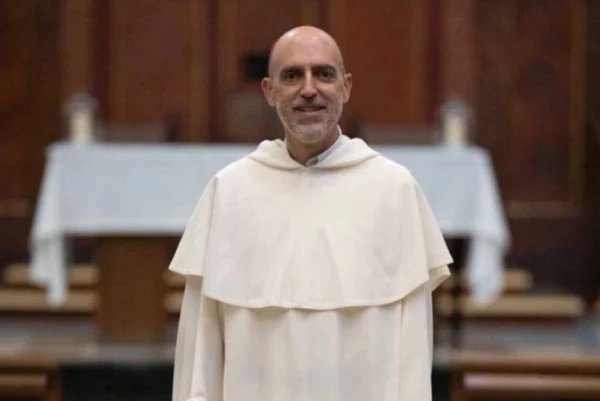
He explained that this year’s course offers tools to “become witnesses and heralds of hope founded in Christ” and sees it as an opportunity to “deepen our understanding of catholicity, live together, pray, celebrate together, share a meal, and learn firsthand about the experiences of the Church spread throughout the world and in so many and diverse dioceses.”
Gómez, who was also prior of St. Thomas Aquinas–El Olivar Convent in Madrid, expressed his gratitude for having been able to share time with bishops representing the five continents, who have come from places such as Papua New Guinea, Samoa, Russia, Poland, Burkina Faso, Algeria, Argentina, Chile, Mexico, Colombia, France, Poland, Portugal, and the United States.
Among the presentations given during the course, what most caught the Spanish prelate’s attention was the “‘Decalogue of Hope for a Bishop in the Jubilee Year,’ which was the first introduction to the course.”
He explained that in general, all the presentations were in some way “tied together by the unifying theme of hope and have also helped us deepen this sense of communion and what communion means in the service of the people of God.”
The presentations also noted the importance of being “a Church that goes forth as a servant of the Gospel in the midst of the world.” Ultimately, the bishop explained, “we learn to listen with a heart that resembles Christ’s.”
“We must nurture our relationship with God and with our fellow bishops, with our collaborators the priests, and with the people of God in general. We are called to be instruments of communion and also signs of hope,” he added.
Abuse prevention
During the formation sessions, they also tackled the issue of abuse prevention within the Church.
“It must be recognized that mistakes may have been made in caring for victims and also in the lack of prevention. We also reflected on the support provided to individuals and the great efforts the Church has made to put the abused person at the center were emphasized.”
A bishop you must “make that pain your top concern, empathize with it, and always seek truth, justice, and comprehensive reparation for the good of these people who have been hurt, and for the community, and to do so with a certain sense of the call to conversion, so that this itself may become a sign of light and hope,” he added.
Gómez, who before assuming his position as bishop was director of the migration department at the Spanish Bishops’ Conference, explained that another topic addressed was migration and its challenges “in order to work on the reception, protection, advancement, and integration of migrants” and to be able to make a faithful reading of this reality.
“We also,” the bishop continued, “asked ourselves what young people need from the Church and what God wants to tell us through them.”
What should a bishop be like?
According to the Spanish prelate, a bishop must “be close to the people, have a passion for God and also a missionary spirit. I believe it is also important to cultivate, as a spiritual attitude, humility, simplicity, allowing oneself to be accompanied, and also great trust in providence and in the Spirit, who guides his people.”
After expressing his “excitement” for finally meeting with the Holy Father, he also emphasized the need to share “humbly and simply” what they experienced in Rome and to continue to deepen [our understanding] “when we return to our dioceses, with our people, in the service of our people.”
Cardinals’ presentations
During this period of formation, there were two courses available for the new bishops: “Opening a Door to Hope: Calls to the Episcopate in a Jubilee Context,” given by the Dicastery for Evangelization, which took place at the Pontifical College of St. Peter, and a course by the Dicastery for Bishops, given at the Pontifical College of St. Paul. On Sept. 8–9, the participants of both courses met at the Pontifical Urbaniana University and shared a time of fellowship.
Among the speakers were Cardinal Jean-Marc Aveline, Cardinal Luis Antonio Tagle — who made it clear that bishops are “stewards” and not “lords” of God’s flock — and Cardinal Christoph Schönborn, who emphasized the importance of the bishop being close to seminarians and priests, who “must feel that the bishop appreciates, esteems, and loves them.”
This story was first published by ACI Prensa, CNA’s Spanish-language news partner. It has been translated and adapted by CNA.