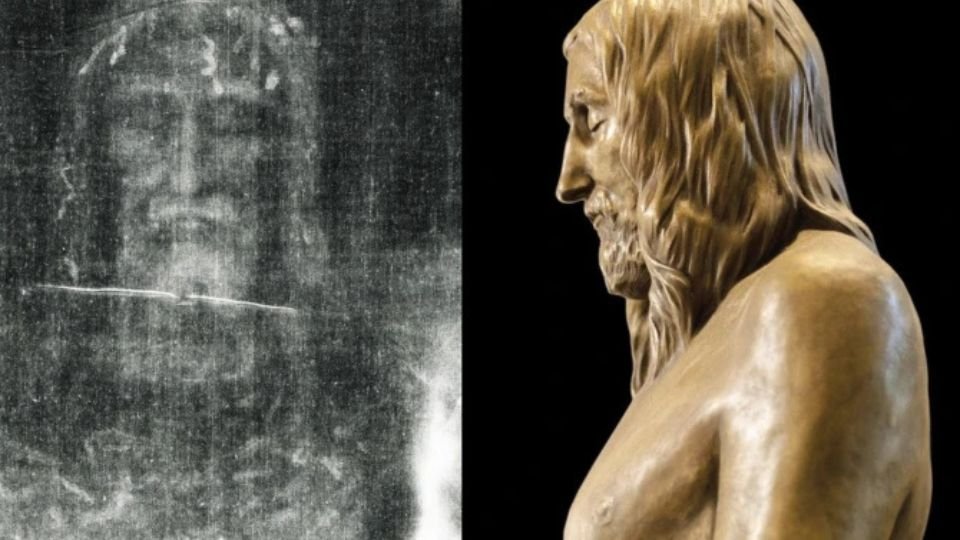
The Shroud of Turin is one of the most studied and controversial religious artifacts in the world. Housed in the Cathedral of St. John the Baptist in Turin, Italy, the linen cloth bears the image of a man who appears to have suffered physical trauma consistent with crucifixion. Many Christians believe it to be the burial shroud of Jesus Christ.
SIGN UP FOR OUR NEWSLETTER HERE
While the Catholic Church has never formally declared the shroud to be authentic, it has encouraged its veneration as a powerful aid to faith and reflection. Pope Francis called the shroud “an icon of the Lord’s love” and “a mirror of the Gospel.”
Here’s what we know about the Shroud of Turin, based on recent studies and commentary from experts, scientists, and Catholic thinkers.
Evidence suggesting authenticity
The shroud depicts the front and back of a man’s body, showing wounds that match the Gospel accounts of Christ’s passion: scourge marks, punctures in the wrists and feet, and a wound in the side.
Italian engineer Giulio Fanti, who has conducted detailed forensic studies of the shroud, reports that the bloodstains correspond with those of a person subjected to severe physical torture and crucifixion. His analysis points to real human blood containing high levels of creatinine and ferritin — markers consistent with intense trauma.
Fanti also observes that the direction and shape of the blood flows suggest multiple body positions, as would be expected if the man had been moved post-mortem, wrapped in cloth, and buried according to ancient Jewish customs.
A debate over the dating
In 1988, three independent laboratories dated a sample from the shroud using carbon-14 testing and concluded that the cloth originated between A.D. 1260 and 1390. However, many scientists have questioned these results due to the location of the tested material. The sample was taken from a corner of the cloth that was likely part of a medieval repair following fire damage.
Nuclear engineer Robert Rucker has proposed that a burst of neutron radiation — possibly at the moment of Christ’s resurrection — could have altered the carbon isotopes in the linen, leading to a false medieval date. His research, while not universally accepted, supports the theory that the cloth could be much older than the 1988 tests suggest.
Further testing of uncontaminated samples has been called for by several researchers, but new carbon dating has not yet been authorized.
The shroud in popular media
The shroud has lately been the subject of renewed public interest thanks to the 2023 documentary “The Shroud: Face to Face” by filmmaker Robert Orlando.
Once skeptical, Orlando now presents the cloth as a compelling mystery that bridges history, science, and faith. The film explores the shroud alongside other images traditionally associated with Christ, including the Veil of Veronica and the Manoppello Image.
The documentary features commentary from Jesuit priest and physicist Father Robert Spitzer, who views the shroud as a “supernatural” object bearing witness to Christ’s death and resurrection.
Other cloths venerated as images of Christ
The Shroud of Turin is not the only cloth believed to bear the image of Jesus.
Others include the Veil of Veronica. According to tradition, a woman named Veronica wiped the face of Jesus on his way to Calvary, leaving a miraculous image. Several relics claim to be this veil, but none have undergone scientific analysis comparable to the shroud.
Also venerated is the Manoppello Image. Preserved in a church in Manoppello, Italy, this cloth bears a faint image of a man’s face and is sometimes associated with the Veil of Veronica.
Both images appear in “The Shroud: Face to Face,” where they are presented as part of the broader mystery of what Christ may have looked like.
A mystery that endures
While the Church does not require belief in the shroud’s authenticity, it recognizes its value in drawing the faithful into deeper contemplation of Christ’s suffering and love. As Pope Francis said in 2015, the shroud “draws people to the face and the martyred body of Jesus.”
Whether it is a miraculous relic or a centuries-old artwork, the Shroud of Turin continues to invite scientific inquiry, spiritual reflection, and personal conversion.
This article was originally published by CNA.